
Imagine you’re having dinner with coworkers after a successful project. As the bill arrives, someone smiles and says, “Let’s go Dutch.” Everyone immediately understands that each person will pay for their own meal, avoiding awkward conversations about who owes what. This simple phrase has become a practical part of modern English because it promotes fairness, independence, and transparency in social and professional situations. Whether you’re dining with friends, attending networking events, or traveling with colleagues, understanding what “Go Dutch” means and knowing suitable alternatives helps you communicate naturally while choosing the right tone for every occasion.
What Does “Go Dutch” Mean?
Go Dutch means that each person in a group pays for their own share of a meal, activity, or expense rather than one person covering the total cost. The phrase is commonly used in restaurants, social gatherings, business lunches, and casual outings where people agree to divide expenses fairly.
Origin & History of “Go Dutch”
The phrase “Go Dutch” originated in English during the 17th century, a period marked by political and economic rivalry between England and the Netherlands. During that time, several expressions containing the word “Dutch” carried negative or satirical connotations due to tensions between the two nations.
One theory suggests that “Go Dutch” evolved from the idea that everyone pays for themselves rather than relying on another person’s generosity. Although the original expression may have reflected stereotypes, its modern meaning has become entirely practical and neutral.
Today, the phrase no longer carries its historical criticism in everyday conversation. Instead, it represents fairness, shared responsibility, and financial independence. Across English-speaking countries, people commonly use it when friends, coworkers, classmates, or travel companions decide to split expenses equally or individually.
Synonyms & Alternatives by Tone
Professional & Neutral Alternatives
- Split the bill
- Split the cost
- Pay separately
- Divide the expenses
- Share the cost
Polite & Supportive Alternatives
- Let’s each pay our own way
- We can each cover our own share
- Let’s divide the payment fairly
- Everyone can pay individually
- We can settle our own portions
Encouraging & Reassuring Alternatives
- No worries, let’s split it
- We can share the expense
- Let’s keep it fair for everyone
- Everyone contributes equally
- Let’s make it easy and split the cost
Casual, Playful & Idiomatic Alternatives
- Chip in
- Split it evenly
- Cover your own tab
- Everyone pitches in
- Halfsies
When Should You Use “Go Dutch”?
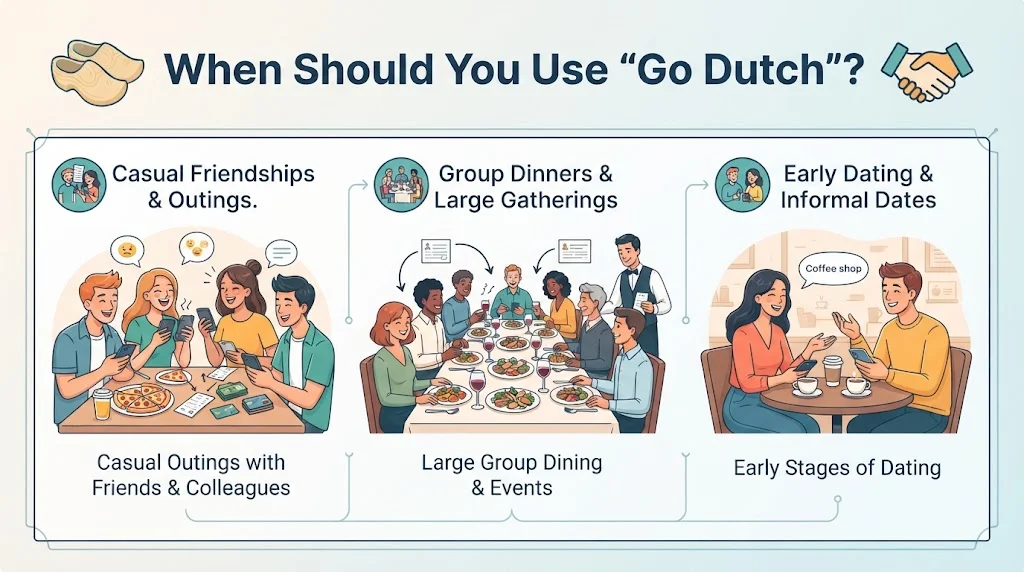
The phrase works best when the goal is to communicate that everyone will handle their own expenses clearly and without confusion.
Professional Settings
In workplace lunches, networking events, conferences, or team outings, “Go Dutch” can prevent misunderstandings about reimbursement or payment expectations. It establishes fairness while keeping financial arrangements straightforward.
Casual Conversations
Friends often use the phrase before dining out, watching a movie, traveling together, or attending events. It removes assumptions that one person is expected to pay for everyone.
Writing, Presentations, and Digital Communication
Although more common in speech, the phrase also appears in emails, group chats, invitations, and event planning messages. For formal business communication, alternatives such as “pay separately” or “split the cost” are usually clearer.
When It Is Especially Effective
- Group dinners
- Office lunches
- Coffee meetings
- Weekend trips
- Shared entertainment expenses
- Student gatherings
- Travel planning
- Informal networking events
When Should You Avoid “Go Dutch”?
Although widely understood, the phrase is not appropriate in every situation.
Overly Formal Situations
Formal business proposals, contracts, official correspondence, and corporate policies usually require more precise wording such as “each participant is responsible for their own expenses.”
Legal, Academic, or Sensitive Contexts
Legal agreements, reimbursement policies, financial documents, and academic writing should avoid idiomatic expressions because they may reduce clarity or appear too informal.
Situations Where Nuance May Be Lost
When discussing hospitality, client relationships, cultural traditions, or celebrations, saying “Go Dutch” may unintentionally sound transactional. In these cases, explaining payment arrangements directly is more considerate.
Is “Go Dutch” Professional, Polite, or Casual?
The phrase is generally considered casual to moderately neutral rather than highly professional.
Its tone is friendly, practical, and efficient. Most native English speakers interpret it as a simple way to discuss shared expenses without creating awkwardness.
In professional conversations between colleagues, it is usually acceptable when the environment is informal. However, in communication with clients, executives, or external partners, expressions such as “split the bill” or “each person will cover their own expenses” often sound more polished.
Emotionally, the phrase carries very little positive or negative weight. Instead, it signals fairness, equality, and financial independence.
Audience perception also depends on familiarity. Native speakers generally recognize the phrase immediately, while ESL learners may understand more direct alternatives more easily.
Pros and Cons of Using “Go Dutch”
Advantages
Clarity
Most English speakers immediately understand that everyone will pay for themselves.
Efficiency
The phrase communicates the payment arrangement in just two words, making conversations faster and simpler.
Accessibility
It is widely recognized in everyday English and appears frequently in conversations about dining, travel, and social activities.
Potential Drawbacks
Oversimplification
The phrase does not explain whether costs will be divided equally or whether each person will pay only for what they ordered.
Tone Mismatch
In highly formal or client-facing communication, the idiom may sound too conversational.
Repetition
Using the phrase repeatedly in writing or speech can make communication feel repetitive when many suitable alternatives are available.
Real-Life Examples of “Go Dutch” by Context
Emails
“Hi everyone, let’s go Dutch for lunch tomorrow so everyone can order whatever they’d like.”
Meetings
“After the conference, we’re planning dinner. We’ll go Dutch so there’s no need to process reimbursements.”
Presentations
“For optional team dinners during the event, participants will go Dutch unless otherwise stated.”
Conversations
“I’m happy to meet for coffee, but let’s go Dutch this time.”
Social Media
“Weekend brunch with friends! We decided to go Dutch, and it made everything simple.”
“Go Dutch” vs Similar Expressions (Key Differences)
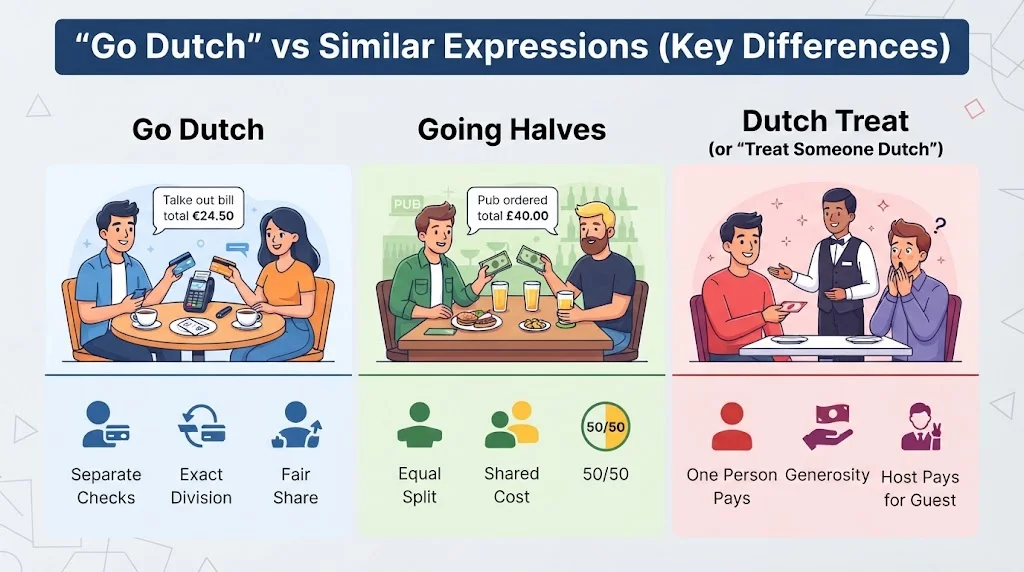
| Phrase | Meaning Difference | Tone Difference | Best Use Scenario |
| Go Dutch | Everyone pays their own share | Casual, friendly | Meals, outings, social events |
| Split the bill | Usually divides one bill equally | Neutral | Restaurants and cafés |
| Pay separately | Each person pays individually at checkout | Professional, direct | Restaurants, business meals |
| Share the cost | General expense sharing, not limited to meals | Neutral | Travel, subscriptions, events |
| Chip in | Everyone contributes toward a shared expense | Informal | Group gifts, parties, projects |
| Cover your own tab | Each person pays only for what they ordered | Casual | Bars, restaurants, informal gatherings |
Common Mistakes & Misuse of “Go Dutch”
One common mistake is assuming “Go Dutch” always means splitting the bill equally. In practice, some groups interpret it as each person paying only for what they ordered.
Another mistake is using the phrase in formal contracts or official documents where precise financial language is expected.
Some speakers also overuse the expression, even when alternatives such as “pay separately” or “share the cost” would better match the audience.
Cultural misunderstandings can occur because payment customs vary around the world. In some cultures, offering to pay for everyone is a sign of hospitality, making “Go Dutch” feel less appropriate unless everyone agrees beforehand.
Psychological Reason People Prefer “Go Dutch”
The phrase reduces cognitive load because it instantly communicates a familiar payment arrangement without lengthy explanations.
It also promotes a sense of fairness. When everyone contributes equally or pays for themselves, people often perceive the arrangement as transparent and balanced.
In today’s fast-paced communication, short expressions save time and reduce unnecessary discussion. Whether planning dinner through a messaging app or organizing a group outing, “Go Dutch” quickly establishes expectations.
Many people also appreciate the independence it implies, allowing participants to enjoy social activities without feeling financially obligated to others.
US vs UK Usage of “Go Dutch”
The phrase is widely recognized in both American and British English.
In the United States, “Go Dutch” remains common in everyday conversation, particularly when discussing restaurant bills or casual social plans.
In the United Kingdom, speakers also understand and use the expression, although alternatives such as “split the bill” and “pay separately” are often heard just as frequently.
Overall, the phrase carries a similar tone in both regions: informal, practical, and friendly.
“Go Dutch” in Digital & Modern Communication
In emails, “Go Dutch” works well for informal invitations among coworkers or friends.
On Slack, Microsoft Teams, WhatsApp, and other messaging platforms, it provides a quick way to coordinate payment expectations before group events.
Social media users often include the phrase in posts about dinners, vacations, concerts, and celebrations to explain how expenses were handled.
AI-generated summaries and productivity tools increasingly favor more explicit alternatives like “split the bill” or “each person pays individually” because they reduce ambiguity for diverse audiences.
Linguistic & Communication Insight
Emotional Weight & Subtext
Although literally about payment, “Go Dutch” often signals equality, mutual respect, and independence. Native speakers rarely interpret it as unfriendly when introduced politely.
Direct vs Indirect Phrasing
The phrase is more direct than saying, “Perhaps everyone could pay for themselves.” It efficiently communicates the arrangement while remaining socially acceptable in most informal settings.
Professional Communication Perspective
Among colleagues, the expression usually feels practical and transparent. With clients or senior executives, more explicit wording often projects greater professionalism and avoids possible misunderstandings.
Pragmatic Reasons for Alternatives
Experienced communicators often choose alternatives such as “split the bill,” “pay separately,” or “each participant covers their own expenses” because these expressions are clearer for international audiences, reduce ambiguity, and fit formal communication more naturally.
Social Signaling
Word choice influences how people perceive generosity, fairness, and collaboration. Saying “Go Dutch” suggests that everyone participates equally rather than expecting one person to assume financial responsibility.
Tone & Context Guidance
Use the phrase confidently in casual conversations, group planning, travel, and informal workplace settings. Choose more direct, descriptive language in legal documents, corporate communications, academic writing, or situations where cultural expectations about paying may differ.
Split the Bill
Meaning: “Split the bill” means dividing the total cost of a meal or service among everyone involved. In many situations, the amount is shared equally unless the group agrees on a different arrangement.
Why This Phrase Works: It is one of the clearest and most widely understood alternatives, making payment expectations obvious.
Real-World Usage Insight: Restaurants, cafés, and coworkers frequently use this phrase because it avoids confusion and sounds natural in everyday English.
Best Use: Casual dinners, office lunches, family outings, and group meals.
Avoid When: The bill is not being divided equally or when each person is paying only for their own order.
Tone: Neutral, friendly, and practical.
US vs UK Usage: Extremely common in both the US and the UK.
Example (Meeting): “Before we order, let’s split the bill so everyone knows how we’ll handle the payment.”
Pay Separately
Meaning: “Pay separately” means each individual pays directly for their own purchases instead of combining everything into one payment.
Why This Phrase Works: It removes ambiguity by clearly stating how payment will be handled.
Real-World Usage Insight: Many restaurants ask customers whether they would like to pay together or separately, making this phrase familiar to native speakers.
Best Use: Business meals, restaurants, cafés, and travel expenses.
Avoid When: One person intends to pay first and collect reimbursements later.
Tone: Professional, direct, and polite.
US vs UK Usage: Common in both regions, especially in customer service settings.
Example (Email): “To simplify reimbursement, everyone will pay separately during lunch.”
Share the Cost
Meaning: “Share the cost” means multiple people contribute toward an expense rather than leaving the entire payment to one person.
Why This Phrase Works: It applies to many situations beyond dining, making it versatile.
Real-World Usage Insight: Friends often use this expression for travel, accommodation, subscriptions, and event tickets.
Best Use: Vacations, shared services, entertainment, and group purchases.
Avoid When: Individual expenses vary significantly and equal sharing would be unfair.
Tone: Friendly, cooperative, and neutral.
US vs UK Usage: Equally common in American and British English.
Example (Message): “Let’s share the cost of the rental car so everyone contributes fairly.”
Divide the Expenses
Meaning: “Divide the expenses” means allocating costs among everyone involved according to an agreed arrangement.
Why This Phrase Works: It sounds more structured than casual idioms and works well in professional communication.
Real-World Usage Insight: Teams planning conferences or group travel often use this phrase because it sounds organized and transparent.
Best Use: Project budgets, business travel, events, and shared purchases.
Avoid When: Casual conversations where a simpler phrase would sound more natural.
Tone: Professional and neutral.
US vs UK Usage: Widely understood in both countries, especially in workplace settings.
Example (Email): “We’ll divide the expenses after the trip using the shared spreadsheet.”
Each Person Pays Their Own Way
Meaning: This phrase means every participant is responsible for their own costs without expecting someone else to cover them.
Why This Phrase Works: It is straightforward and leaves very little room for misunderstanding.
Real-World Usage Insight: It frequently appears when organizing trips, social gatherings, and volunteer events.
Best Use: Invitations, group travel, community activities, and informal events.
Avoid When: The host has already offered to pay.
Tone: Neutral, respectful, and clear.
US vs UK Usage: Common in both regions and easily understood by international audiences.
Example (Email): “Dinner is optional, and each person pays their own way.”
Cover Your Own Tab
Meaning: “Cover your own tab” means each person pays only for the food or drinks they personally ordered.
Why This Phrase Works: It accurately describes payment in restaurants, cafés, and bars where individual orders differ.
Real-World Usage Insight: Native speakers often use this phrase during casual evenings out with friends.
Best Use: Bars, restaurants, cafés, and informal social gatherings.
Avoid When: The venue issues only one combined bill or in formal business settings.
Tone: Casual and conversational.
US vs UK Usage: More common in the United States but understood in the United Kingdom.
Example (Conversation): “Let’s just cover our own tabs tonight since everyone ordered something different.”
Chip In
Meaning: “Chip in” means everyone contributes some money toward a shared expense, although the amounts do not always have to be equal.
Why This Phrase Works: It emphasizes teamwork and shared responsibility rather than strict accounting.
Real-World Usage Insight: Friends regularly use it when buying gifts, ordering pizza, or organizing celebrations.
Best Use: Parties, group gifts, office celebrations, and shared purchases.
Avoid When: Exact individual payment amounts need to be specified.
Tone: Informal, friendly, and collaborative.
US vs UK Usage: Very common in both American and British English.
Example (Message): “We’re buying a retirement gift for Sarah. If you’d like to chip in, let me know.”
Split the Cost
Meaning: “Split the cost” means dividing the price of something between two or more people.
Why This Phrase Works: It is flexible enough to apply to meals, travel, subscriptions, or almost any shared expense.
Real-World Usage Insight: Roommates, coworkers, and travel companions frequently use this phrase because it is simple and practical.
Best Use: Rent, hotel rooms, transportation, software subscriptions, and dining.
Avoid When: One person is intentionally paying the full amount as a gift.
Tone: Neutral and cooperative.
US vs UK Usage: Popular and natural in both the US and the UK.
Example (Meeting): “To stay within budget, we’ll split the cost of the conference materials equally.”
Everyone Pays Individually
Meaning: “Everyone pays individually” means each participant is responsible for paying for their own purchases or share without combining payments into one transaction.
Why This Phrase Works: It is direct, unambiguous, and suitable for both spoken and written communication.
Real-World Usage Insight: Event organizers and restaurants often use this wording because it clearly explains payment expectations.
Best Use: Corporate events, conferences, restaurants, and group activities.
Avoid When: The organizer has arranged a single payment for the entire group.
Tone: Professional, neutral, and informative.
US vs UK Usage: Common and easily understood in both the US and the UK.
Example (Email): “Please note that everyone pays individually for lunch after the workshop.”
Settle Your Own Bill
Meaning: “Settle your own bill” means each person pays the amount they personally owe before leaving.
Why This Phrase Works: It communicates financial responsibility clearly and avoids confusion about payment.
Real-World Usage Insight: Hotels, restaurants, and business dinners often use this phrase when separate payments are expected.
Best Use: Restaurants, travel, accommodation, and business outings.
Avoid When: The payment has already been covered by a host or company.
Tone: Neutral and slightly formal.
US vs UK Usage: Understood in both countries, though heard more often in hospitality settings.
Example (Meeting): “At the end of dinner, everyone can settle their own bill.”
Pitch In
Meaning: “Pitch in” means contributing money, effort, or resources to support a shared goal or expense.
Why This Phrase Works: It highlights cooperation rather than focusing only on payment.
Real-World Usage Insight: Native speakers frequently use it when organizing office parties, family events, or community projects.
Best Use: Team activities, celebrations, shared gifts, and volunteer events.
Avoid When: Exact payment responsibilities need to be explained.
Tone: Friendly, encouraging, and collaborative.
US vs UK Usage: More common in American English but widely understood in the UK.
Example (Message): “We’re ordering lunch for the team. Feel free to pitch in if you’d like to join.”
Halfsies
Meaning: “Halfsies” is an informal expression meaning two people split something equally, especially the cost of a purchase or meal.
Why This Phrase Works: It sounds lighthearted and creates a relaxed atmosphere among friends.
Real-World Usage Insight: Younger speakers often use this expression jokingly in casual conversations.
Best Use: Close friends, partners, siblings, and informal outings.
Avoid When: Professional communication or formal situations.
Tone: Playful, informal, and humorous.
US vs UK Usage: More common in the US but recognized by many UK speakers.
Example (Conversation): “That dessert looks amazing. Want to do halfsies?”
Share the Bill
Meaning: “Share the bill” means two or more people divide the payment for a meal or service.
Why This Phrase Works: It sounds natural and emphasizes fairness without using an idiom.
Real-World Usage Insight: Many people use this phrase when suggesting an equal payment arrangement before dining out.
Best Use: Restaurants, cafés, and casual business lunches.
Avoid When: Individual spending differs greatly and equal sharing would not be fair.
Tone: Friendly, neutral, and practical.
US vs UK Usage: Common in both American and British English.
Example (Meeting): “Let’s share the bill so everyone contributes equally.”
Everyone Covers Their Own Expenses
Meaning: This phrase means every participant is responsible for paying all of their personal costs during an activity or event.
Why This Phrase Works: It is highly specific and appropriate for professional or formal communication.
Real-World Usage Insight: Organizations frequently include this wording in event invitations and travel policies.
Best Use: Conferences, company travel, workshops, and official announcements.
Avoid When: Casual conversations where shorter expressions sound more natural.
Tone: Professional, formal, and precise.
US vs UK Usage: Widely accepted in both the US and the UK.
Example (Email): “Accommodation is optional, and everyone covers their own expenses throughout the trip.”
Contribute Equally
Meaning: “Contribute equally” means each participant provides the same amount toward a shared expense or project.
Why This Phrase Works: It emphasizes fairness while encouraging shared responsibility.
Real-World Usage Insight: Teams, clubs, and roommates often use this wording when discussing shared financial commitments.
Best Use: Group purchases, community projects, subscriptions, and household expenses.
Avoid When: Participants are expected to contribute different amounts.
Tone: Neutral, cooperative, and encouraging.
US vs UK Usage: Equally common in American and British English.
Example (Meeting): “We’ll contribute equally toward the venue rental for the workshop.”
Conclusion
The phrase “Go Dutch” remains one of the most widely recognized ways to describe a situation where everyone pays for their own share of a meal or shared expense. Its popularity comes from its simplicity, making conversations about money more transparent and reducing the awkwardness that can arise when deciding who should pay.
While the expression is perfectly natural in casual settings, choosing the right alternative can make your communication even more effective. In professional environments, phrases like “pay separately” or “everyone covers their own expenses” often sound clearer and more polished. Understanding the meaning, history, tone, and alternatives to “Go Dutch” helps you adapt your language to different audiences, cultures, and situations.
Whether you’re planning a business lunch, organizing a group trip, or meeting friends for dinner, selecting the most appropriate expression improves clarity, builds trust, and ensures everyone shares the same expectations. Mastering these alternatives will make your English sound more natural, confident, and contextually appropriate.
FAQs
What does “Go Dutch” mean?
“Go Dutch” means that each person pays for their own share of a meal, activity, or expense instead of one individual paying the full amount. It is commonly used during restaurant visits, social outings, business lunches, and travel plans where everyone agrees to handle their own costs fairly and transparently.
Is “Go Dutch” a polite expression?
Yes. “Go Dutch” is generally considered polite because it promotes fairness and avoids assumptions about who should pay. However, in formal business or client-facing situations, more direct alternatives such as “pay separately” or “each participant covers their own expenses” may sound more professional.
Is “Go Dutch” appropriate in professional communication?
It can be appropriate in informal workplace conversations or team lunches. However, for official emails, corporate policies, or client communications, expressions like “split the cost”, “pay separately”, or “everyone covers their own expenses” provide greater clarity and maintain a more professional tone.
What’s the difference between “Go Dutch” and “split the bill”?
Although people often use them interchangeably, “Go Dutch” usually means each person pays for their own share, while “split the bill” often suggests dividing the total amount equally. The exact meaning depends on the group’s agreement and the context of the conversation.
Is “Go Dutch” commonly used in the United States?
Yes. The phrase is widely used throughout the United States in everyday conversations about dining, dating, travel, and social gatherings. Most American English speakers immediately understand that it refers to everyone paying for themselves.
Do people in the United Kingdom use “Go Dutch”?
Yes. British English speakers also use and understand “Go Dutch.” However, phrases such as “split the bill” and “pay separately” are equally common, especially in restaurants and other situations involving shared expenses.
Can “Go Dutch” be used outside restaurants?
Absolutely. While it is most often associated with meals, the phrase also applies to vacations, entertainment, transportation, accommodation, event tickets, and other shared expenses where each participant pays for their own portion.
What is the best professional alternative to “Go Dutch”?
The best professional alternatives include “pay separately,” “split the cost,” and “everyone covers their own expenses.” These expressions avoid idiomatic language, making them easier for international audiences to understand while maintaining a polished and business-friendly tone.
Why do people prefer saying “Go Dutch”?
People prefer “Go Dutch” because it is short, familiar, and immediately communicates a fair payment arrangement. The phrase reduces unnecessary discussion, establishes expectations quickly, and helps prevent awkwardness when groups decide how to handle shared expenses.
How can ESL learners use “Go Dutch” naturally?
ESL learners can use “Go Dutch” in casual conversations with friends, classmates, or coworkers when discussing meals or shared activities. For more formal situations, learning alternatives like “pay separately” or “share the cost” will help them communicate more confidently and appropriately.


