
Imagine a coworker proudly announces they finished a challenging project ahead of schedule. Someone replies, “Bully for you!” Depending on the speaker’s tone, that response might sound genuinely congratulatory or subtly sarcastic. Understanding what this phrase means is important because its interpretation depends heavily on context, audience, and delivery.
“Bully for you” is an old English expression that traditionally means “good for you” or “well done.” While it originally conveyed sincere praise, many modern English speakers recognize it as a phrase that can also express irony or mild sarcasm. Because of this shift in meaning, choosing the right alternative can make communication clearer, friendlier, and more professional.
Whether you’re a professional writing emails, a student learning English, an ESL learner expanding your vocabulary, or a content writer looking for natural expressions, knowing when to use and when to avoid this phrase can improve your communication. This guide explores its meaning, history, tone, practical usage, and the best alternatives for different situations.
What Does “Bully For You” Mean?
“Bully for you” is an English expression used to acknowledge another person’s achievement, success, or good fortune. It traditionally means “good for you” or “well done,” although in modern conversation it may also be used sarcastically depending on the speaker’s tone, context, and relationship with the listener.
The phrase expresses approval or recognition of someone’s accomplishment. In its literal sense, it congratulates or encourages someone after they have achieved something positive. However, because the expression sounds somewhat old-fashioned, many native speakers today associate it with humorous or ironic usage.
You might hear it when someone shares:
- A personal achievement
- Career success
- Academic accomplishment
- Good news
- A completed goal
The intended meaning often depends less on the words themselves and more on voice, facial expression, and context, making it important to choose carefully in professional communication.
Origin & History of “Bully For You”
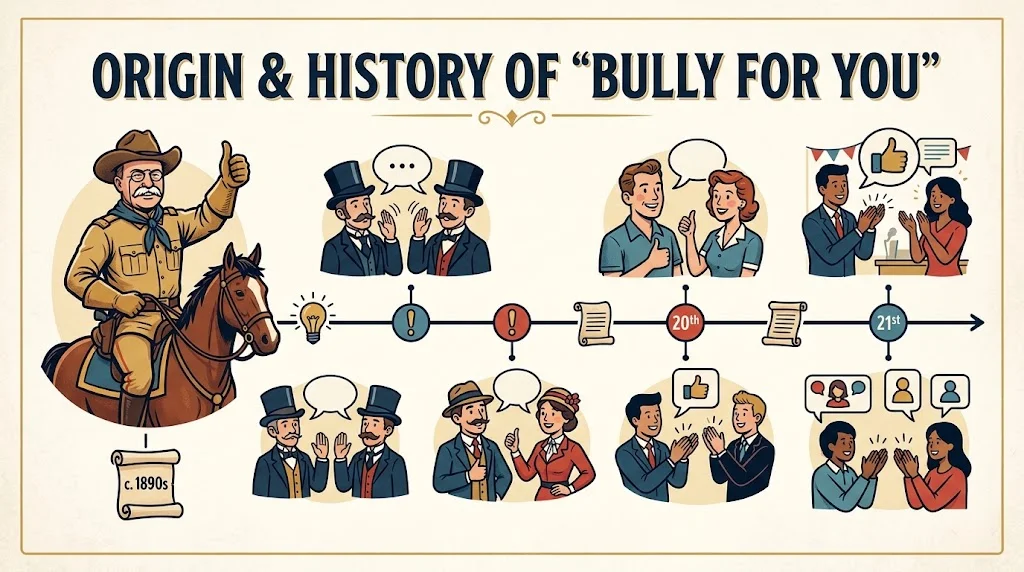
The expression “bully for you” dates back to the late nineteenth century in American English. At that time, the word “bully” had a very different meaning from the one most people know today. Instead of referring to someone who intimidates others, “bully” was commonly used as an adjective meaning excellent, admirable, or first-rate.
The word itself entered English centuries earlier through Dutch influences, where similar words carried meanings related to a good companion, sweetheart, or admirable person. Over time, American English adopted “bully” as an enthusiastic expression of approval. People would say “Bully!” in the same way modern speakers might say “Excellent!” or “Great!”
From this positive meaning came the phrase “bully for you,” which literally meant “excellent for you” or “good for you.” It appeared in newspapers, literature, political speeches, and everyday conversation throughout the late 1800s and early 1900s.
As language evolved during the twentieth century, the negative meaning of “bully”—someone who intimidates or harasses others—became far more common. As a result, the original positive sense gradually disappeared from everyday speech.
Today, “bully for you” survives mostly as an old-fashioned expression. Native speakers may use it sincerely, humorously, or sarcastically. In television, films, and novels, it often appears when a character wants to sound witty, dismissive, or ironically congratulatory.
This evolution demonstrates how word meanings can change dramatically over time, making historical knowledge valuable for understanding modern English expressions.
Synonyms & Alternatives by Tone
Professional & Neutral Alternatives
- Good for you
- Congratulations
- Well done
- That’s excellent
- That’s great to hear
- Nice work
- I appreciate your effort
- That’s an impressive achievement
- You should be proud of that
- I’m happy to hear that
Polite & Supportive Alternatives
- I’m glad for you
- That’s wonderful
- I’m pleased to hear that
- You deserve it
- I’m happy it worked out
- That’s encouraging
- I’m delighted for you
- You earned it
- I’m cheering you on
- Keep up the great work
Encouraging & Reassuring
- You’ve got this
- Keep it up
- You’re doing great
- Way to go
- That’s the spirit
- Keep moving forward
- You’re making great progress
- Believe in yourself
- You’re on the right track
- I’m rooting for you
Casual, Playful & Idiomatic Alternatives
- Good on you
- Nice one
- Way to go
- Lucky you
- Cheers to that
- Hats off to you
- Go you
- Awesome
- Sweet
- You nailed it
When Should You Use “Bully For You”?
Although the phrase is less common than it once was, there are still situations where “bully for you” can communicate exactly what you intend. The key is understanding your audience and the tone you want to create.
Professional Settings
In most workplaces, “bully for you” is not the safest choice because many people interpret it as sarcastic. If colleagues know you well and appreciate old-fashioned humor, it may be understood as friendly praise. Otherwise, straightforward alternatives such as “well done” or “congratulations” communicate appreciation more clearly.
Casual Conversations
The phrase works best among friends or family members who understand your personality. Spoken with a warm smile, it can express genuine happiness for someone’s success. Spoken with a flat or exaggerated tone, however, it may sound dismissive.
Writing, Presentations, and Digital Communication
In emails, reports, presentations, blog posts, or social media, the phrase should be used cautiously because readers cannot hear your tone of voice. Without vocal cues, “bully for you” is more likely to be interpreted as ironic than sincere.
When It Is Especially Effective
The expression works well when:
- You’re intentionally using vintage or classic English.
- The audience understands its historical meaning.
- A humorous or theatrical tone fits the conversation.
- You’re quoting literature, historical speech, or classic dialogue.
- Your relationship with the listener makes sarcasm impossible to misunderstand.
Using the phrase thoughtfully helps ensure your message reflects encouragement rather than unintended criticism.
When Should You Avoid “Bully For You”?
Although “bully for you” has a positive historical meaning, it is not suitable for every situation because many modern listeners associate it with sarcasm.
Avoid using it in formal business communication, including client emails, executive presentations, official announcements, and professional networking. Clear, direct praise is usually more appropriate and leaves less room for misunderstanding.
It should also be avoided in legal, academic, healthcare, or government settings, where precise language is essential. Ambiguous expressions can distract from the intended message or appear unprofessional.
Sensitive situations are another poor fit. If someone is discussing personal challenges, health issues, grief, financial struggles, or emotional experiences, the phrase may sound dismissive, even if you genuinely intend to be supportive.
Digital communication presents additional risks. Text messages, instant messaging, and emails remove vocal tone and facial expressions, making ironic interpretations much more likely.
Finally, avoid using the expression with ESL learners or international audiences, since many people are unfamiliar with its historical meaning and may focus on the modern definition of “bully,” leading to unnecessary confusion.
Is “Bully For You” Professional, Polite, or Casual?
“Bully for you” generally falls into the casual and conversational category rather than professional language.
From a formality perspective, it is informal and somewhat old-fashioned. While it originally expressed sincere praise, modern usage often carries an additional layer of irony because the phrase is relatively uncommon in contemporary English.
Its emotional subtext depends almost entirely on delivery. Spoken warmly, it communicates genuine congratulations. Spoken with exaggerated emphasis or a flat tone, it may suggest impatience, disbelief, or mock enthusiasm.
Audience perception varies significantly. Older native speakers may recognize its traditional positive meaning, while younger speakers often encounter it primarily in television, movies, or humorous conversations where it is used sarcastically.
For workplace communication, clear alternatives such as “Congratulations,” “Well done,” or “Good for you” are generally safer choices. They communicate appreciation without risking confusion.
Overall, “bully for you” is best viewed as a casual expression with mixed tone potential. Understanding your audience and the surrounding context is essential before choosing to use it.
Pros and Cons of Using “Bully For You”
Like many idiomatic expressions, “bully for you” has strengths and limitations. Understanding both helps you decide whether it fits your audience and purpose.
Advantages
Clarity (in the right context)
When listeners recognize the phrase’s traditional meaning, it clearly communicates approval or congratulations. Among people familiar with classic English expressions, the intended message is usually easy to understand.
Efficiency
The phrase is short and memorable. Instead of offering a lengthy compliment, it provides quick recognition of someone’s achievement or success.
Accessibility
Because it is a common expression in older literature and popular culture, many native speakers understand its historical meaning. It can also add personality and variety to informal conversations.
Distinctive Style
Unlike everyday compliments such as “Good job,” “bully for you” stands out. It gives speech or writing a classic, witty, or vintage feel when used appropriately.
Potential Drawbacks
Oversimplification
The phrase offers general praise but does not explain what was impressive or why the achievement matters. In professional settings, more specific feedback is often more meaningful.
Tone Mismatch
Modern audiences frequently associate the expression with sarcasm. Without supportive tone or context, it can sound dismissive instead of encouraging.
Repetition
Using the phrase repeatedly may make conversations feel predictable or overly theatrical, especially when more natural alternatives are available.
Generational Differences
Younger speakers may recognize the words but not the historical meaning. This can create misunderstandings, particularly in multicultural or international environments.
Limited Professional Suitability
Because the phrase carries possible ironic interpretations, it is rarely the best option for business communication, customer service, or formal writing.
Overall, “bully for you” works best as an occasional, context-aware expression rather than a universal replacement for modern compliments.
Real-Life Examples of “Bully For You” by Context
Emails
Example
“Congratulations on completing the certification ahead of schedule. Bully for you! Your dedication really paid off.”
Why it works: The positive sentence before the phrase makes the sincere meaning clear.
Meetings
Example
Employee: “Our team exceeded the quarterly sales target.”
Manager: “Bully for you—that’s an excellent result. Let’s discuss how we can build on this success.”
Why it works: The follow-up praise removes any possibility of misunderstanding.
Presentations
Example
“Our interns successfully launched their first campaign. Bully for you! Reaching that milestone this early is impressive.”
Why it works: The audience immediately hears additional praise that reinforces the positive intent.
Conversations
Example
Friend: “I finally finished my marathon training.”
Friend: “Bully for you! I know how much effort you put into it.”
Why it works: Close relationships make humorous or old-fashioned expressions feel more natural.
Social Media
Example
“Passed my final exams today!”
Reply: “Bully for you! Enjoy celebrating—you’ve earned it.”
Why it works: The supportive follow-up makes the compliment sound genuine rather than sarcastic.
“Bully For You” vs Similar Expressions (Key Differences)
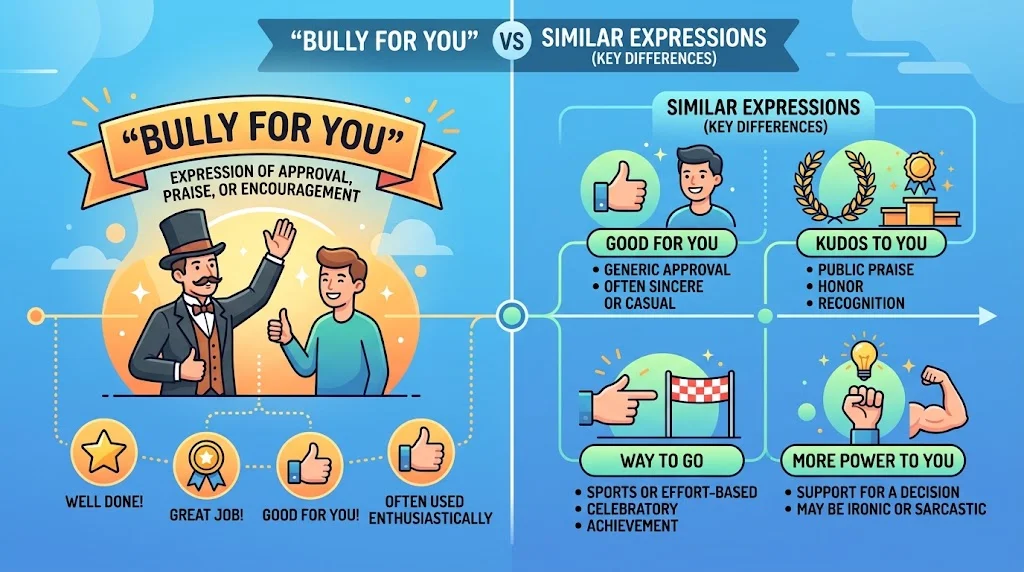
| Phrase | Meaning Difference | Tone Difference | Best Use Scenario |
| Good for you | Directly congratulates someone’s success without ambiguity. | Friendly, neutral, modern. | Everyday conversations, emails, workplace communication. |
| Well done | Focuses on recognizing effort or achievement. | Professional, respectful. | Performance reviews, meetings, presentations. |
| Congratulations | Celebrates a specific accomplishment or milestone. | Formal to semi-formal. | Promotions, graduations, awards, announcements. |
| Good on you | Expresses approval, often for doing the right thing. | Casual, especially in British and Australian English. | Friendly conversations and informal writing. |
| Way to go | Encourages enthusiasm after success. | Casual, energetic, upbeat. | Team celebrations, sports, social media, conversations. |
| Hats off to you | Shows admiration and respect for someone’s effort. | Warm, appreciative, slightly formal. | Speeches, recognition events, thoughtful messages. |
The biggest difference is that “bully for you” carries a stronger possibility of being interpreted sarcastically than the other expressions. Most modern alternatives communicate praise more directly and with less risk of misunderstanding.
Common Mistakes & Misuse of “Bully For You”
Using It in Formal Business Communication
Many professionals assume the phrase simply means “good job.” However, because it can sound ironic, using it in client emails, executive meetings, or official documents may unintentionally create a negative impression.
Ignoring Tone
The same words can sound supportive or sarcastic depending on vocal delivery. Written communication removes those vocal cues, making careful word choice even more important.
Using It with International Audiences
Many English learners have only encountered the modern meaning of “bully.” Seeing the phrase without historical context may confuse them or cause them to misunderstand your intention.
Using It During Sensitive Conversations
Avoid using the phrase when someone discusses personal struggles, disappointment, illness, or emotional experiences. Even sincere praise may appear dismissive because of the expression’s sarcastic reputation.
Overusing the Expression
Repeatedly relying on “bully for you” can make conversations sound unnatural. Mixing different expressions keeps communication more engaging and appropriate for different audiences.
Assuming Everyone Understands the Historical Meaning
Not all native speakers know that “bully” once meant “excellent.” Expecting universal understanding can lead to unnecessary confusion.
Psychological Reason People Prefer “Bully For You”
Language choices often reflect more than vocabulary—they reveal personality, relationships, and communication goals. Although “bully for you” is less common today, some speakers still prefer it for psychological and social reasons.
Cognitive Load Reduction
Short expressions require little effort to process. “Bully for you” quickly signals recognition without requiring a lengthy explanation.
Trust and Authority Signals
People who use older idioms sometimes project confidence, cultural knowledge, or familiarity with classic English. In the right audience, this can make the speaker appear well-read or witty.
Attention Economy
Because the phrase is unusual in modern English, it attracts attention more effectively than common compliments like “nice job.” Its novelty makes listeners pause and notice the message.
Expression of Personality
Some speakers enjoy using vintage expressions because they reflect their personal style. Choosing distinctive language helps conversations feel less repetitive.
Social Connection
Within groups that appreciate classic sayings or dry humor, “bully for you” can strengthen relationships through shared cultural understanding and playful communication.
However, these psychological benefits only exist when the audience understands the intended meaning. Otherwise, the same phrase may create uncertainty rather than connection.
US vs UK Usage of “Bully For You”
Although English is shared across many countries, “bully for you” is not equally common everywhere.
United States
The phrase has strong historical roots in American English but is now considered old-fashioned. Many Americans recognize it from classic literature, older films, television shows, or historical figures rather than everyday conversation.
Modern American speakers are also more likely to hear it used sarcastically than sincerely.
United Kingdom
British English recognizes the phrase as well, although it is also relatively uncommon in daily speech. UK speakers may interpret it as witty, theatrical, or ironic, particularly when spoken with exaggerated emphasis.
Similarities
In both countries:
- It is far less common than “good for you.”
- Tone strongly influences interpretation.
- Younger speakers encounter it less frequently than older generations.
- Professional communication generally favors clearer alternatives.
Regional Preference
If your audience includes people from multiple English-speaking countries, choosing expressions like “Congratulations,” “Well done,” or “Good for you” usually provides greater clarity and avoids regional or generational misunderstandings.
“Bully For You” in Digital & Modern Communication
Digital communication removes facial expressions and vocal tone, making word choice more important than ever.
Emails
In professional emails, “bully for you” is generally not recommended because recipients may interpret it as sarcastic. Clearer compliments such as “Congratulations” or “Well done” communicate appreciation more effectively.
Slack and WhatsApp
Among close teammates or friends, the phrase can add humor if everyone understands your communication style. With unfamiliar colleagues, however, it may create unnecessary confusion.
Social Media
On platforms like X, LinkedIn, Facebook, or Instagram, readers often interpret short comments without additional context. Pairing the phrase with supportive language or emojis can help clarify positive intent, although modern alternatives remain safer.
AI-Generated Summaries
AI writing tools generally avoid “bully for you” because it has multiple interpretations. Instead, they prefer straightforward expressions that reduce ambiguity and improve readability across different audiences.
Modern Communication Trends
Today’s communication emphasizes clarity, inclusiveness, and directness. While classic idioms remain valuable, professionals increasingly choose language that minimizes misunderstanding, especially in global and digital environments.
Conclusion
“Bully for you” is a fascinating English expression that has evolved significantly over time. Once a sincere way to say “good for you” or “well done,” it is now often interpreted through the speaker’s tone and context, making it one of the more nuanced phrases in modern English. While it can still convey genuine praise, it also carries a strong potential for sarcasm, especially in digital communication where vocal cues are absent. For professionals, students, ESL learners, and writers, understanding this distinction is essential for communicating clearly and effectively.
In many situations, modern alternatives such as “Congratulations,” “Well done,” or “I’m happy for you” provide the same positive message with less risk of misunderstanding. Ultimately, the best choice depends on your audience, relationship, and purpose. By selecting language that matches the situation, you can build stronger connections, avoid unintended offense, and communicate with greater confidence in both personal and professional settings.
FAQs
What does “Bully for you” mean?
“Bully for you” traditionally means “good for you,” “well done,” or “congratulations.” It expresses approval or recognition of someone’s success or achievement. However, in modern English, the phrase is sometimes used sarcastically, so the speaker’s tone and context are important in determining whether it sounds sincere or ironic.
Is “Bully for you” a compliment?
Yes, “bully for you” is originally a compliment. It was historically used to praise or congratulate someone for an accomplishment or positive news. Today, though, many people associate it with sarcasm, meaning the compliment may not always be interpreted as genuine unless the surrounding context clearly indicates sincere praise.
Is “Bully for you” considered rude?
Not necessarily. The phrase itself is not rude, but it can sound dismissive or sarcastic depending on how it is spoken or written. In professional or unfamiliar settings, choosing a clearer alternative such as “Congratulations” or “Good for you” is usually a safer option.
Why does “bully” have a positive meaning in this phrase?
In older English, “bully” could mean excellent, admirable, or first-rate, which is completely different from its modern meaning of someone who intimidates others. “Bully for you” preserves that older positive sense, even though the standalone word has largely changed meaning over time.
Is “Bully for you” still commonly used?
The expression is relatively uncommon in everyday modern English. Most native speakers prefer more direct phrases like “Well done,” “Congratulations,” or “Good for you.” Today, “bully for you” is more likely to appear in historical writing, classic literature, or conversations intended to sound humorous or old-fashioned.
Can I use “Bully for you” in business communication?
It is generally not recommended for formal business communication. Because some readers may interpret it as sarcastic, it can create confusion or appear unprofessional. Clear and direct expressions such as “Congratulations,” “Excellent work,” or “Well done” communicate appreciation more effectively in professional environments.
What are the best alternatives to “Bully for you”?
Some of the strongest alternatives include “Good for you,” “Congratulations,” “Well done,” “Nice work,” “That’s wonderful,” “I’m happy for you,” “Way to go,” “Good on you,” “You should be proud,” and “Hats off to you.” The best choice depends on the level of formality and the relationship between the speakers.
Is “Bully for you” more common in the US or the UK?
The phrase is recognized in both the United States and the United Kingdom, but it is uncommon in everyday conversation in both regions. American and British speakers alike often view it as old-fashioned, and both audiences may interpret it as either sincere praise or sarcasm depending on context.
How can I tell whether “Bully for you” is sincere or sarcastic?
The meaning usually depends on tone of voice, facial expressions, and the surrounding conversation. Warm delivery and supportive comments suggest genuine praise, while exaggerated emphasis or negative context often signals sarcasm. In written communication, where tone is harder to judge, misunderstandings are more likely.
Should ESL learners use “Bully for you”?
ESL learners should understand the phrase because it appears in books, movies, and conversations, but it is generally better to use more modern alternatives in daily communication. Expressions such as “Good for you,” “Congratulations,” or “Well done” are clearer, more widely used, and less likely to be misunderstood.


