
Picture this: your manager ends a meeting by saying, “Let’s dig in and solve this issue,” or your friend invites everyone to “dig in” before dinner is served. The same two-word phrase appears in completely different situations, yet native English speakers immediately understand the intended meaning from the context. That flexibility makes “dig in” one of the most versatile idiomatic expressions in everyday English.
Whether you’re writing professional emails, participating in meetings, learning English, or creating content, understanding dig in helps you communicate more naturally. It can signal determination, encourage collaboration, invite people to start eating, or motivate a team to begin work. Choosing the right alternative is equally important because tone influences how your message is received. Knowing when to use dig in and when to choose another expression can make your communication clearer, friendlier, and more professional.
What Does “Dig In” Mean?
Dig in means to begin doing something with focus, determination, or enthusiasm, or, in another common context, to begin eating a meal. The phrase is widely used in everyday English, professional communication, and casual conversation, where the intended meaning depends on the surrounding context.
Origin & History of “Dig In”
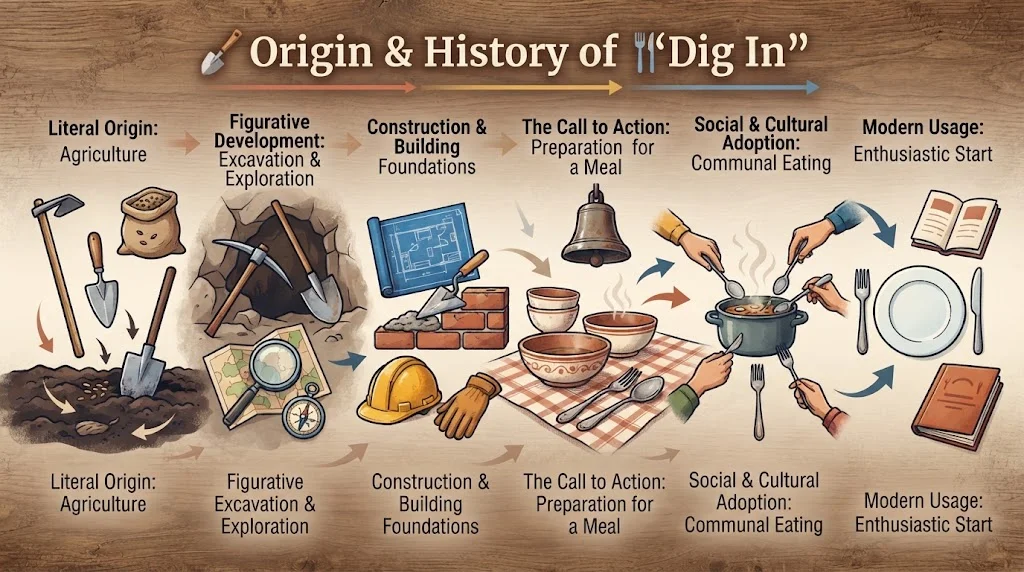
The phrase dig in has more than one historical background, which explains why it carries different meanings today.
One of its earliest uses comes from the military. Soldiers were instructed to dig in by digging defensive trenches or fortifications to protect themselves during combat. In this sense, the phrase represented preparation, persistence, and refusing to give up under pressure. Over time, this meaning expanded beyond military settings to describe someone becoming firmly committed to a position or task.
A second, more informal meaning developed around dining. In North American English especially, dig in became a friendly invitation for people to begin eating. The expression suggests enjoying a meal enthusiastically rather than waiting formally.
As English evolved, the phrase gained another popular interpretation in workplaces and education. Teams now say “Let’s dig in” before starting a project, analyzing data, solving a problem, or exploring a complex topic. Instead of referring to physical digging, the phrase emphasizes deep engagement, active participation, and sustained effort.
Today, dig in is understood across many English-speaking regions, although its exact meaning depends heavily on context. It has become a practical expression that communicates action, commitment, and readiness without sounding overly formal.
Synonyms & Alternatives by Tone
Professional & Neutral Alternatives
- Get started
- Begin working
- Dive into
- Focus on
- Tackle
- Examine
- Work through
- Address
- Move forward with
- Analyze
Polite & Supportive Alternatives
- Let’s get started
- Take a closer look
- Let’s work through this
- Feel free to begin
- Please start when you’re ready
- Let’s explore this together
- Let’s review
- Let’s walk through it
- Let’s look into it
- Let’s begin
Encouraging & Reassuring
- Give it your best
- Keep going
- Stay focused
- You’ve got this
- Let’s make progress
- Take it one step at a time
- Keep at it
- Stick with it
- Let’s solve this together
- Continue with confidence
Casual, Playful & Idiomatic Alternatives
- Dive in
- Jump in
- Get cracking
- Roll up your sleeves
- Get the ball rolling
- Go for it
- Have at it
- Dig into it
- Pitch in
- Let’s get moving
When Should You Use “Dig In”?
The phrase dig in works best when you want to encourage action, commitment, or participation. Because it adapts to different situations, it fits both personal and professional communication when used thoughtfully.
Professional Settings
In meetings, workshops, brainstorming sessions, and project discussions, dig in encourages a team to begin meaningful work. It creates an energetic tone without sounding aggressive.
Examples include:
- “Let’s dig in and review the quarterly results.”
- “We’ll dig in after everyone has joined the meeting.”
It is especially effective when collaboration is expected rather than simply giving instructions.
Casual Conversations
Friends and family commonly use dig in while sharing meals or beginning activities.
Examples include:
- “Dinner’s ready, dig in!”
- “We’ve planned the trip. Let’s dig in and finalize everything.”
In these settings, the phrase sounds friendly, welcoming, and natural.
Writing, Presentations, and Digital Communication
Presenters often use dig in to introduce a new section.
Examples include:
- “Let’s dig into today’s agenda.”
- “We’ll dig into the research findings next.”
Writers also use it in blogs, newsletters, training materials, and educational content because it feels conversational while keeping readers engaged.
When It Is Especially Effective
Dig in works particularly well when:
- A team is about to begin a collaborative task.
- Someone needs encouragement to start a challenging assignment.
- A presenter wants to transition smoothly into detailed information.
- A host invites guests to start eating.
- A writer wants to create an approachable, engaging tone.
Its versatility allows speakers to sound confident without becoming overly formal.
When Should You Avoid “Dig In”?
Although dig in is widely accepted, it is not appropriate in every situation.
Overly Formal Situations
Highly formal reports, executive summaries, official government documents, and ceremonial speeches generally benefit from more precise language such as begin, commence, examine, or proceed.
Legal, Academic, or Sensitive Contexts
Legal contracts, research papers, medical writing, and compliance documents require language that leaves little room for interpretation. Because dig in is idiomatic, readers who are unfamiliar with English expressions may misunderstand it.
Situations Where Nuance May Be Lost
International audiences, ESL learners, or multicultural teams may interpret the phrase literally. Replacing it with clearer alternatives like begin working, analyze, or review improves understanding.
Likewise, if emotions are running high during conflict resolution or performance discussions, dig in may unintentionally sound forceful or confrontational, even when the speaker intends encouragement.
Is “Dig In” Professional, Polite, or Casual?
The answer depends on context.
From a professional perspective, dig in is generally considered semi-formal. It is common in modern workplaces, especially among collaborative teams, managers, consultants, and educators. It sounds motivating rather than authoritative.
As a polite expression, dig in is welcoming when inviting people to eat or encouraging participation. It feels inclusive because it suggests working together instead of issuing commands.
In casual conversations, the phrase feels completely natural. Native speakers frequently use it with friends and family without thinking twice.
Its emotional subtext often communicates:
- Readiness
- Confidence
- Teamwork
- Enthusiasm
- Determination
However, audience perception matters. Traditional industries or highly formal organizations may prefer direct alternatives like begin, review, or proceed, while startups and creative workplaces often embrace conversational phrases such as dig in.
Overall, dig in strikes a balance between professionalism and friendliness, making it highly effective in modern communication when matched with the right audience.
Pros and Cons of Using “Dig In”
Advantages
Clarity
In most English-speaking environments, dig in immediately signals that it’s time to begin an activity or become fully engaged.
Efficiency
The phrase communicates motivation and action in just two words, making it useful in meetings, presentations, and conversations.
Accessibility
Because it appears frequently in everyday speech, many native speakers recognize it instantly. It creates a conversational tone that feels approachable and collaborative.
Potential Drawbacks
Oversimplification
Complex projects or technical discussions may require more precise verbs such as analyze, evaluate, or investigate instead of the broader dig in.
Tone Mismatch
Formal documents, legal writing, and academic publications often require straightforward language rather than idiomatic expressions.
Repetition
Using dig in repeatedly across emails, presentations, or articles can make communication sound predictable. Rotating among suitable alternatives keeps writing more engaging and natural.
A balanced communicator knows when the phrase adds energy and when a more specific alternative improves clarity.
Real-Life Examples of “Dig In” by Context
Emails
“Thanks for gathering the research. Let’s dig in tomorrow morning and identify our top recommendations.”
Meetings
“Now that everyone has the latest figures, let’s dig in and discuss what they tell us.”
Presentations
“Before looking at the solutions, let’s dig into the customer feedback collected over the past six months.”
Conversations
“I finally finished all my errands. Now I can dig in and finish reading this book.”
Social Media
“New tutorial just dropped! Dig in and let me know your favorite tip in the comments.”
“Dig In” vs Similar Expressions (Key Differences)
| Phrase | Meaning Difference | Tone Difference | Best Use Scenario |
| Dig In | Begin something with focus or start eating | Friendly, collaborative | Meetings, meals, projects |
| Dive In | Begin immediately without hesitation | Energetic and informal | Workshops, brainstorming, learning |
| Get Started | Simply begin an activity | Neutral and professional | Emails, instructions, workplace communication |
| Tackle | Focus on solving a challenge | Determined and proactive | Problem-solving, project management |
| Jump In | Join quickly or participate immediately | Casual and enthusiastic | Team discussions, conversations |
| Roll Up Your Sleeves | Prepare for serious effort | Motivational and idiomatic | Challenging projects, leadership discussions |
Common Mistakes & Misuse of “Dig In”
Even though dig in is a familiar English expression, it is easy to misuse when the context, audience, or tone is not considered carefully. Understanding these common mistakes helps you communicate more naturally and avoid confusion.
Overusing the Phrase
Because dig in is versatile, some speakers use it repeatedly in meetings, presentations, or written content. Hearing the same phrase several times can make communication sound repetitive.
Instead of saying:
- “Let’s dig into the report.”
- “Let’s dig into the budget.”
- “Let’s dig into the strategy.”
Consider varying your language with alternatives like let’s review, let’s examine, let’s get started, or let’s explore.
Using It in the Wrong Context
The phrase works best when encouraging action or inviting someone to begin eating. It is less appropriate when discussing highly emotional, legal, or sensitive matters.
Less suitable:
- “Let’s dig in to the employee complaint.”
Better:
- “Let’s carefully review the employee complaint.”
The second version sounds more thoughtful and professional.
Confusing the Two Meanings
Since dig in can refer to both eating and beginning work, context matters.
For example:
- “Everyone, dig in.”
At a dinner table, this clearly means “start eating.”
At a project meeting, it means “let’s begin working.”
Without context, especially in written communication, readers may briefly hesitate before understanding the intended meaning.
Using It with International Audiences
Many English learners understand literal meanings before idioms. Someone unfamiliar with the expression may imagine actual digging instead of beginning a task.
In global communication, replacing dig in with begin, review, or start working often improves clarity.
Sounding Too Forceful
In discussions involving conflict or disagreement, dig in can sometimes suggest stubbornness because another meaning of the phrase is to refuse to change one’s position.
For example:
- “Both sides dug in during negotiations.”
Here, the phrase means they became firmly committed to their viewpoints rather than beginning work.
Understanding this secondary meaning helps prevent unintended messages.
Psychological Reason People Prefer “Dig In”
Language influences how people think and respond. The popularity of dig in is not accidental; it reflects several psychological principles that make communication feel more engaging and actionable.
Cognitive Load Reduction
People naturally prefer language that is easy to process.
Instead of saying:
“Let’s begin conducting a detailed analysis of the available information.”
Many speakers simply say:
“Let’s dig in.”
The shorter expression reduces mental effort while still communicating the intended action.
Creates a Sense of Momentum

The phrase signals that planning is over and action is beginning.
Psychologically, this transition helps groups move from discussion to execution, making meetings feel more productive.
Encourages Shared Participation
Unlike commands such as:
- “Start working.”
Dig in often includes the speaker as part of the group.
Expressions like:
- “Let’s dig in.”
create a collaborative atmosphere that increases engagement and team ownership.
Builds Positive Energy
The phrase sounds enthusiastic without becoming overly dramatic.
It encourages progress while avoiding pressure, making people more receptive to the task ahead.
Supports Modern Communication Habits
Today’s workplace values approachable leadership.
Managers increasingly choose conversational expressions because they reduce hierarchy and encourage open participation.
Dig in fits this communication style perfectly by sounding confident, friendly, and action-oriented.
US vs UK Usage of “Dig In”
Although dig in is understood throughout the English-speaking world, its frequency and common meanings vary slightly between the United States and the United Kingdom.
United States
American English uses dig in very frequently.
Common meanings include:
- Begin eating.
- Start working.
- Explore a topic deeply.
- Commit fully to a task.
Examples include:
- “Dinner’s ready—dig in.”
- “Let’s dig into the customer data.”
The phrase feels natural in workplaces, classrooms, and everyday conversation.
United Kingdom
British English also recognizes dig in, although speakers may choose alternatives such as:
- Get started
- Crack on
- Get stuck in
- Tuck in (for meals)
For beginning work, many British professionals naturally say get stuck in, while tuck in is a familiar invitation to begin eating.
Overall Regional Preference
The meaning remains consistent across both regions, but Americans generally use dig in more often in business communication.
British speakers may reserve it for certain situations while preferring regionally familiar alternatives.
For international audiences, get started remains the clearest universally understood option.
“Dig In” in Digital & Modern Communication
Modern communication favors language that is concise, conversational, and motivating. Dig in fits these expectations well across digital platforms.
Emails
Managers frequently use the phrase when transitioning from planning to action.
Example:
“Now that everyone has access to the files, let’s dig in and prepare our recommendations.”
The wording feels collaborative rather than demanding.
Slack, Microsoft Teams, and WhatsApp
Short workplace messages often include:
- “Let’s dig in.”
- “Time to dig in.”
- “Ready to dig in?”
These messages create momentum without sounding overly formal.
Social Media
Content creators frequently encourage audiences with phrases like:
- “Dig in to today’s guide.”
- “Dig in and tell us what you think.”
- “Dig in to these tips.”
The expression increases engagement by inviting participation.
Online Learning
Teachers and trainers often introduce lessons with statements such as:
“Let’s dig into today’s topic.”
The phrase creates an approachable learning environment while encouraging curiosity.
AI-Generated Summaries and Business Content
Modern AI writing often favors conversational transitions.
Instead of:
“We will now analyze the following information.”
Many AI-generated summaries naturally use:
“Let’s dig in.”
This style aligns with reader expectations for accessible, human-centered communication while maintaining clarity.
Linguistic & Communication Insight
Emotional Weight & Subtext
Native speakers hear more than the literal meaning when someone says dig in. The phrase often signals enthusiasm, readiness, and commitment. It suggests that the speaker expects active participation rather than passive observation. Depending on context, it can also communicate confidence and optimism, making listeners feel that meaningful work or an enjoyable meal is about to begin.
Direct vs Indirect Phrasing
Compared with softer alternatives such as let’s take a look or let’s review, dig in sounds more energetic and action-oriented. It encourages immediate engagement without appearing overly forceful.
Examples:
- “Let’s take a look.” → Gentle and exploratory.
- “Let’s review.” → Neutral and professional.
- “Let’s dig in.” → Collaborative, energetic, and focused.
Choosing between these options depends on how much urgency or enthusiasm you want to communicate.
Professional Communication Perspective
In modern workplaces, dig in often reflects collaborative leadership rather than top-down management. Team leaders use it to encourage participation, while presenters use it to transition naturally into detailed discussions.
However, industries such as law, finance, healthcare, and academia sometimes favor more precise verbs like analyze, evaluate, or examine, especially in formal documentation.
Pragmatic Reasons for Alternatives
Experienced communicators do not always choose the most familiar phrase; they choose the one that best fits the audience.
Alternatives may be preferred because they:
- Reduce ambiguity for international readers.
- Sound more formal in executive communication.
- Avoid unintended military or stubbornness-related associations.
- Create a softer tone during sensitive conversations.
- Improve clarity in technical or academic writing.
Selecting the right expression demonstrates awareness of both language and audience expectations.
Social Signaling
Word choice subtly shapes how others perceive you.
Using dig in often signals:
- Confidence without arrogance.
- Willingness to collaborate.
- Positive energy.
- Practical leadership.
- Approachability.
By contrast, highly formal alternatives may signal authority and precision, while very casual expressions can create friendliness but reduce perceived professionalism.
Thoughtful communicators intentionally balance these signals based on the relationship, setting, and purpose of the conversation.
Tone & Context Guidance
The effectiveness of dig in depends on matching it to the situation.
Use it when:
- Beginning collaborative work.
- Introducing a presentation.
- Encouraging a team.
- Inviting people to start a meal.
- Writing conversational business content.
Consider an alternative when:
- Writing legal or academic documents.
- Addressing emotionally sensitive issues.
- Communicating with audiences unfamiliar with English idioms.
- Seeking maximum precision in technical communication.
The strongest communicators recognize that no single phrase is universally best. Dig in succeeds because it combines clarity, warmth, and momentum, but choosing the right alternative when context demands it demonstrates greater communication skill and strengthens credibility.
Dive In
Meaning: Dive in means to begin an activity immediately and enthusiastically, often without spending too much time preparing. It emphasizes action, curiosity, and confidence.
Why This Phrase Works: It creates momentum and encourages people to stop overthinking and start making progress. The phrase feels energetic and motivating without sounding forceful.
Real-World Usage Insight: Professionals often use dive in when introducing presentations, brainstorming sessions, or workshops. Content creators also use it to engage readers at the start of articles or videos.
Best Use: Creative meetings, training sessions, tutorials, workshops, and educational content.
Avoid When: Legal documents, formal academic writing, or situations requiring careful planning before action.
Tone: Friendly, enthusiastic, collaborative.
US vs UK Usage: Extremely common in the US and widely understood in the UK, although British speakers may sometimes prefer get stuck in.
Example (Meeting): “Now that everyone has reviewed the agenda, let’s dive in and discuss our first proposal.”
Get Started
Meaning: Get started simply means to begin a task or activity. It is one of the clearest and most universally understood alternatives.
Why This Phrase Works: It avoids idioms, making it suitable for both native and non-native English speakers. The wording is direct without sounding demanding.
Real-World Usage Insight: Managers, teachers, customer support teams, and presenters frequently use get started because it works equally well in spoken and written communication.
Best Use: Business emails, meetings, classrooms, onboarding guides, and international communication.
Avoid When: You want to sound especially energetic or inspirational.
Tone: Neutral, professional, approachable.
US vs UK Usage: Equally common in American and British English.
Example (Email): “Once you’ve downloaded the files, you can get started on the first draft.”
Tackle
Meaning: Tackle means to actively deal with a challenge, problem, or demanding task until progress is made.
Why This Phrase Works: It suggests determination and practical problem-solving instead of simply beginning an activity.
Real-World Usage Insight: Project managers, consultants, and team leaders regularly use tackle when discussing obstacles, deadlines, or complex assignments.
Best Use: Problem-solving meetings, project planning, troubleshooting, and strategic discussions.
Avoid When: Referring to enjoyable or relaxing activities, as it may sound unnecessarily intense.
Tone: Determined, proactive, confident.
US vs UK Usage: Common and natural in both varieties of English.
Example (Meeting): “Let’s tackle the budget concerns before moving on to the marketing plan.”
Conclusion
The phrase dig in remains one of the most flexible and useful expressions in modern English because it adapts to a wide range of situations. Whether you’re encouraging a team to begin a project, inviting guests to start eating, or motivating someone to tackle a challenge, it communicates readiness, enthusiasm, and collaboration. However, like any idiom, its effectiveness depends on context, audience, and tone. In formal legal, academic, or international communication, clearer alternatives such as get started, examine, or address may be more appropriate.
By understanding its history, emotional subtext, and practical applications, you can confidently decide when dig in strengthens your message and when another expression better fits the situation. Expanding your vocabulary with suitable alternatives also helps you avoid repetition, sound more natural, and communicate with greater precision. Ultimately, choosing the right phrase isn’t just about grammar; it’s about connecting with your audience most clearly and effectively.
FAQs
What does “dig in” mean?
Dig in commonly means to begin a task with focus and determination or to start eating a meal. The intended meaning depends on context. In workplaces, it often signals the start of collaborative work, while at the dinner table it serves as a friendly invitation to begin eating. Both uses are widely accepted in everyday English.
Is “dig in” a professional phrase?
Yes. Dig in is considered semi-formal and is commonly used in modern workplaces, presentations, workshops, and team meetings. It sounds collaborative and encouraging rather than authoritative. However, for legal documents, academic papers, or highly formal reports, more precise alternatives like begin, analyze, or review are generally preferred.
Is “dig in” an idiom?
Yes. Dig in is an English idiom because its meaning often extends beyond the literal act of digging. Depending on the situation, it can mean starting work enthusiastically, becoming deeply involved in a subject, inviting people to eat, or remaining firmly committed to a position during a disagreement.
What are the best alternatives to “dig in”?
Some of the strongest alternatives include dive in, get started, tackle, focus on, work through, examine, address, move forward with, jump in, and roll up your sleeves. The best choice depends on your audience, level of formality, and communication goal.
Can “dig in” have more than one meaning?
Yes. The phrase has several accepted meanings. It can mean starting work, beginning a meal, studying something carefully, or refusing to change your opinion. Native speakers usually determine the intended meaning from the surrounding conversation, making context essential for accurate interpretation.
Is “dig in” common in American and British English?
Yes, but usage differs slightly. American English frequently uses dig in for both meals and work-related situations. British English also understands the phrase, although speakers often choose alternatives like get stuck in for work or tuck in when inviting people to begin eating.
Should I use “dig in” in business emails?
Yes, provided the email has a conversational or collaborative tone. Phrases like “Let’s dig in to the project” or “We’ll dig in during tomorrow’s meeting” sound natural in most workplaces. For highly formal business correspondence, however, alternatives such as begin, review, or analyze may be more appropriate.
Why do people like using “dig in”?
People often prefer dig in because it is short, memorable, and action-oriented. It creates a sense of momentum and teamwork while reducing the need for lengthy explanations. Its conversational tone also makes communication feel approachable and engaging, especially in collaborative environments.
When should I avoid using “dig in”?
Avoid using dig in in legal agreements, academic research, technical manuals, or sensitive discussions where idiomatic language could create ambiguity. It may also confuse English learners or international audiences who are unfamiliar with the expression, making clearer alternatives a better choice.
How can I use “dig in” naturally?
Use dig in when encouraging action or participation. For example, you might say, “Let’s dig in to today’s agenda,” during a meeting, or “Dinner’s ready, dig in!” at a family gathering. Matching the phrase to the appropriate context ensures it sounds natural, friendly, and effective.


