Imagine you’re writing an email to a client, texting a friend, or speaking during a meeting. You want to express the idea of going somewhere to see someone, but repeating “pay a visit” every time can make your communication sound predictable. Choosing the right alternative helps you match the situation, sound more natural, and communicate with greater clarity.
The phrase “pay a visit” is a common English expression that means going to see someone or going to a particular place, usually for a short period. It appears in professional emails, everyday conversations, travel writing, customer service, and formal communication. While the phrase is polite and widely understood, different situations often call for different wording. Knowing when to use “pay a visit”—and when another expression works better—can improve your writing, make your speech more engaging, and help you connect with native speakers more naturally.
Whether you’re a professional writing business emails, a student improving your vocabulary, an ESL learner building confidence, or a content writer looking for variety, understanding the meaning, history, tone, and alternatives to “pay a visit” will help you communicate more effectively.
What Does “Pay A Visit” Mean?
Pay a visit means to go somewhere or meet someone for a short time, usually for social, personal, professional, or practical reasons. The phrase refers to intentionally visiting a person, place, or organization and is commonly used in both spoken and written English to describe planned or purposeful visits.
Origin & History of “Pay A Visit”
The expression “pay a visit” has been part of English for centuries. Here, the verb “pay” does not refer to money. Instead, it reflects an older meaning of giving, rendering, or performing something intentionally. Similar historical expressions include pay attention, pay respect, and pay compliments, where “pay” means offering something rather than making a financial transaction.
During the 17th and 18th centuries, visiting friends, relatives, and influential people was considered an important social custom, particularly in Britain. Formal visits demonstrated courtesy, respect, and social etiquette. Because these visits were viewed as a social obligation or act of civility, the phrase “pay a visit” became widely accepted in both spoken and written English.
Over time, the expression gradually became less formal while retaining its polite tone. Today, people use it in many contexts—from visiting family members and tourist attractions to meeting clients, checking on colleagues, or stopping by a local business. Although modern English offers many alternatives, “pay a visit” remains a clear, respectful, and versatile expression understood across English-speaking countries.
Synonyms & Alternatives by Tone
Professional & Neutral Alternatives
- Visit
- Meet with
- Call on
- Stop by
- Drop in
- Attend
- Go to see
- Schedule a visit
Polite & Supportive Alternatives
- Come by
- Check in on
- See
- Spend some time with
- Call in
- Make time to visit
- Visit with
Encouraging & Reassuring Alternatives
- Stop in
- Come and see
- Drop by anytime
- Swing by
- Pop in
- Check on
- Catch up in person
Casual, Playful & Idiomatic Alternatives
- Pop over
- Swing over
- Drop around
- Head over
- Look someone up
- Come over
- Drop in for a chat
When Should You Use “Pay A Visit”?
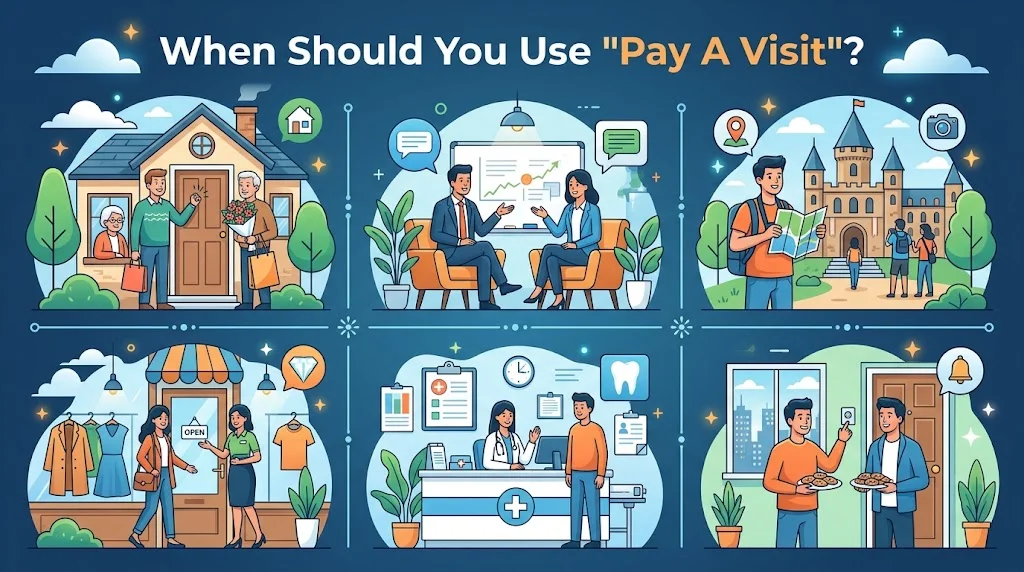
The phrase “pay a visit” works best when you want to describe a deliberate trip to see someone or somewhere in a polite, natural way. It is flexible enough for professional communication, everyday conversations, and written content while maintaining a respectful tone.
Professional Settings
In workplaces, “pay a visit” can describe planned meetings with clients, business partners, suppliers, or different office locations. It sounds courteous without being overly formal.
Examples include:
- “Our regional manager will pay a visit to the new branch next week.”
- “I’d like to pay a visit to your office to discuss the proposal.”
Casual Conversations
Among friends and family, the phrase is perfectly acceptable, although shorter alternatives like visit, stop by, or come over often sound more natural in everyday speech.
For example:
- “We’re planning to pay a visit to Grandma this weekend.”
- “Let’s pay a visit to the new café.”
Writing, Presentations, and Digital Communication
Content writers, bloggers, presenters, and marketers often use “pay a visit” because it reads smoothly and encourages action without sounding overly promotional.
Examples include:
- “Pay a visit to our showroom for a live demonstration.”
- “Visitors should pay a visit to the museum while exploring the city.”
When It Is Especially Effective
“Pay a visit” is particularly useful when you want to:
- Emphasize a planned or intentional visit.
- Maintain a polite and professional tone.
- Describe visits to people, businesses, landmarks, or institutions.
- Write in a style that feels natural but slightly more refined than simply saying “visit.”
- Communicate respectfully with audiences across different English-speaking cultures.
When Should You Avoid “Pay A Visit”?
Although “pay a visit” is widely accepted, it is not always the best choice. Some situations require more precise, direct, or context-specific language.
Overly Formal Situations
In legal, medical, academic, or government writing, the phrase may sound too conversational or imprecise. Specific verbs often communicate the intended meaning more accurately.
For example:
- Preferred: “The inspector conducted a site inspection.”
- Instead of: “The inspector paid a visit.”
Legal, Academic, or Sensitive Contexts
When discussing investigations, audits, official reviews, emergencies, or serious events, “pay a visit” can unintentionally make the situation sound informal.
Examples include:
- legal proceedings
- compliance inspections
- medical examinations
- emergency response
- disciplinary meetings
In these contexts, verbs like inspect, examine, review, investigate, or meet with provide greater clarity.
Situations Where Nuance May Be Lost
Sometimes the phrase does not explain why someone is visiting. If the purpose matters, choose wording that communicates the action more specifically.
Compare these examples:
- “The consultant met with the client.”
- “The technician inspected the equipment.”
- “The doctor checked on the patient.”
- “The team visited the manufacturing facility.”
These alternatives make the purpose immediately clear instead of simply describing the act of visiting.
Is “Pay A Visit” Professional, Polite, or Casual?
“Pay a visit” occupies a middle ground between formal and informal English, making it one of the most versatile expressions for describing a visit.
Tone Analysis
The phrase conveys courtesy, intention, and respect. It suggests that the visit is purposeful rather than accidental, making it suitable for both personal and professional communication.
Formality Level
Its formality can be described as moderately formal. It is more polished than simply saying “visit” or “stop by,” but considerably less formal than expressions like “conduct an official visit” or “make an inspection.”
Emotional Subtext
Unlike commands such as “go see”, “pay a visit” feels thoughtful and considerate. It often implies goodwill, genuine interest, or a willingness to spend time with someone rather than merely completing a task.
Audience Perception
Different audiences generally perceive the phrase positively:
- Professionals see it as courteous and appropriate.
- Students encounter it frequently in educational materials and formal writing.
- ESL learners benefit from understanding it because it appears regularly in books, news articles, and business English.
- Native speakers recognize it as a natural expression, although in casual conversation they often choose shorter alternatives such as visit, stop by, or drop in.
Overall, “pay a visit” remains a professional, polite, and broadly acceptable phrase that works well across many forms of modern communication when used in the right context.
Pros and Cons of Using “Pay A Visit”
Like many common English expressions, “pay a visit” offers several advantages while also having limitations depending on the audience and context.
Advantages
Clarity
The phrase communicates a simple idea that is immediately understood by native and non-native English speakers alike. It clearly indicates that someone intends to visit a person or place.
Efficiency
Instead of explaining the purpose of going somewhere in several words, “pay a visit” summarizes the action in one familiar expression.
Accessibility
Because it is widely recognized in business English, education, journalism, and everyday conversation, the phrase is suitable for a broad audience. It is easy for ESL learners to understand and useful for writers aiming for clear communication.
Professional Yet Friendly
The expression strikes a balance between professionalism and warmth. It sounds respectful without appearing overly formal, making it effective in emails, articles, presentations, and customer communication.
Potential Drawbacks
Oversimplification
The phrase describes the act of visiting but often leaves the purpose unclear. In situations requiring precision, more specific verbs may communicate your message better.
Tone Mismatch
In highly formal, legal, medical, or technical documents, “pay a visit” may sound too conversational. More precise wording is often preferred.
Repetition
Using “pay a visit” repeatedly throughout a document or conversation can make your writing feel repetitive. Rotating between suitable alternatives creates smoother, more engaging communication.
Less Common in Casual Speech
While still natural, everyday conversations often favor shorter expressions like visit, stop by, come over, or drop in, which may sound more conversational depending on the audience.
Real-Life Examples of “Pay A Visit” by Context
Seeing how “pay a visit” is used in everyday communication makes it easier to choose the right wording for different situations. The phrase works across professional, personal, and digital settings when the visit is intentional and the tone is polite.
Emails
Example 1
I’d like to pay a visit to your office next Thursday to discuss the project timeline. Please let me know if that works for your team.
Example 2
Our customer success manager will pay a visit next week to review your onboarding experience and answer any questions.
Meetings
Example 1
Before we finalize the expansion plans, we should pay a visit to the new facility and assess the available space.
Example 2
The executive team plans to pay a visit to each regional office during the quarterly review.
Presentations
Example 1
If you’re traveling to Tokyo, be sure to pay a visit to the innovation center to see the latest product demonstrations.
Example 2
Visitors are encouraged to pay a visit to our research lab after today’s presentation.
Conversations
Example 1
We haven’t seen our grandparents in months. Let’s pay a visit this weekend.
Example 2
I was thinking of paying a visit to Alex after work to see how he’s recovering.
Social Media
Example 1
If you’re exploring the city this summer, pay a visit to the local art market—you won’t regret it.
Example 2
We finally paid a visit to the new bookstore downtown, and it exceeded our expectations.
“Pay A Visit” vs Similar Expressions (Key Differences)
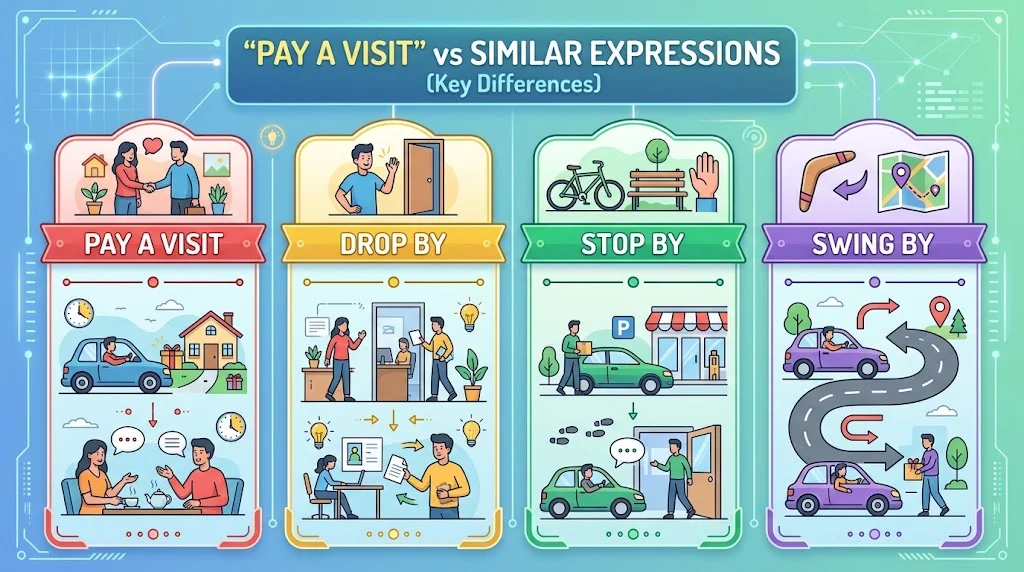
Although these expressions all involve going somewhere or seeing someone, they differ in meaning, tone, and the situations where they work best.
| Phrase | Meaning Difference | Tone Difference | Best Use Scenario |
| Visit | Directly means going to see someone or somewhere without emphasizing intention. | Neutral and versatile. | Everyday conversation, business writing, travel content. |
| Stop By | Suggests a brief or informal visit, often spontaneous. | Casual and friendly. | Friends, coworkers, neighborhood visits. |
| Drop In | Implies an unexpected or unplanned visit. | Informal and conversational. | Casual conversations and social settings. |
| Call On | Usually means visiting someone officially or professionally. | Formal and traditional. | Business meetings, official visits, diplomatic contexts. |
| Come Over | Focuses on visiting someone’s home or personal space. | Warm and informal. | Family gatherings, invitations, social events. |
| Check In On | Emphasizes concern for someone’s well-being rather than simply visiting. | Caring and supportive. | Health, family, friends, caregiving situations. |
Common Mistakes & Misuse of “Pay A Visit”
Even though “pay a visit” is straightforward, learners and writers sometimes use it in ways that sound unnatural or confusing.
Overusing the Phrase
Repeating “pay a visit” throughout an article, presentation, or conversation makes your language feel repetitive.
Less Effective
We paid a visit to the museum, then paid a visit to the café, and later paid a visit to the hotel.
Better
We visited the museum, stopped by the café, and checked into the hotel later that afternoon.
Using It in the Wrong Context
The phrase works for people and places but not for every action involving travel or attendance.
Incorrect
I paid a visit to the online meeting.
Better
I joined the online meeting.
Choosing It When Precision Matters
Sometimes a more specific verb communicates the purpose much better.
Instead of:
The engineer paid a visit to the factory.
Use:
The engineer inspected the factory.
Cultural Misunderstandings
In many English-speaking cultures, “pay a visit” often implies a planned and purposeful visit. If the visit is brief, unexpected, or informal, native speakers may naturally choose expressions like stop by, drop in, or come over instead.
Psychological Reason People Prefer “Pay A Visit”
The popularity of “pay a visit” is not just about grammar—it also reflects how people process language and interpret social interactions.
Cognitive Load Reduction
The phrase communicates an entire idea with very little effort. Readers immediately understand that someone intends to visit another person or place without needing additional explanation.
Trust and Authority Signals
Because the expression appears frequently in professional writing, news articles, books, and educational materials, it carries a sense of reliability and credibility.
Attention Economy
Modern readers prefer concise language. “Pay a visit” quickly communicates the intended action without unnecessary detail, making it effective in emails, websites, and marketing content.
Modern Communication Habits
People increasingly favor expressions that are polite without sounding overly formal. “Pay a visit” strikes that balance, making it suitable across multiple communication styles.
US vs UK Usage of “Pay A Visit”
Both American and British English use “pay a visit,” but there are subtle differences in frequency and preference.
Popularity
The phrase is widely understood on both sides of the Atlantic. However, American English often favors the simpler verb visit, especially in everyday conversation.
Tone Perception
In British English, “pay a visit” tends to retain a slightly more traditional and courteous tone. In American English, it sounds polite but somewhat less common in casual speech.
Regional Preferences
United States
- More likely to say visit, stop by, or come over.
- Pay a visit appears more often in writing than in casual conversation.
United Kingdom
- The phrase remains comfortably natural in both speech and writing.
- It often conveys a sense of politeness or intentionality.
Despite these differences, both audiences understand the phrase without confusion.
“Pay A Visit” in Digital & Modern Communication
Digital communication has changed how people write, but “pay a visit” continues to appear in many online contexts.
Emails
The phrase adds professionalism without sounding stiff.
Example
We’d love for you to pay a visit to our office during your trip.
Slack and WhatsApp
In workplace chats or messaging apps, shorter alternatives often sound more natural.
Instead of:
I’ll pay a visit to your desk.
People commonly write:
I’ll stop by your desk.
Social Media
Brands frequently use the phrase as a gentle call to action.
Example
Pay a visit to our newest location this weekend and discover what’s new.
AI-Generated Summaries
AI writing tools often recommend “pay a visit” because it is concise, universally understood, and appropriate for many audiences. However, human writers usually improve readability by alternating them with natural synonyms that better fit the surrounding context.
Linguistic & Communication Insight
Understanding “pay a visit” goes beyond its dictionary definition. Native speakers interpret the phrase through tone, context, and social expectations, making it a useful example of how language shapes relationships and communication.
Emotional Weight & Subtext
Although the phrase simply means to visit, it often suggests that the visit is intentional, thoughtful, and respectful. Native speakers may perceive it as implying genuine interest rather than convenience or obligation.
For example:
- “I’ll pay a visit to my grandparents this weekend.”
This sounds more caring than simply saying:
- “I’ll go there this weekend.”
The wording subtly communicates purpose and consideration.
Direct vs Indirect Phrasing
“Pay a visit” is moderately indirect. It softens the action compared with more direct expressions.
Compare these examples:
- Pay a visit — respectful and measured.
- Go see — direct and conversational.
- Drop by — relaxed and informal.
- Meet with — purposeful and professional.
- Check on — caring and supportive.
The choice depends on whether the speaker wants to emphasize courtesy, urgency, collaboration, or concern.
Professional Communication Perspective
In workplace communication, “pay a visit” often sounds more relationship-focused than task-focused.
Compare:
I’ll pay a visit to the client next week.
This suggests building rapport.
Whereas:
I’ll inspect the client’s facility next week.
This emphasizes evaluation rather than the relationship.
Professionals often choose wording that reflects the objective of the visit, especially when communicating with customers, partners, or executives.
Pragmatic Reasons for Alternatives
Experienced communicators frequently replace “pay a visit” with more precise language because it helps reduce ambiguity.
Examples include:
- Meet when collaboration is the goal.
- Stop by for informal interactions.
- Inspect for evaluations.
- Check in when expressing care.
- Visit when simplicity is preferred.
Choosing the right alternative improves clarity while matching the audience’s expectations.
Social Signaling
Word choice communicates more than literal meaning. Saying “pay a visit” can signal professionalism, politeness, and intentional engagement. Shorter alternatives may signal familiarity, efficiency, or a relaxed relationship.
These subtle differences influence how colleagues, clients, readers, and friends perceive the speaker.
Tone & Context Guidance
Use “pay a visit” when you want your communication to sound courteous, intentional, and slightly polished without becoming overly formal.
Consider another expression when:
- The visit is spontaneous.
- The purpose needs to be more specific.
- The audience expects casual conversation.
- Precision is more important than politeness.
Strong communicators adjust their wording to fit the audience, relationship, and purpose, making the message feel both natural and effective.
Conclusion
“Pay a visit” is a versatile English expression that communicates the idea of intentionally visiting a person, place, or organization. Its polite and respectful tone makes it suitable for professional emails, everyday conversations, travel writing, and digital communication. However, choosing the right alternative depends on your audience, purpose, and the level of formality you want to express.
While “pay a visit” works well when you want to highlight courtesy and intention, alternatives such as visit, stop by, meet with, drop in, and check in on can provide clearer meaning in specific situations. Understanding these differences helps professionals, students, ESL learners, and writers communicate more naturally.
Effective communication is not only about choosing correct words—it is about choosing words that match the situation. By understanding the meaning, tone, and practical use of “pay a visit”, you can make your conversations and writing more precise, engaging, and appropriate for different audiences.
FAQs
What does “pay a visit” mean?
“Pay a visit” means to go somewhere or see someone for a specific purpose, usually for a short period. The phrase is commonly used when describing planned visits to friends, family members, workplaces, businesses, or locations. It carries a polite and intentional tone, making it suitable for both personal and professional communication.
Is “pay a visit” formal or informal?
“Pay a visit” is considered moderately formal and polite. It is more refined than simply saying “visit” but less formal than expressions used in official or legal contexts. The phrase works well in emails, articles, presentations, and conversations where you want to sound respectful without being overly formal.
What are the best alternatives to “pay a visit”?
The best alternatives depend on context. “Visit” is the most neutral option, while “stop by” and “drop in” sound more casual. “Meet with” works well professionally, and “check in on” is appropriate when showing concern for someone’s well-being. Choosing the right alternative improves clarity and tone.
Can “pay a visit” be used in professional emails?
Yes, “pay a visit” can be used in professional emails when referring to planned meetings, office visits, or client interactions. It creates a polite impression and suggests purpose. However, for highly formal situations, more specific terms like “meet with,” “conduct an inspection,” or “schedule a meeting” may be more suitable.
Is “pay a visit” common in American and British English?
“Pay a visit” is understood in both American and British English. British speakers may use it slightly more often in formal or polite situations, while American speakers frequently choose simpler alternatives like “visit” or “stop by” in everyday conversation. Both versions consider the phrase natural and correct.
What is the difference between “pay a visit” and “visit”?
The main difference is tone and emphasis. “Visit” is a direct and neutral verb, while “pay a visit” adds a sense of intention, politeness, or courtesy. For example, “I visited my client” is straightforward, while “I paid a visit to my client” suggests a planned and respectful interaction.
Is “pay a visit” suitable for academic writing?
“Pay a visit” can appear in general academic writing, but it may not always be the best choice for formal research or technical documents. Academic writing often requires precise language, so words like “examine,” “observe,” “investigate,” or “conduct a field visit” may communicate the purpose more clearly.
Why do people say “pay a visit” instead of “go see”?
People use “pay a visit” because it sounds more polite, thoughtful, and intentional than “go see.” The phrase emphasizes the social value of the visit rather than only the physical action of going somewhere. It is especially useful when expressing respect toward clients, relatives, guests, or important locations.
Can “pay a visit” be used for places and people?
Yes, “pay a visit” can describe visiting both people and places. Examples include paying a visit to a friend, a museum, a company office, or a historical site. However, when the purpose of the visit matters, a more specific expression may provide better clarity.
What is the difference between “pay a visit” and “drop by”?
“Pay a visit” usually suggests a planned and respectful visit, while “drop by” suggests a shorter, more casual, or sometimes unexpected visit. For professional meetings or formal communication, “pay a visit” may sound more appropriate. For friends, neighbors, or quick workplace interactions, “drop by” often feels more natural.