
Imagine you’re giving feedback during a meeting, writing a blog post, or chatting with a friend, and someone says, “You really know how to turn a phrase.” It instantly recognizes a person’s ability to express ideas in a memorable, clever, or elegant way. Whether you’re a student improving your writing, a professional crafting persuasive emails, or an ESL learner building confidence in English, understanding turn a phrase helps you communicate with greater precision and style. Choosing the right alternative also lets you match your tone to the situation, making your message sound more natural, professional, or engaging.
What Does “Turn A Phrase” Mean?
Turn a phrase means to express an idea in a particularly effective, clever, memorable, or elegant way using words. The phrase is commonly used to praise someone’s writing or speaking style, especially when their choice of language makes a message more engaging, clear, or impactful without changing its underlying meaning.
Origin & History of “Turn A Phrase”
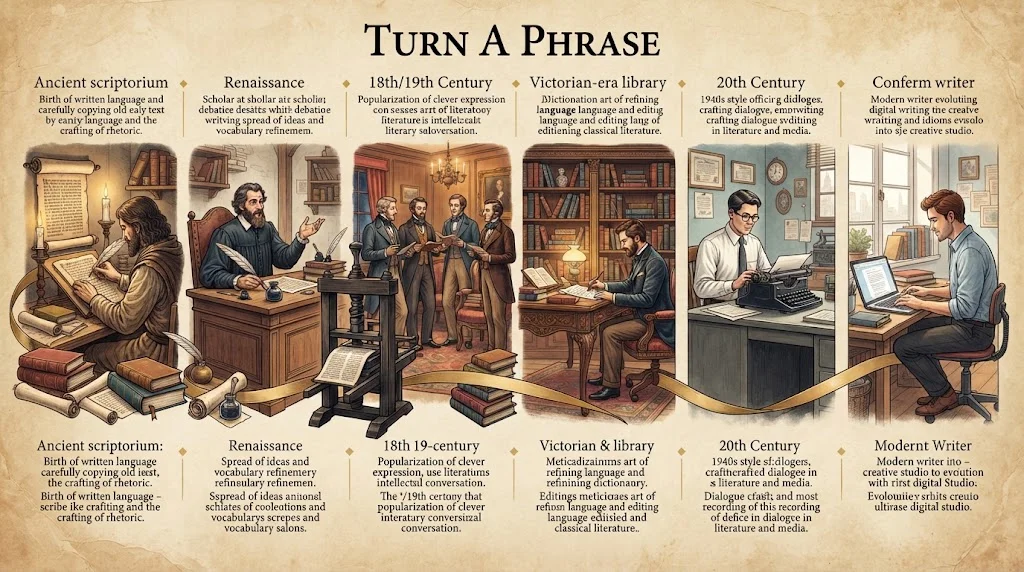
The expression turn a phrase comes from the long-standing English use of the verb turn, meaning to shape, form, or craft something carefully. Writers and speakers have used this sense of turn for centuries to describe the deliberate creation of language that is both accurate and expressive.
The phrase became especially popular during the eighteenth and nineteenth centuries, when literature, public speaking, and formal correspondence placed great value on eloquence. Authors, poets, and politicians were often praised for their ability to “turn a phrase,” meaning they could present familiar ideas in fresh, memorable ways.
Although its roots lie in literary and rhetorical traditions, the expression remains relevant today. Modern journalists, marketers, speechwriters, content creators, and everyday communicators still use it to compliment someone whose wording stands out for its clarity, creativity, or wit. In today’s digital world, where concise and engaging communication is highly valued, turn a phrase continues to represent skillful language rather than simply using sophisticated vocabulary.
Synonyms & Alternatives by Tone
Professional & Neutral Alternatives
- Express it well
- Phrase it effectively
- Communicate clearly
- Put it eloquently
- Articulate the idea
- State it precisely
- Word it carefully
- Convey the message effectively
Polite & Supportive Alternatives
- Say it thoughtfully
- Put it nicely
- Express yourself clearly
- Explain it well
- Present it gracefully
- Choose your words carefully
- Communicate with clarity
- Make your point respectfully
Encouraging & Reassuring
- You explained that beautifully
- You said it perfectly
- That’s a great way to put it
- You captured the idea well
- You expressed it clearly
- That came across really well
- You made the point effectively
- Your wording works well
Casual, Playful & Idiomatic Alternatives
- Have a way with words
- Knack for words
- Put it just right
- Hit the nail on the head
- Nailed the wording
- Said it like a pro
- Worded it perfectly
- Spoke like a natural
When Should You Use “Turn A Phrase”?
The expression turn a phrase works best when you want to recognize or describe someone’s ability to communicate ideas in an engaging, polished, or memorable way. Rather than focusing on what someone says, it highlights how they say it.
Professional Settings
In workplaces, the phrase is useful when complimenting colleagues who write compelling reports, deliver persuasive presentations, or produce clear client communications. It acknowledges strong communication skills without sounding exaggerated.
Examples include:
- Praising a colleague’s presentation after a meeting.
- Recognizing a copywriter’s headline or marketing campaign.
- Complimenting a speechwriter or executive on effective messaging.
- Providing positive performance feedback about written communication.
Casual Conversations
Friends and family often use the phrase lightheartedly after hearing a clever joke, thoughtful observation, or memorable comment. It serves as an appreciative compliment rather than formal praise.
For example, someone might say:
“You always know how to turn a phrase.”
This suggests admiration for the person’s natural ability to express ideas creatively.
Writing, Presentations, and Digital Communication
The phrase frequently appears when discussing:
- Blog articles
- Opinion pieces
- Books
- Newsletters
- Speeches
- Podcasts
- LinkedIn posts
- Marketing copy
- Social media captions
Editors and writers may use it when complimenting language that feels vivid, concise, or memorable.
When It Is Especially Effective
Turn a phrase is particularly effective when:
- You want to compliment communication skills rather than technical expertise.
- Someone has expressed a complicated idea in simple language.
- A sentence is memorable because of its wording.
- You wish to acknowledge creativity without sounding overly emotional.
- You’re discussing writing, journalism, storytelling, or public speaking.
Because the compliment focuses on language itself, it feels thoughtful and specific rather than generic.
When Should You Avoid “Turn A Phrase”?
Although turn a phrase is widely understood among native English speakers, it is not suitable in every context.
Overly Formal Situations
Legal contracts, regulatory documents, academic research papers, and technical manuals prioritize precision over style. Using an idiomatic compliment like turn a phrase may seem unnecessary or overly conversational.
Instead, consider straightforward alternatives such as:
- Expresses ideas clearly
- Uses precise language
- Communicates effectively
Legal, Academic, or Sensitive Contexts
In situations involving legal advice, medical communication, compliance, or crisis management, clarity should always take priority over stylistic expression. Praising wording can unintentionally shift attention away from factual accuracy.
For example, in legal writing, it is more appropriate to discuss clarity, precision, or accuracy than someone’s ability to turn a phrase.
Situations Where Nuance May Be Lost
Not every audience is familiar with English idioms. ESL learners, international clients, or multicultural teams may interpret the phrase literally instead of understanding its figurative meaning.
In global communication, clearer alternatives often work better, such as:
- You explained that clearly.
- That’s well written.
- You communicated the idea effectively.
- Your wording is very effective.
Choosing direct language helps ensure your compliment is immediately understood across cultures.
Is “Turn A Phrase” Professional, Polite, or Casual?
Turn a phrase occupies an interesting middle ground between professional and conversational English. It is neither slang nor highly formal, making it appropriate in many contexts where thoughtful praise is welcome.
Tone Analysis
The expression carries a positive and appreciative tone. It emphasizes linguistic skill, creativity, and effective communication without sounding overly enthusiastic. Because it praises the quality of someone’s wording rather than the person directly, it often feels sincere and measured.
Formality Level
The phrase is generally considered moderately formal. It appears comfortably in:
- Editorial discussions
- Workplace conversations
- Professional networking
- Literary reviews
- Public speaking feedback
- Educational settings
However, it is less common in official reports, contracts, or academic research writing.
Emotional Subtext
When someone says another person can turn a phrase, they imply more than simple competence. The compliment suggests that the speaker values:
- Creativity
- Thoughtfulness
- Intelligence
- Persuasiveness
- Strong writing or speaking ability
It often conveys genuine admiration for communication skills rather than merely acknowledging correctness.
Audience Perception
Most native English speakers interpret a turn of phrase as an educated, respectful compliment. Writers, editors, teachers, journalists, marketers, and professionals are especially likely to recognize and appreciate it.
For broader international audiences, however, simpler alternatives may improve understanding. If immediate clarity is your priority, direct expressions such as express it well or communicate clearly are often more effective while preserving the intended compliment.
Pros and Cons of Using “Turn A Phrase”
Like many idiomatic expressions, turn a phrase has strengths and limitations. Understanding both helps you choose it intentionally rather than using it by habit.
Advantages
Clarity
When used correctly, turn a phrase immediately communicates admiration for someone’s ability to express ideas effectively. Native English speakers generally understand it as praise for communication rather than merely vocabulary.
Efficiency
The expression conveys a complete idea in just a few words. Instead of saying someone consistently uses memorable, elegant, and effective wording, you can simply say they know how to turn a phrase.
Accessibility
Although literary in origin, the phrase remains widely recognized across journalism, education, business, publishing, and everyday conversation. It works well in both spoken and written English.
Potential Drawbacks
Oversimplification
The phrase praises style but does not specify what makes the communication effective. Someone may wonder whether you’re complimenting creativity, clarity, humor, or persuasive ability.
Tone Mismatch
In highly technical, legal, scientific, or regulatory environments, the expression may feel too informal or stylistic. Direct language is often more appropriate when precision is essential.
Repetition
Repeatedly describing every strong communicator as someone who can turn a phrase makes the compliment lose its impact. Rotating among different expressions keeps your feedback more authentic and specific.
Real-Life Examples of “Turn A Phrase” by Context
Emails
“Your client update was excellent. You really know how to turn a phrase while keeping the message clear and professional.”
Meetings
“I liked how you explained the proposal. You have a real talent for turning a phrase that everyone understands.”
Presentations
“The closing line was memorable. You certainly know how to turn a phrase.”
Conversations
“I never would have described it that way; you always know how to turn a phrase.”
Social Media
“Another thoughtful post. You really know how to turn a phrase without making things overly complicated.”
“Turn A Phrase” vs Similar Expressions (Key Differences)
| Phrase | Meaning Difference | Tone Difference | Best Use Scenario |
| Have a way with words | Focuses on overall communication talent rather than one specific expression | Warm, conversational | Complimenting a naturally gifted speaker or writer |
| Put it well | Praises a single statement instead of general language ability | Neutral, professional | Meetings, emails, presentations |
| Express yourself clearly | Emphasizes clarity over creativity | Professional and supportive | Coaching, education, workplace feedback |
| Speak eloquently | Highlights polished spoken communication | Formal and complimentary | Speeches, interviews, public presentations |
| Articulate your thoughts | Focuses on organizing ideas logically | Professional and instructional | Performance reviews, mentoring |
| Choose your words carefully | Suggests thoughtful wording rather than stylistic talent | Neutral and cautionary | Sensitive conversations, negotiations |
Common Mistakes & Misuse of “Turn A Phrase”
Overuse
Because turn a phrase is a distinctive compliment, using it repeatedly can make your feedback sound automatic instead of genuine. Tailoring your praise to the specific situation often feels more meaningful.
Incorrect Context
The phrase should compliment someone’s wording, not simply the accuracy of their information. Saying a financial analyst can turn a phrase may sound odd if you’re discussing data analysis rather than communication.
Contradictory Usage
Avoid pairing the expression with criticism that directly contradicts it.
For example:
❌ “He can really turn a phrase, but his writing is confusing from start to finish.”
If the writing lacks clarity, another compliment may be more appropriate.
Cultural Misunderstandings
Non-native English speakers may interpret turn a phrase literally, imagining someone physically changing words rather than praising communication skill. In multicultural settings, clearer alternatives may reduce confusion.
Psychological Reason People Prefer “Turn A Phrase”
Cognitive Load Reduction
People naturally appreciate language that presents ideas clearly and memorably. Someone who can turn a phrase reduces the effort required to understand complex information.
Trust and Authority Signals
Well-crafted language often creates an impression of expertise. When ideas are expressed smoothly and confidently, audiences are more likely to view the speaker or writer as knowledgeable and credible.
Attention Economy
Modern communication competes for limited attention. Memorable wording helps emails, presentations, articles, and social media posts stand out without becoming overly dramatic.
Modern Communication Habits
Readers increasingly skim content before deciding whether to engage further. Strong phrasing captures attention quickly while making information easier to remember and share.
US vs UK Usage of “Turn A Phrase”
Both American and British English use turn a phrase, and its meaning remains virtually identical across regions.
In the United States, the expression commonly appears in journalism, publishing, education, politics, and professional communication. It is viewed as an intelligent compliment without sounding old-fashioned.
In the United Kingdom, the phrase retains slightly stronger literary associations because of its long history in British writing and public speaking. It is frequently used when discussing authors, columnists, broadcasters, or skilled conversationalists.
Overall, neither region considers the phrase unusual. The main difference lies in frequency rather than meaning, with British speakers sometimes using it in more literary contexts.
“Turn A Phrase” in Digital & Modern Communication
Emails
Managers, editors, and colleagues often use the phrase when recognizing clear writing.
Example:
“You really know how to turn a phrase. That email explained everything without unnecessary detail.”
Slack / WhatsApp
The expression appears naturally in informal workplace conversations.
Example:
“Nice update—you really turned a phrase there.”
Social Media
Content creators frequently receive this compliment when posting thoughtful captions, witty observations, or insightful commentary.
Example:
“You always know how to turn a phrase. Your posts are genuinely enjoyable to read.”
AI-Generated Summaries
As AI-generated content becomes more common, compliments like turn a phrase increasingly distinguish genuinely human writing. Readers often reserve the expression for language that feels original, natural, and emotionally engaging rather than merely grammatically correct.
Linguistic & Communication Insight
Emotional Weight & Subtext
Native English speakers hear more than the literal meaning when someone uses a phrase. The expression implies creativity, intelligence, careful thought, and an appreciation for language itself. It praises not only communication but also the speaker’s ability to make ideas memorable.
Direct vs Indirect Phrasing
Compared with direct compliments such as You explained that clearly, turn a phrase is more indirect and stylistic. It recognizes craftsmanship rather than simply effectiveness.
For example:
- You explained it clearly emphasizes understanding.
- You know how to turn a phrase emphasizes expression.
The first focuses on the outcome, while the second highlights the communicator’s skill.
Professional Communication Perspective
In workplaces, the phrase often functions as high-quality positive feedback. It recognizes employees who simplify difficult concepts, write persuasive reports, or deliver engaging presentations.
Because it praises communication rather than personality, it usually feels professional and constructive.
Pragmatic Reasons for Alternatives
Experienced communicators often choose alternatives depending on their audience.
For instance:
- Express it clearly prioritizes comprehension.
- Put it well offers concise praise.
- Articulate your thoughts encourages improvement.
- Have a way with words sounds warmer and more conversational.
- Communicate effectively suits formal business settings.
Selecting the right phrase helps reduce ambiguity while matching the tone expected by the audience.
Social Signaling
Language choices communicate identity as well as information. Using a turn of phrase signals an appreciation for thoughtful writing and effective communication. It often reflects familiarity with literature, journalism, or professional writing without sounding pretentious.
At the same time, choosing simpler alternatives may signal inclusiveness when speaking to international audiences or people unfamiliar with English idioms.
Tone & Context Guidance
The expression works best when genuinely recognizing someone’s communication skills, particularly after a presentation, article, speech, or conversation that stands out because of its wording. It is less appropriate in highly technical documentation, legal writing, or situations where clarity for a global audience outweighs stylistic expression. Matching the phrase to your audience ensures the compliment feels sincere, understandable, and well judged.
Have a Way with Words
Meaning: This phrase describes someone who naturally communicates in an engaging, persuasive, or memorable way. It recognizes consistent skill in speaking or writing rather than a single well-crafted sentence.
Why This Phrase Works: It feels genuine and personal while praising overall communication ability instead of one specific expression.
Real-World Usage Insight: Managers, teachers, editors, and friends often use it to compliment people whose language leaves a lasting impression.
Best Use: Performance reviews, creative writing feedback, speeches, everyday compliments.
Avoid When: You need to praise one specific sentence rather than someone’s general communication style.
Tone: Warm, complimentary, conversational.
US vs UK Usage: Common and well understood in both American and British English.
Example (Meeting): “Sarah has a real way with words. Her explanation made a complicated proposal easy for everyone to understand.”
Put It Well
Meaning: This expression praises someone for expressing a particular idea clearly and effectively.
Why This Phrase Works: It is concise, professional, and appropriate in nearly every communication setting.
Real-World Usage Insight: Frequently heard in meetings, interviews, classrooms, and workplace discussions after someone makes an insightful point.
Best Use: Professional discussions, presentations, emails, feedback sessions.
Avoid When: You want to praise someone’s long-term communication skills rather than one comment.
Tone: Neutral, respectful, professional.
US vs UK Usage: Equally common in both regions.
Example (Meeting): “You put it well when you explained how customer feedback should guide the product roadmap.”
Express It Clearly
Meaning: This phrase emphasizes making ideas easy for others to understand without unnecessary complexity.
Why This Phrase Works: It focuses on clarity, one of the most valued qualities in modern communication.
Real-World Usage Insight: Common in coaching, education, business writing, and international communication.
Best Use: Workplace coaching, presentations, instructional writing, client communication.
Avoid When: Creativity or stylistic elegance is more important than clarity.
Tone: Professional, supportive, encouraging.
US vs UK Usage: Widely used in both American and British English.
Example (Email): “Thanks for revising the report. You expressed the recommendations clearly, making them much easier to follow.”
Phrase It Effectively
Meaning: This alternative highlights choosing wording that communicates the intended message accurately and appropriately.
Why This Phrase Works: It encourages thoughtful communication without sounding overly critical or formal.
Real-World Usage Insight: Often used during editing, mentoring, and collaborative writing projects.
Best Use: Editing documents, presentation preparation, workplace feedback.
Avoid When: The audience expects casual or conversational language.
Tone: Professional, constructive, neutral.
US vs UK Usage: Common in both countries, especially in business environments.
Example (Email): “I think you’ve phrased it effectively. The revised introduction sounds much more persuasive.”
Articulate the Idea

Meaning: This phrase means expressing thoughts in a logical, organized, and understandable way.
Why This Phrase Works: It emphasizes both clarity and structured thinking, making it valuable in professional communication.
Real-World Usage Insight: Managers and educators frequently use it when encouraging stronger communication skills.
Best Use: Performance reviews, interviews, presentations, mentoring.
Avoid When: Complimenting creative or humorous wording rather than a logical explanation.
Tone: Professional, encouraging, analytical.
US vs UK Usage: Equally accepted in the United States and the United Kingdom.
Example (Meeting): “You articulated the idea so clearly that everyone agreed on the next steps almost immediately.”
Word It Carefully
Meaning: This expression encourages selecting language thoughtfully, especially when accuracy or sensitivity matters.
Why This Phrase Works: It balances precision with diplomacy, reducing the chance of misunderstanding.
Real-World Usage Insight: Common during negotiations, customer communication, and discussions involving sensitive topics.
Best Use: Client emails, HR conversations, public statements, negotiations.
Avoid When: Informal conversations where spontaneity is more appropriate.
Tone: Careful, professional, considerate.
US vs UK Usage: Frequently used in both American and British English.
Example (Email): “Let’s word this carefully so the client understands the delay without feeling overlooked.”
Put It Eloquently
Meaning: This phrase compliments someone for expressing an idea gracefully and with refined language.
Why This Phrase Works: It acknowledges both clarity and elegance without exaggerating the compliment.
Real-World Usage Insight: Often heard after speeches, presentations, interviews, and published writing.
Best Use: Literary discussions, keynote speeches, executive presentations, formal compliments.
Avoid When: Everyday conversations where the compliment may sound overly formal.
Tone: Elegant, respectful, sophisticated.
US vs UK Usage: Slightly more common in literary or academic settings in both regions.
Example (Presentation): “You put it eloquently during your closing remarks, and the audience responded immediately.”
Communicate Clearly
Meaning: This alternative emphasizes delivering information so that others understand it quickly and accurately.
Why This Phrase Works: It focuses on practical communication rather than stylistic flair, making it suitable across industries.
Real-World Usage Insight: Frequently used in leadership training, customer service, education, and business communication.
Best Use: Workplace coaching, professional development, presentations, documentation.
Avoid When: You specifically want to praise creativity or memorable wording.
Tone: Direct, professional, supportive.
US vs UK Usage: Extremely common in both the US and the UK across professional and educational contexts.
Example (Meeting): “Our goal is to communicate clearly so every team understands the project timeline without additional clarification.”
Conclusion
The phrase Turn A Phrase remains one of the most effective compliments for recognizing someone’s ability to communicate with style, clarity, and impact. While its literary roots give it a timeless quality, it continues to fit naturally in today’s workplace, classrooms, digital communication, and everyday conversations. Understanding when to use this expression—and when a simpler alternative may be more appropriate—helps you tailor your language to your audience and purpose. Whether you’re writing emails, delivering presentations, creating content, or improving your English fluency, choosing the right wording can strengthen your message and build credibility.
The alternatives covered in this guide provide flexible options for professional, casual, and supportive situations, allowing you to express appreciation or give feedback more naturally. Ultimately, great communication is not about using complicated words; it’s about selecting language that is clear, engaging, and meaningful. Mastering Turn A Phrase and its best alternatives will help you communicate with greater confidence, precision, and authenticity.
FAQs
What does “Turn A Phrase” mean?
Turn A Phrase means expressing an idea in a clever, elegant, or memorable way. It is usually used as a compliment for someone who communicates effectively through speaking or writing. Rather than focusing on the message itself, it recognizes the skill and creativity behind the choice of words and how they make ideas more engaging or impactful.
Is “Turn A Phrase” considered professional?
Yes, Turn A Phrase is generally considered moderately professional. It is appropriate in workplaces, editorial discussions, presentations, and educational settings when complimenting someone’s communication skills. However, in highly technical, legal, or scientific documents, more direct expressions like “communicates clearly” or “expresses ideas effectively” may be more suitable.
Is “Turn A Phrase” an idiom?
Yes. Turn A Phrase is an English idiomatic expression because its figurative meaning differs from its literal words. It doesn’t refer to physically turning words but instead describes the ability to express ideas in a particularly effective, elegant, or memorable manner.
When should I use “Turn A Phrase”?
Use Turn A Phrase when complimenting someone’s writing, speech, presentation, article, social media post, or conversation. It is especially effective when you want to recognize skillful wording rather than simply agreeing with the content of what someone has said.
What are the best alternatives to “Turn A Phrase”?
Some of the strongest alternatives include Have a Way with Words, Put It Well, Express It Clearly, Communicate Clearly, Phrase It Effectively, Articulate the Idea, Put It Eloquently, and Word It Carefully. The best choice depends on your audience, level of formality, and communication goals.
Is “Turn A Phrase” common in American and British English?
Yes. The phrase is widely understood in both the United States and the United Kingdom. American English often uses it in journalism, business, and education, while British English also retains its literary and rhetorical associations. The meaning remains consistent across both varieties of English.
Can I use “Turn A Phrase” in business emails?
Absolutely. It works well when complimenting a colleague’s report, proposal, presentation, or written communication. For example, saying, “You really know how to turn a phrase,” is a thoughtful way to acknowledge someone’s ability to communicate ideas effectively while maintaining a professional tone.
Why do native English speakers use “Turn A Phrase”?
Native speakers often use Turn A Phrase because it praises communication skills in a nuanced and meaningful way. It recognizes creativity, precision, and clarity simultaneously, making it a more distinctive compliment than simply saying someone writes or speaks well.
Can ESL learners use “Turn A Phrase” naturally?
Yes. ESL learners can confidently use Turn A Phrase once they understand its figurative meaning. It is most appropriate when complimenting someone’s language or writing skills. Learning this idiom also helps learners sound more natural and understand compliments commonly used by native English speakers.
Does “Turn A Phrase” improve writing?
While simply using the expression won’t improve writing, understanding what it represents certainly can. Writers who focus on clarity, precision, rhythm, and memorable wording naturally become better at communicating. Developing the ability to “turn a phrase” is ultimately about expressing ideas in ways that readers easily understand and remember.


