
You’re finishing a quarterly review and reach the line about a teammate’s latest report. “Honestly, it was pretty run of the mill” pops into your head, and you can already picture it landing flat, maybe a little cutting. Run of the mill means ordinary or average, with nothing that makes it stand out. That’s a fair description, but the phrase carries a shrug that can sting. Choosing a different word lets you say the same thing honestly while sounding fair, clear, and professional.
What does “run of the mill” actually mean?
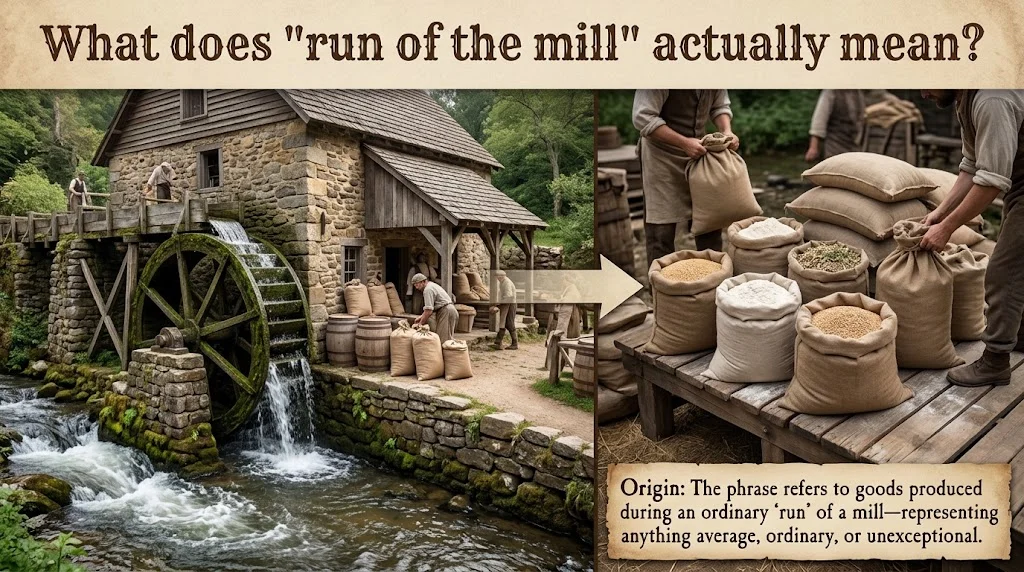
Something may seem ordinary or average, without any special qualities that make it stand out. In everyday English, run-of-the-mill describes things that are typical, common, or unremarkable. It is usually used as a hyphenated adjective before a noun, such as a run-of-the-mill meeting, and can suggest mild disappointment rather than outright criticism.
The intent behind it is usually to say “nothing surprising here.” People reach for it to describe a movie that was fine but forgettable, a product that does the job without charm, a day at work where nothing happened, or a candidate whose résumé looks like the previous ten. It can be neutral (“just a run-of-the-mill software update”) or quietly negative (“a run-of-the-mill pitch”). The same words, two very different feelings, which is exactly why context and delivery matter.
Where did the phrase come from?
Nobody can point to a single verified first use, so treat any tidy story with caution. The most common explanation is that it comes from the ordinary output of a mill, meaning goods that came off the line as they were, before anything was sorted into better or worse grades. A close cousin, “run of the mine,” has been linked to coal and ore taken straight from the mine without screening, and some writers think the two expressions influenced each other. Others simply read “run” as “the usual course” of something. None of these theories is settled. [Editor: verify with a reputable etymology source, such as the Oxford English Dictionary or Merriam-Webster, before adding dates or first citations.
What matters today is the leftover sense of “unselected, unsorted, nothing picked out as special.” That’s why the phrase still feels a bit dismissive: it implies no one chose this item for being good.
Twenty replacements, sorted by tone
Professional and Neutral
- Standard
- Ordinary
- Typical
- Conventional
- Unremarkable
Polite and Supportive
- Serviceable
- Solid
- Dependable
- Straightforward
- Reliable
Encouraging and Reassuring
- Tried-and-true
- Decent
- Workable
- Perfectly fine
- Steady
Casual and Playful
- Plain vanilla
- Garden-variety
- Bog-standard
- Nothing special
- Nothing to write home about
When does it fit naturally?
It works best in relaxed, spoken settings where you’re describing something and nobody’s feelings are on the line. Think of a chat with a coworker about a webinar, a casual review of a restaurant, or a quick aside in a team meeting about a routine bug fix.
In writing, it suits blog posts, newsletters, and opinion pieces with a conversational voice. In presentations, it can be handy when you want to contrast ordinary with exceptional (“Most onboarding emails are run-of-the-mill. Ours is built around one question.”). It works because the contrast gives the phrase a job. It fits least well when you’re describing a person’s work, effort, or product directly to them.
When should you steer clear?
Avoid it anywhere precision or sensitivity matters.
- Formal or legal writing: Contracts, policies, and compliance documents need defined terms. Use “standard,” “customary,” or “typical,” and say what the baseline is.
- Academic writing: It’s an evaluative idiom with no measurable meaning. Try “conventional,” “unremarkable,” or describe the actual feature, such as “consistent with prior findings.”
- Feedback on someone’s work: Calling a colleague’s effort run of the mill can feel like a verdict on them. Say “solid,” then name what would take it further.
- Sensitive moments: Never use it about a person’s illness, loss, creative project, or milestone. “It’s a common situation, and here’s what usually helps” does the job.
- Multilingual audiences: Idioms can confuse readers who learned English as a second language. Plain words travel better.
How formal is it, and what tone does it carry?
It sits in the middle of the formality scale: acceptable in business conversation, a little loose for formal documents. The emotional subtext leans mildly negative or lukewarm. It rarely insults, but it seldom flatters.
Audience perception depends on what you’re describing. About a routine task or a generic product, it sounds honest and unbothered. About a person, an idea someone just pitched, or a result someone worked hard on, it can sound dismissive or bored. A fair verdict: neutral for things, cool for people, and risky when the listener has a stake.
Is it worth using? Pros and cons
Advantages
- It’s quick and widely understood, so you rarely need to explain it.
- It conveys “average, with no surprises” in a single memorable chunk.
- It sounds natural in speech, which makes writing feel less stiff.
- It’s useful for setting up contrast with something excellent.
Drawbacks
- It’s vague. It doesn’t tell the reader why something is ordinary or what’s missing.
- It can come across as dismissive, especially when applied to someone’s work.
- It’s easy to overuse, and repeated use makes writing sound jaded.
- It’s an idiom, so it can trip up non-native readers and translation tools.
Run-of-the-mill in real life: examples by context
Email. Writing to a vendor after reviewing a proposal: “The pricing is in line with what we’ve seen elsewhere, so I’d call it run-of-the-mill. Can you tell us what sets your onboarding apart?”
Meeting. Discussing a routine release: “This sprint is pretty run-of-the-mill, just bug fixes and one small UI tweak, so I’ll keep the update short.”
Presentation. Opening a talk on customer support: “Most help centers are run-of-the-mill. They answer the question you asked and nothing else. We wanted ours to answer the next question too.”
Conversation. Over lunch, about a film: “It wasn’t bad, just run-of-the-mill. I’d forgotten the plot by the time I got home.”
Social media. A caption on a coffee photo: “Run-of-the-mill Tuesday latte, but the foam art is doing its best.”
[Editor: swap in one or two real examples from your own work or readers for credibility.]
How it compares with similar expressions
| Phrase | Meaning Difference | Tone Difference | Best Use Scenario |
| Run of the mill | Ordinary, nothing sets it apart | Mildly dismissive or flat | Casual remarks about routine things |
| Average | Sits in the middle of a range, often measurable | More neutral and factual | Data, ratings, comparisons |
| Mediocre | Not good enough; below expectations | Clearly negative | Honest criticism, when you mean it |
| Middle-of-the-road | Moderate, avoiding extremes | Neutral, sometimes mildly critical | Describing styles, opinions, or products |
| Generic | Lacking individual character or branding | Slightly critical | Products, designs, templates, copy |
| Garden-variety | Common and unexceptional | Casual, a little wry | Everyday problems or objects |
Takeaway. “Average” states a position, “mediocre” passes a judgment, and “run of the mill” sits between them with a shrug. If you want to be fair and specific, “average” or “typical” is safer. If you mean to criticize, “mediocre” is more honest than hiding behind a softer idiom. Save “run of the mill” for moments when the shrug is exactly what you want.
Mistakes people make with it
- Using it as praise. Some writers treat it as “reliable,” but listeners often hear “boring.” Fix: Use “solid” or “dependable” if you mean it as a compliment.
- Aiming it at a person. “Your idea is run of the mill” stings. Fix: Describe the idea, not the person: “This is a familiar approach. What could make it ours?”
- Overusing it in one piece. Three uses in an article make the writer sound unimpressed by everything. Fix: Vary it with “standard,” “typical,” or a concrete detail.
- Dropping hyphens before a noun. “A run of the mill report” looks off. Fix: Hyphenate before a noun (“a run-of-the-mill report”), leave it open after (“the report was run of the mill”).
- Using it where idioms don’t travel. A multinational audience may not know it. Fix: Use “ordinary” or “typical.”
- Mixing messages. “It was run of the mill, but I loved it” confuses people. Fix: Say “It was simple, and I loved that about it.”
Do Americans and Brits use it differently?

Both varieties of English understand and use “run of the mill,” and I wouldn’t claim a big difference in how common it is: usage varies by speaker and context. The clearer regional differences are among the alternatives. “Bog-standard” is distinctly British and would sound unfamiliar or odd to many Americans. “Garden-variety” is understood on both sides of the Atlantic, though in my experience it’s often associated with American speech; usage varies. “Plain vanilla” is widely understood in both. [Editor: confirm with a corpus tool or usage guide before making any popularity claims.
How it plays in email, Slack, WhatsApp, and social media
Short messages strip away tone, so the phrase’s shrug can look sharper than intended.
- Email: Read more carefully and by more people. Skip it in feedback or anything that might get forwarded.
- Slack or Teams: Fine for quick, low-stakes chatter. Risky in a public channel about a colleague’s work, where it can read as public criticism.
- WhatsApp or text: Friendly and casual among friends, and often paired with emoji that soften it.
- Social media: Works as a self-aware, wry caption. As a reply to someone’s post, it can sound like a jab, so add specifics or choose “solid.”
When in doubt, add a concrete detail: “Pretty standard setup, nothing wrong with it” reads warmer than the phrase alone.
What listeners really hear
To most native speakers, “run of the mill” carries a small sigh. It signals “no spark,” not “bad.” That’s a subtle but important difference, and it explains why people can be touchy about it. Nobody wants their work to sound like the pile that came off the line unchosen.
It’s also an indirect phrase. It hints at a judgment without saying what you wanted instead. In a workplace, that vagueness can make listeners defensive: they don’t know whether you’re mildly unimpressed or quietly writing them off, so they fill in the worst version. Experienced communicators often swap it for something more direct, like “This meets the brief. To stand out, we’d need X,” because specific feedback builds trust and gives people something to act on.
Quick cues
- Safe: talking about objects, routines, or situations; casual chat; setting up a contrast; when no one involved has a stake.
- Risky: feedback on someone’s work; first impressions of a pitch; anything written that may be forwarded; formal or multilingual settings.
Quick answers
What does run of the mill mean? It means ordinary or average, with nothing special about it. It’s often a little dismissive.
Is “run of the mill” rude? Not usually, but it can sound dismissive when applied to a person’s work or ideas. Context and tone decide.
Is it hyphenated? Hyphenate it before a noun (“a run-of-the-mill day”). After a verb, leave it open (“the day was run of the mill”).
What’s a more polite alternative? “Solid,” “serviceable,” “straightforward,” or “decent” all convey “not exceptional” without the sting.
Is it formal enough for business writing? It’s acceptable in conversational business writing, but for reports, contracts, or formal reviews, “standard,” “typical,” or “conventional” are safer.
What’s the British equivalent? “Bog-standard” is the distinctly British casual equivalent, though “run of the mill” is also used in the UK.
Standard
Meaning: Conforming to an established norm or expected level.
Why It Works: It describes ordinary without any judgment, which makes it the safest direct swap in most sentences.
Real-World Usage Insight: Product specs, policies, and process documents lean on it constantly because it signals “what you’d expect” rather than “disappointing.”
Best Use: Describing procedures, features, rates, or equipment that follow the usual pattern.
Avoid When: You want to convey that something is bland or uninspired; “standard” won’t carry that.
Tone: Neutral and businesslike.
US vs UK Usage: Common in both; no meaningful difference that I’m confident about.
Example: In a procurement email: “The contract includes our standard 30-day payment terms, so no changes needed on your side.”
Ordinary
Meaning: Not unusual, special, or different from what you’d normally find.
Why It Works: It’s the closest plain-English twin of the original and is understood by nearly everyone, including non-native speakers.
Real-World Usage Insight: It can be warm (“an ordinary Tuesday”) or flat (“an ordinary pitch”) depending on what follows it.
Best Use: Everyday descriptions of days, people, settings, or objects where “normal” is the point.
Avoid When: Giving feedback on someone’s effort, since “ongoing ordinary” sounds like a verdict.
Tone: Neutral, occasionally cool.
US vs UK Usage: Usage varies little; it’s standard in both.
Example: In a group chat: “Nothing dramatic happened, just an ordinary day of back-to-back calls.”
Typical
Meaning: Showing the usual features of a certain type of person, thing, or situation.
Why It Works: It leans on comparison rather than quality, so it informs without evaluating.
Real-World Usage Insight: Handy in reports and analysis (“a typical customer”) because it implies a pattern you could actually check.
Best Use: Setting expectations, describing patterns, or reassuring someone that their situation is common.
Avoid When: Describing a single remarkable item; calling it typical may unintentionally undersell it.
Tone: Neutral and factual.
US vs UK Usage: Both use it freely.
Example: During a client call: “A typical rollout takes about six weeks, though yours could move faster since your data is clean.”
Unremarkable
Meaning: Not special enough to be noticed or commented on.
Why It Works: It keeps the cool, slightly flat note of the original while sounding more composed and written.
Real-World Usage Insight: Reviewers and analysts like it because it criticizes gently, with a raised eyebrow rather than a shrug.
Best Use: Reviews, assessments, and written commentary that need to sound measured.
Avoid When: The person you’re describing will read it. “Unremarkable” is honest but can sting.
Tone: Formal-leaning, mildly negative.
US vs UK Usage: Used in both; usage varies by writer rather than region.
Example: In a design review note: “The layout is unremarkable, which is fine for a utility screen, but the landing page needs more personality.”
Conventional
Meaning: Following accepted methods, styles, or ideas.
Why It Works: It focuses on adherence to tradition or custom rather than lack of quality.
Real-World Usage Insight: In strategy and academic writing, it is the go-to contrast with “innovative.”
Best Use: Formal writing, comparisons of methods, or describing traditional approaches.
Avoid When: Chatting casually; it can sound stiff.
Tone: Formal and slightly analytical.
US vs UK Usage: Common in both; no difference I can verify.
Example: In a grant proposal: “Conventional screening methods miss early-stage cases; our approach adds a second test.”
Serviceable
Meaning: Good enough to do the job, though not impressive.
Why It Works: It acknowledges the thing works, which makes “not exciting” feel fair instead of dismissive.
Real-World Usage Insight: Editors and reviewers use it as polite shorthand for “functional, no frills.” Some people still hear faint praise in it.
Best Use: Describing tools, drafts, or designs that do what they must.
Avoid When: Giving feedback to someone sensitive about their work; the damning-with-faint-praise reading is real.
Tone: Polite, measured, mildly understated.
US vs UK Usage: Understood on both sides; usage varies.
Example: In a code review: “The script is serviceable as it stands. Let’s refactor once we know how often it’ll run.”
Solid
Meaning: Reliably good, well made, and dependable, though not necessarily exceptional.
Why It Works: It turns “nothing special” into a compliment about steadiness, which is usually what the other person needs to hear.
Real-World Usage Insight: Managers lean on it in feedback because it reads as respect. It does, however, sometimes read as a ceiling if every review says “solid.”
Best Use: Praising work that meets a high bar without being a standout.
Avoid When: The person is hoping for “excellent”; pair it with specifics so it doesn’t feel like a brush-off.
Tone: Warm, supportive, professional.
US vs UK Usage: Common in both.
Example: In a Slack reply to a teammate: “Solid draft. The intro is clear. I’d tighten the second section, and it’s ready.”
Straightforward
Meaning: Simple and uncomplicated, with no hidden difficulty.
Why It Works: It reframes “ordinary” as a strength: easy to follow, easy to do, no surprises.
Real-World Usage Insight: Great for processes and instructions, where “plain” is exactly what people want.
Best Use: Describing tasks, explanations, or processes that are easy and clear.
Avoid When: The thing is meant to be creative or distinctive, where “straightforward” can sound like “uninspired.”
Tone: Friendly, practical, neutral.
US vs UK Usage: Both use it equally as far as I know.
Example: In an onboarding email: “Setup is straightforward: install the app, sign in, and you’re done.”
Tried-and-true

Meaning: Proven reliable through repeated use.
Why It Works: It converts “unexciting” into “tested,” which is a real selling point.
Real-World Usage Insight: Common in recipes, advice, and marketing, where familiarity builds trust. Some listeners may hear “older method.”
Best Use: Recommending methods, recipes, or tools that have a track record.
Avoid When: You’re pitching something new or innovative; it can undercut your message.
Tone: Warm, reassuring, a little homespun.
US vs UK Usage: Understood in both; usage varies.
Example: In a team meeting: “Let’s stick with the tried-and-true checklist for this launch and save experiments for the next one.”
Decent
Meaning: Of acceptable quality, fairly good.
Why It Works: It’s short, friendly, and honest, with a gentle positive lean.
Real-World Usage Insight: Tone depends heavily on delivery. A warm “that’s decent” is encouraging, while a flat one signals mild letdown.
Best Use: Informal reviews, quick assessments, and encouraging a work in progress.
Avoid When: The person expected strong praise; “decent” can feel like a cooled-off compliment.
Tone: Casual, mildly positive.
US vs UK Usage: Common in both; the casual “decent” (as in “a decent pub”) is, in my experience, heard a lot in British speech, though usage varies.
Example: In a WhatsApp message: “Tried the new ramen place near the office. Decent broth, big portions, I’d go back.”
Workable
Meaning: Capable of being used or carried out successfully.
Why It Works: It speaks to practicality, giving the listener the sense that things can move forward.
Real-World Usage Insight: Often used for plans, drafts, and compromises where perfection isn’t the goal.
Best Use: Responding to ideas, plans, or timelines that aren’t perfect but will do.
Avoid When: Praising finished creative work; “workable” suits plans better than art.
Tone: Pragmatic, calm, encouraging.
US vs UK Usage: Both use it; no difference I can confirm.
Example: In a planning meeting: “That schedule is workable if design signs off by Wednesday.”
Conclusion
Run of the mill describes something ordinary, with nothing that sets it apart, and it usually carries a faint shrug. That small bit of coolness is the whole story. Aimed at a routine task, a generic product, or an uneventful day, it sounds relaxed and honest. Aimed at a person or their effort, it can sound like a dismissal.
So the choice comes down to your audience and the stakes. In casual talk, go ahead. In formal writing, reviews, or anything someone will read about their own work, reach for a replacement that fits: standard or typical for neutral facts, solid or serviceable for kind but honest feedback, garden-variety or plain vanilla for a lighter touch.
Here is a tip you can use today: before you send, ask whether the person on the other end has something riding on it. If so, swap the idiom for a specific detail about what works and what would lift it. Precision almost always lands better than a shrug.
FAQs
What does “run of the mill” mean?
It means ordinary, average, or typical, with nothing special to make it stand out. The phrase is usually hyphenated before a noun, as in a run-of-the-mill meeting. People often use it with a slight shrug, so it can sound neutral when describing routine things and mildly disappointed when describing something they had hoped would be better.
Is “run of the mill” rude?
Not usually, but it can feel dismissive depending on what it describes. Said about a routine task or a generic product, it is mild. Said about a person, an idea they pitched, or work they cared about, it can sound like a put-down. Listeners with something at stake tend to hear the criticism more strongly than the speaker intended.
Is “run of the mill” professional enough for work?
In casual workplace conversation, it is acceptable, but it is too loose for formal documents. In meetings or chat, describing a routine task as run of the mill is fine. In reports, reviews, or contracts, words like standard, typical, or conventional are safer because they sound neutral and carry no real hint of judgment about anyone’s hard work.
What are good alternatives to “run of the mill”?
Standard, typical, and ordinary work for neutral situations, while solid, serviceable, and straightforward suit kind but honest feedback. For a lighter tone, garden-variety, plain vanilla, and nothing special fit casual chat among friends. Bog-standard is a blunt British option. The right choice depends on whether you want to inform, encourage, or joke, and on who is actually listening.
Can I use “run of the mill” in an email?
Yes, but only when the email is informal and nobody’s work is being judged. It works in a friendly note about a routine update. Avoid it in feedback, proposals, or anything likely to be forwarded, since the lukewarm tone can read as criticism. Adding a concrete detail, such as what is missing, makes the message clearer and kinder.
Is “run of the mill” used differently in the US and UK?
Both American and British speakers understand and use it, though no firm regional difference in how common it is can be confirmed. The differences show up in related slang: bog-standard is distinctly British, while garden-variety is understood in both places but often linked with American speech. Plain vanilla is widely understood on both sides of the Atlantic.
What is the biggest mistake people make with “run of the mill”?
The most common mistake is using it as praise or aiming it at a person. Some writers mean reliable, but listeners often hear boring. Saying someone’s idea is run of the mill can sting. A better approach is to describe what the idea does instead, or use solid when you mean it as a compliment, and add specifics.
Is “run of the mill” hyphenated?
Hyphenate it when it comes before a noun, as in a run-of-the-mill report. When it follows a verb, leave the words separate: the report was run of the mill. Leaving out the hyphens before a noun looks slightly off to many readers, so a quick check before publishing is worthwhile, especially in headlines or client-facing copy.
Where does “run of the mill” come from?
Its exact origin is not firmly established. A common explanation links it to the ordinary, unsorted output of a mill, and a related phrase, run of the mine, may have influenced it. Other theories read run as the usual course of things. Because no first use has been verified, any specific date or inventor should be treated with caution.
What tone does “run of the mill” convey?
Mildly lukewarm: the phrase suggests something is not bad but not impressive either. It sits in the middle of the formality scale, fine in conversation and a bit loose in formal writing. Directed at objects or routines, it sounds neutral, while directed at people it can sound cool or bored, which is why context and audience matter.


