

Imagine you’re preparing for an important job interview. Your documents are scattered across different folders, your presentation isn’t finished, and your schedule is full of last-minute changes. A colleague tells you, “You should get your ducks in a row before tomorrow.” In that moment, they are encouraging you to become organized and prepared before taking the next step.
The phrase “Get Your Ducks In A Row” is widely used in everyday English to remind someone to organize tasks, plans, resources, or priorities before acting. Whether you’re managing a business project, planning a move, studying for exams, or coordinating a team, this expression communicates the importance of preparation simply and memorably.
Because it is an idiom, however, it may not always be the best choice for every audience or situation. Professional communication, academic writing, international workplaces, and conversations with ESL learners often benefit from clearer or more neutral alternatives. Understanding its meaning, tone, and suitable replacements helps you communicate with greater confidence, professionalism, and precision.
What Does “Get Your Ducks In A Row” Mean?
Get Your Ducks In A Row means to organize tasks, plans, resources, or responsibilities before taking action. The phrase refers to preparing everything in a logical order so work can proceed efficiently, reducing confusion, mistakes, or unnecessary delays in personal, professional, and everyday situations.
Origin & History of “Get Your Ducks In A Row”
The exact origin of “Get Your Ducks In A Row” is uncertain, but language historians generally agree that it emerged in American English during the early twentieth century. Several explanations have been suggested, although none has been proven.
One popular theory connects the phrase to mother ducks leading their ducklings in a neat, orderly line. Observing ducklings following one another in sequence naturally created an image of organization, preparation, and orderly movement. This visual association made the expression easy to understand and remember.
Another theory points to carnival or fairground duck-shooting games. Before each round began, operators reportedly arranged mechanical ducks into position, meaning everything needed to be properly organized before play could start. Although this explanation is widely repeated, historical evidence remains limited.
Some researchers also believe the phrase developed from everyday observations rather than a single event. Since ducks naturally travel together in an organized line, the expression may simply have evolved as a metaphor for having everything prepared before moving forward.
Over time, the meaning expanded beyond physical organization. Today, “Get Your Ducks In A Row” commonly refers to organizing schedules, finances, documents, business strategies, personal goals, or project plans. It appears frequently in workplaces, educational settings, media, and casual conversations because it conveys preparation in a friendly, approachable way.
Its lasting popularity reflects a universal communication need: people value expressions that encourage planning before action. Although modern workplaces increasingly prefer more direct wording such as “prepare thoroughly” or “organize your priorities,” this idiom remains one of the most recognizable ways to express readiness in English.
Synonyms & Alternatives by Tone
Professional & Neutral Alternatives
- Get organized
- Prepare everything
- Put everything in order
- Organize your priorities
- Finalize your preparations
- Ensure everything is ready
- Complete the groundwork
- Arrange everything properly
- Prepare in advance
- Have everything prepared
Polite & Supportive Alternatives
- Take some time to prepare
- Make sure everything is ready
- Plan things carefully
- Get everything sorted
- Put things in order
- Double-check your preparations
- Make a clear plan
- Stay organized
- Set everything up first
- Be well prepared
Encouraging & Reassuring
- You’re on the right track
- Take it one step at a time
- Build a solid plan
- Get everything lined up
- Prepare with confidence
- Set yourself up for success
- Focus on the essentials first
- Create a strong foundation
- Stay one step ahead
- Get ready before you begin
Casual, Playful & Idiomatic Alternatives
- Get your act together
- Line everything up
- Have all your bases covered
- Get everything squared away
- Put your house in order
- Tie up loose ends
- Get everything sorted
- Button everything up
- Get your stuff together
- Be ready to roll
When Should You Use “Get Your Ducks In A Row”?
The phrase works best when the main goal is to encourage preparation before taking action. It is especially useful when someone needs to organize information, resources, or responsibilities to improve efficiency and reduce mistakes.
Professional Settings
Managers, colleagues, and project leaders often use the expression when discussing planning, deadlines, budgets, or project readiness. It encourages organization without sounding overly critical, especially in informal workplace conversations.
Examples include:
- Preparing for a product launch.
- Organizing project documentation.
- Completing required approvals.
- Planning a client presentation.
- Coordinating team responsibilities.
In highly formal business writing, however, direct alternatives such as “complete the preparations” or “ensure all requirements are met” are usually more appropriate.
Casual Conversations
Friends and family frequently use the phrase when discussing everyday responsibilities.
Common situations include:
- Planning a vacation.
- Preparing for an exam.
- Organizing a wedding.
- Moving to a new home.
- Starting a new job.
- Managing household finances.
Here, the idiom sounds supportive rather than demanding.
Writing, Presentations, and Digital Communication
The phrase appears naturally in:
- Business blogs
- Productivity articles
- Leadership presentations
- Career advice
- Team newsletters
- Internal company messages
- LinkedIn posts
- Productivity podcasts
Because many readers instantly recognize the expression, it communicates preparation efficiently while keeping the tone conversational.
When It Is Especially Effective
The phrase is particularly effective when:
- Multiple tasks need coordination.
- Preparation directly affects success.
- Organization prevents future problems.
- Teams need a simple reminder to plan.
- The audience appreciates conversational language.
- You want advice to sound encouraging instead of commanding.
When Should You Avoid “Get Your Ducks In A Row”?
Although widely understood, the phrase is not suitable for every communication setting.
Overly Formal Situations
Formal reports, contracts, policy documents, executive summaries, and government communications generally benefit from literal language instead of idioms.
Instead of:
“Please get your ducks in a row before submission.”
Consider:
“Please ensure all required documentation is complete before submission.”
Legal, Academic, or Sensitive Contexts
Legal documents, research papers, compliance reports, healthcare communication, and financial regulations require precise wording. Idioms may introduce unnecessary ambiguity, particularly for international audiences.
Situations Where Nuance May Be Lost
The phrase may also be less effective when communicating with:
- ESL learners unfamiliar with English idioms.
- International business partners.
- Clients who prefer direct language.
- Highly technical audiences.
- Individuals experiencing stress or crisis, where empathy and clarity matter more than figurative language.
In these cases, straightforward alternatives improve understanding and reduce the chance of misinterpretation.
Is “Get Your Ducks In A Row” Professional, Polite, or Casual?
The phrase occupies a middle ground between casual conversation and professional communication.
Tone Analysis
Its overall tone is:
- Friendly
- Practical
- Encouraging
- Slightly conversational
- Moderately informal
It motivates preparation without sounding harsh or authoritarian.
Formality Level
The idiom is generally considered:
- Suitable for casual conversations.
- Appropriate for informal workplace discussions.
- Acceptable in presentations and blogs.
- Less appropriate for legal or highly formal documents.
Emotional Subtext
Native speakers often hear the phrase as constructive advice rather than criticism. It suggests that success depends on preparation and organization instead of rushing into action.
However, depending on delivery, it can occasionally sound slightly patronizing if directed at someone already under pressure.
Audience Perception
Most audiences interpret the expression positively because it implies practical planning rather than personal failure. Professionals often appreciate its simplicity, while international readers may prefer more literal alternatives that avoid idiomatic confusion.
Pros and Cons of Using “Get Your Ducks In A Row”
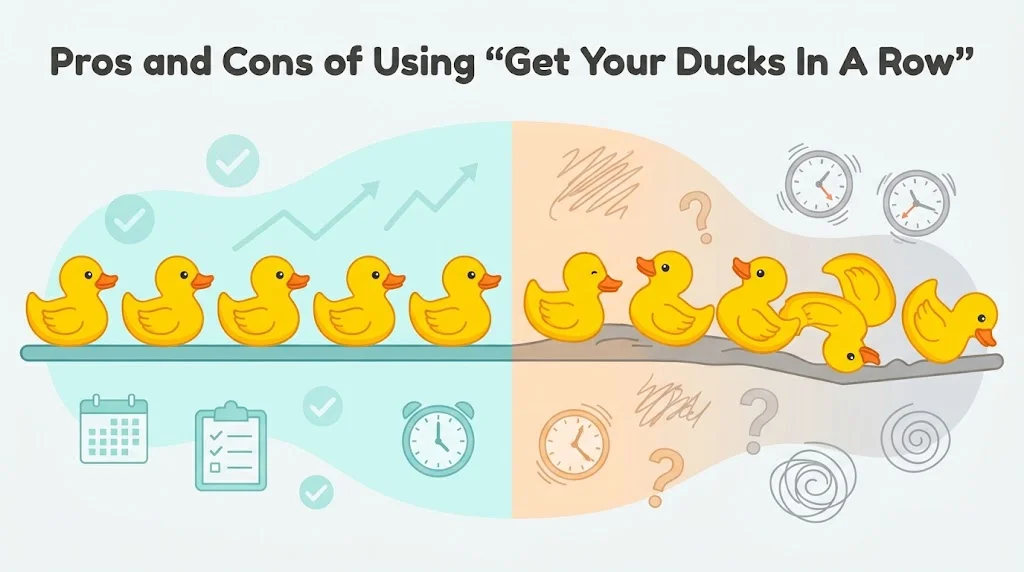
Advantages
Clarity
The phrase quickly communicates the need for organization and preparation without requiring lengthy explanations.
Efficiency
A short idiom conveys an entire planning process in just a few words, making communication faster.
Accessibility
Native English speakers generally recognize the expression immediately, making it memorable across workplaces, schools, and everyday conversations.
Encourages Action
Rather than focusing on problems, the phrase directs attention toward practical preparation and readiness.
Versatile Usage
It applies to business planning, education, finance, personal organization, project management, and daily responsibilities.
Potential Drawbacks
Oversimplification
Complex challenges often require detailed planning rather than a simple reminder to “get organized.”
Tone Mismatch
In highly formal communication, the phrase may appear too conversational.
Repetition
Because the idiom is widely used, repeated use can make writing feel predictable or cliché.
Cross-Cultural Confusion
International readers may interpret the phrase literally if they are unfamiliar with English idioms.
Limited Precision
The expression does not specify exactly what needs to be organized, making literal alternatives more suitable when detailed instructions are required.
Real-Life Examples of “Get Your Ducks In A Row” by Context
Emails
“Before we submit the proposal on Friday, let’s get our ducks in a row by reviewing the budget, timeline, and supporting documents.”
Meetings
“Let’s get our ducks in a row before presenting the strategy to senior leadership next week.”
Presentations
“Successful product launches happen because teams get their ducks in a row long before customers see the final product.”
Conversations
“I’m spending this weekend getting my ducks in a row before starting my new position on Monday.”
Social Media
“Small daily habits help you get your ducks in a row long before big opportunities arrive.”
“Get Your Ducks In A Row” vs Similar Expressions (Key Differences)
| Phrase | Meaning Difference | Tone Difference | Best Use Scenario |
| Get organized | Directly emphasizes organization without using an idiom | Neutral and professional | Business communication, emails, workplace instructions |
| Put your house in order | Focuses on fixing internal problems before progressing | Slightly more serious | Organizational improvement, financial planning |
| Tie up loose ends | Refers to completing unfinished tasks | Practical and conversational | Final project stages, event preparation |
| Get your act together | Suggests improving behavior or performance | More direct and sometimes critical | Personal motivation, informal conversations |
| Have all your bases covered | Focuses on anticipating possible problems | Confident and strategic | Risk management, planning meetings |
| Get everything squared away | Emphasizes completing preparations | Informal, often North American | Team coordination, project completion |
Common Mistakes & Misuse of “Get Your Ducks In A Row”
Overuse
Using the phrase repeatedly throughout emails, presentations, or articles can make communication sound repetitive. Mixing in alternative expressions improves readability and keeps your language fresh.
Incorrect Context
The idiom should not replace precise instructions. Saying “Get your ducks in a row” when detailed procedural guidance is required may leave listeners uncertain about the exact actions they should take.
Contradictory Usage
Avoid using the phrase after work has already been completed or when preparation is no longer relevant. It specifically refers to organizing before action rather than reflecting on finished tasks.
Cultural Misunderstandings
Because this is an English idiom, some international audiences may interpret it literally. In multilingual workplaces or global communication, straightforward alternatives such as “prepare everything in advance” often provide greater clarity.
Psychological Reason People Prefer “Get Your Ducks In A Row”
People naturally seek language that simplifies complex ideas. “Get Your Ducks In A Row” compresses the broader concepts of planning, prioritization, organization, and readiness into one familiar expression, reducing cognitive effort for both the speaker and the listener.
The phrase also signals responsibility and competence. Someone who is encouraged to “get their ducks in a row” is being reminded to prepare thoughtfully rather than react impulsively, reinforcing trust and reliability in professional and personal settings.
In today’s fast-moving communication environment, concise idioms attract attention more effectively than lengthy explanations. They fit naturally into meetings, emails, presentations, and digital conversations where people value speed without sacrificing meaning.
US vs UK Usage of “Get Your Ducks In A Row”
The phrase is significantly more common in the United States, where it appears regularly in business communication, leadership discussions, productivity advice, and everyday conversation.
In the United Kingdom, native speakers generally understand the idiom, but they may choose more direct alternatives such as “get organized,” “put everything in order,” or “sort everything out,” particularly in professional environments.
Overall, the expression is widely recognized across both regions, although American English uses it more frequently and with greater familiarity.
“Get Your Ducks In A Row” in Digital & Modern Communication
Emails
The phrase works well in internal emails where the tone is friendly and collaborative, especially when preparing for deadlines or project milestones.
Slack / WhatsApp
In team chats, it serves as a quick reminder to organize tasks before meetings, launches, or client discussions without sounding overly formal.
Social Media
Productivity creators, career coaches, and business influencers frequently use the idiom because it is memorable, motivational, and easy to understand.
AI-Generated Summaries
Modern AI writing tools often recognize the phrase as shorthand for preparation and organization. However, when clarity is the priority, they may recommend more literal wording for international or formal audiences.
Linguistic & Communication Insight
Emotional Weight & Subtext
Beyond its literal meaning, native speakers hear “Get Your Ducks In A Row” as a gentle reminder to prepare responsibly. It usually conveys encouragement rather than criticism, suggesting that thoughtful organization leads to better outcomes.
Direct vs Indirect Phrasing
Compared with direct commands like “Organize everything now,” this idiom softens the message by presenting preparation as practical advice instead of an order. Softer alternatives such as “Let’s prepare everything first” create an even more collaborative tone, while direct wording may communicate urgency more clearly.
Professional Communication Perspective
In workplace conversations, the phrase is often interpreted as a positive call for planning and coordination. Within close teams, it feels approachable, but in formal reports, executive communications, or client-facing documents, more literal expressions generally project greater precision and professionalism.
Pragmatic Reasons for Alternatives
Experienced communicators frequently choose alternatives such as “complete the preparations,” “organize your priorities,” or “ensure everything is ready” because they reduce ambiguity, avoid idiomatic language for global audiences, and maintain a balanced tone that supports collaboration rather than sounding instructional.
Social Signaling
Word choice influences how people perceive competence, leadership, and trustworthiness. Using this idiom in the right setting can make a speaker sound practical and approachable, while selecting a more direct alternative may signal professionalism, inclusiveness, or cultural awareness when communicating with diverse audiences.
Tone & Context Guidance
Use “Get Your Ducks In A Row” when speaking with colleagues, friends, or audiences comfortable with conversational English. Consider replacing it with a literal alternative in formal, legal, academic, or international communication where clarity and precision are more important than figurative language.
Get Organized

Meaning: “Get organized” means to arrange your tasks, information, materials, or priorities in a logical and manageable way before moving forward. It communicates the same core idea as “Get Your Ducks In A Row” but without using an idiom.
Why This Phrase Works: It is clear, direct, and universally understood by both native and non-native English speakers. Because it avoids figurative language, it improves clarity in professional and international communication.
Real-World Usage Insight: Managers, teachers, project leaders, and coaches often use this phrase when encouraging preparation before deadlines, meetings, or major projects.
Best Use: Workplace communication, project planning, academic settings, business emails, productivity advice.
Avoid When: You want a more conversational, friendly, or humorous tone.
Tone: Professional, neutral, supportive.
US vs UK Usage: Common and equally accepted in both American and British English.
Example (Email / Message / Meeting): “Before we begin the implementation phase, let’s get organized by reviewing everyone’s responsibilities and confirming the project timeline.”
Put Everything In Order
Meaning: “Put everything in order” means to arrange tasks, documents, responsibilities, or plans into a clear and organized sequence before taking action.
Why This Phrase Works: It communicates preparation in literal language, making it suitable for audiences that may not understand English idioms.
Real-World Usage Insight: It frequently appears in workplace instructions, educational settings, financial planning, and organizational discussions where clarity matters.
Best Use: Formal emails, project management, administrative work, planning sessions.
Avoid When: Casual conversations where a lighter, more natural expression would sound friendlier.
Tone: Neutral, professional, organized.
US vs UK Usage: Widely used throughout both the US and UK.
Example (Meeting): “Before presenting to the client, let’s put everything in order so everyone is working from the latest version of the proposal.”
Organize Your Priorities
Meaning: “Organize your priorities” means deciding which responsibilities deserve attention first so your time and effort are used effectively.
Why This Phrase Works: Rather than focusing only on organization, it emphasizes smart decision-making and effective prioritization.
Real-World Usage Insight: Career coaches, business leaders, and productivity experts regularly use this phrase when discussing workload management and strategic planning.
Best Use: Leadership discussions, performance reviews, coaching sessions, productivity articles.
Avoid When: The issue involves organizing physical materials rather than prioritizing work.
Tone: Professional, thoughtful, encouraging.
US vs UK Usage: Equally natural in American and British English.
Example (Meeting): “As the deadline approaches, we should organize our priorities and complete the highest-impact tasks first.”
Prepare Everything
Meaning: “Prepare everything” means making sure all necessary materials, information, and arrangements are ready before beginning an activity.
Why This Phrase Works: It is simple, universally understood, and leaves little room for misunderstanding.
Real-World Usage Insight: This expression is commonly used before presentations, interviews, events, product launches, and exams where readiness directly affects success.
Best Use: Business communication, education, event planning, customer service.
Avoid When: You want to emphasize long-term planning rather than immediate preparation.
Tone: Direct, neutral, practical.
US vs UK Usage: Extremely common across both regions.
Example (Email): “Please prepare everything for tomorrow’s workshop, including the printed materials and presentation slides.”
Get Everything Sorted
Meaning: “Get everything sorted” means resolving outstanding issues and organizing everything so that work can continue smoothly.
Why This Phrase Works: It combines organization with problem-solving, making it useful when preparation includes fixing unfinished details.
Real-World Usage Insight: Teams often use this expression before launches, meetings, travel, or important deadlines when several tasks remain incomplete.
Best Use: Team collaboration, informal business communication, everyday conversations.
Avoid When: Writing highly formal reports or legal documents.
Tone: Friendly, practical, conversational.
US vs UK Usage: More common in British English, although easily understood in the United States.
Example (Message): *”Let’s get everything sorted this afternoon so tomorrow’s client meeting runs without any surprises.”
Conclusion
“Get Your Ducks In A Row” remains one of the most useful English idioms for expressing the importance of preparation, organization, and planning before taking action. Its friendly and memorable wording makes it popular in workplaces, classrooms, and everyday conversations. However, choosing the right alternative can significantly improve clarity, especially in professional, academic, or international communication where literal language is often preferred. Expressions such as “Get Organized,” “Prepare Everything,” or “Ensure Everything Is Ready” communicate the same message with greater precision while matching different audiences and situations.
Understanding the phrase’s meaning, origin, tone, and practical use helps you communicate more confidently and avoid misunderstandings. Whether you’re writing an email, leading a meeting, preparing for an interview, or managing a project, selecting language that fits the context strengthens your credibility and makes your message more effective. Ultimately, successful communication is not just about choosing familiar phrases; it’s about choosing the most appropriate words for your audience and purpose.
FAQs
What does “Get Your Ducks In A Row” mean?
“Get Your Ducks In A Row” means to organize your tasks, plans, documents, or responsibilities before taking action. It encourages preparation and careful planning so everything is ready when needed. The phrase is commonly used in workplaces, schools, and everyday conversations to promote efficiency and reduce mistakes before starting an important activity.
Is “Get Your Ducks In A Row” a professional phrase?
Yes, it can be professional in informal workplace conversations, team meetings, and internal emails. However, because it is an idiom, highly formal communication such as legal documents, executive reports, or academic writing usually benefits from more direct alternatives like “Get Organized” or “Ensure Everything Is Ready.”
Where did the phrase “Get Your Ducks In A Row” originate?
The exact origin is uncertain, but most experts believe it developed in American English during the early twentieth century. Popular theories include ducklings walking in an orderly line and carnival duck games. Regardless of its exact source, the phrase evolved into a common expression for preparation and organization.
What are the best alternatives to “Get Your Ducks In A Row”?
Some of the strongest alternatives include Get Organized, Prepare Everything, Put Everything In Order, Ensure Everything Is Ready, Organize Your Priorities, Finalize Your Preparations, and Get Everything Sorted. The best choice depends on your audience, level of formality, and communication goals.
Is “Get Your Ducks In A Row” common in the UK?
Yes, British English speakers understand the phrase, although it is generally more popular in the United States. In the UK, expressions such as “Get Everything Sorted” or “Sort Everything Out” are often used more naturally in everyday conversations and professional settings.
Can I use “Get Your Ducks In A Row” in business emails?
You can use it in friendly internal emails or informal communication with colleagues who are familiar with English idioms. For external clients, international audiences, or formal business correspondence, clearer alternatives such as “Prepare Everything” or “Ensure Everything Is Ready” are usually more appropriate.
Why is this phrase so popular?
The phrase is memorable because it creates a simple mental image of order and preparation. It also summarizes several ideas—planning, organization, and readiness—in just a few words. This efficiency makes it useful in modern communication, where concise language is highly valued.
Is “Get Your Ducks In A Row” suitable for ESL learners?
Yes, but learners should understand that it is an idiom rather than a literal expression. While it appears frequently in spoken and written English, using direct alternatives in professional or academic communication may improve clarity until learners become more comfortable with English idioms.
What situations should I avoid using this phrase?
Avoid using the phrase in legal documents, academic papers, compliance reports, technical manuals, or sensitive communications where precise language is essential. It may also confuse international readers who are unfamiliar with English idioms, making literal wording a safer choice.
How can I use “Get Your Ducks In A Row” naturally?
Use the phrase when encouraging preparation before an important task. For example, you might say, “Let’s get our ducks in a row before next week’s presentation.” In this context, it sounds supportive, collaborative, and practical, making it an effective reminder to organize work before moving forward.