
Imagine you’re in a team meeting where a small scheduling mistake delays a project by a few minutes. One colleague begins apologizing repeatedly, while another calmly says, “Don’t make a fuss.” Instantly, the conversation shifts from frustration to reassurance. In everyday communication, this simple phrase is often used to encourage someone not to overreact or create unnecessary concern over a minor issue. However, because tone plays such a significant role, choosing the right alternative can make your message sound more supportive, professional, or empathetic. Understanding the meaning, context, and suitable replacements for “Don’t Make A Fuss” helps professionals, students, ESL learners, and writers communicate with greater clarity while avoiding unintended misunderstandings.
What Does “Don’t Make A Fuss” Mean?
“Don’t make a fuss” means not to react with unnecessary worry, complaint, excitement, or drama about a situation that is considered minor or manageable. The phrase encourages someone to remain calm, avoid exaggerating a problem, and handle the situation without creating additional attention or conflict.
Origin & History of “Don’t Make A Fuss”
The expression “don’t make a fuss” comes from the English noun “fuss,” which has been used since the early eighteenth century to describe unnecessary excitement, excessive concern, or noisy activity over something relatively insignificant. Although its exact linguistic origin is uncertain, many language historians believe the word developed from dialectal expressions associated with agitation or bustling behavior.
During the nineteenth century, the phrase became common in British English, particularly in everyday family conversations and social etiquette. Parents often used it to encourage children to stay calm, guests heard it when hosts wanted to avoid unnecessary attention, and workplaces adopted it as a way to discourage overreaction to small inconveniences.
Over time, the phrase evolved from simply describing excessive commotion to expressing reassurance. Today, it can communicate several intentions depending on tone. It may comfort someone who is apologizing too much, remind a colleague not to overcomplicate a minor issue, or gently encourage perspective when emotions begin to escalate.
Modern English speakers continue to use the expression across personal conversations, workplaces, digital messages, and social media. While it remains especially common in British English, it is also widely understood in other English-speaking regions, making it a familiar idiom with lasting cultural relevance.
Synonyms & Alternatives by Tone
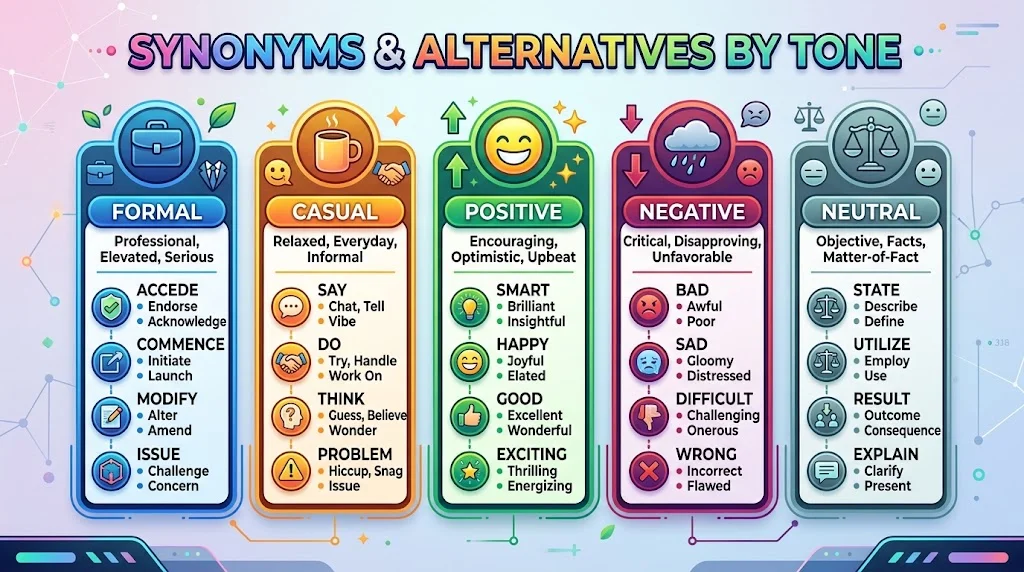
Professional & Neutral Alternatives
- No need to worry.
- There’s no need to overreact.
- Let’s keep this in perspective.
- It’s not a major issue.
- We can handle this calmly.
Polite & Supportive Alternatives
- Please don’t worry about it.
- It’s completely fine.
- There’s nothing to be concerned about.
- Take it easy.
- Don’t concern yourself with it.
Encouraging & Reassuring Alternatives
- Everything will be okay.
- Let’s not stress over it.
- Keep things simple.
- It’s under control.
- Let’s move forward.
Casual, Playful & Idiomatic Alternatives
- Don’t sweat it.
- No big deal.
- Let it go.
- Don’t make a mountain out of a molehill.
- Chill out.
When Should You Use “Don’t Make A Fuss”?
The phrase works best when your goal is to reassure someone that a situation does not deserve excessive attention. It encourages calmness and helps redirect the conversation toward practical solutions rather than unnecessary worry.
Professional Settings
In workplaces, “don’t make a fuss” is most effective during informal discussions with colleagues who already have a comfortable working relationship. For example, if someone apologizes repeatedly for a minor typo in a draft or a small scheduling mistake, the phrase can communicate that the issue is insignificant and easily resolved.
However, managers and leaders should use it carefully. Employees facing genuine concerns may interpret the phrase as dismissive if their feelings or perspectives are overlooked.
Casual Conversations
Friends and family frequently use this expression to reassure one another. It works naturally when someone feels embarrassed about a small mistake, worries about inconveniencing others, or apologizes excessively for something that has little impact.
In these situations, the phrase promotes emotional ease and prevents unnecessary tension.
Writing, Presentations, and Digital Communication
Because written communication lacks vocal tone and facial expressions, the phrase should be used thoughtfully in emails, chat messages, or presentations.
Suitable examples include:
- Informal team chats
- Friendly emails between coworkers
- Internal workplace messaging
- Casual blog writing
- Personal messages
In more formal documents, replacing it with a neutral alternative often creates greater professionalism.
When It Is Especially Effective
The phrase is particularly useful when:
- Someone is over-apologizing for a small mistake.
- A problem has already been resolved.
- Emotions are escalating unnecessarily.
- You want to reduce anxiety without minimizing the issue.
- A conversation benefits from keeping attention on practical solutions rather than blame.
When Should You Avoid “Don’t Make A Fuss”?
Although the phrase is common and generally well understood, it is not appropriate in every situation.
Avoid using it during highly formal business communication, legal discussions, academic writing, or official correspondence. These contexts require more precise and neutral language that avoids conversational idioms.
It is also unsuitable during sensitive situations involving grief, discrimination, workplace conflict, mental health, harassment, or significant financial consequences. In these cases, telling someone not to “make a fuss” may unintentionally suggest that their concerns are unimportant.
Likewise, avoid using the phrase when someone is reporting a legitimate problem. Instead of calming the situation, it can appear dismissive and reduce trust.
When cultural differences are involved, remember that not every English learner understands idiomatic expressions immediately. A clearer alternative may improve understanding and reduce confusion.
Is “Don’t Make A Fuss” Professional, Polite, or Casual?
The phrase generally falls into the casual to semi-professional category. Its appropriateness depends largely on the relationship between speakers, the seriousness of the situation, and the overall communication style.
From a professionalism standpoint, the phrase works best in relaxed workplace environments where colleagues communicate informally. It can help reduce tension and reassure someone after a minor mistake. However, it may sound overly casual in executive communication, client interactions, or official business writing.
In terms of politeness, the phrase can sound warm and reassuring when spoken with empathy. A gentle tone communicates understanding and support, while a sharp or impatient delivery may come across as dismissive or condescending.
Emotionally, “don’t make a fuss” often signals that the speaker believes the situation is manageable and not worth excessive concern. Native speakers usually interpret it as encouragement to stay calm, although context determines whether it feels comforting or minimizing.
Overall, audience awareness matters more than the phrase itself. The same words can either strengthen rapport or unintentionally discourage open communication depending on how and when they are used.
Pros and Cons of Using “Don’t Make A Fuss”
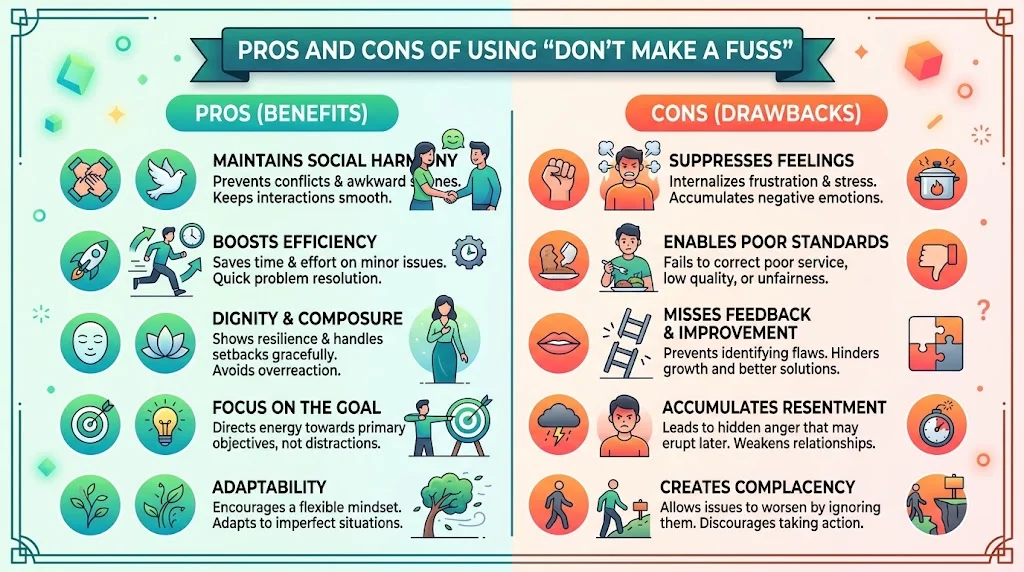
Advantages
Clear and easy to understand
The phrase communicates a simple message that encourages calmness without requiring lengthy explanations.
Efficient communication
It quickly reassures someone that a situation does not deserve excessive attention, helping conversations move toward practical solutions.
Accessible for everyday use
Because it is widely recognized across English-speaking communities, most native speakers understand its intended meaning immediately.
Reduces unnecessary anxiety
In appropriate situations, the phrase helps prevent people from dwelling on minor mistakes or inconveniences.
Supports relaxed communication
Among friends, family, and familiar coworkers, it creates an atmosphere that values perspective over unnecessary worry.
Potential Drawbacks
Can oversimplify genuine concerns
What appears minor to one person may feel significant to another. Using the phrase too quickly may unintentionally dismiss valid emotions.
Possible tone mismatch
Without careful wording or vocal warmth, the expression may sound impatient, critical, or insensitive.
Less suitable in formal settings
Business reports, legal documents, academic papers, and client communications usually benefit from more neutral language.
Risk of repetition
Frequent use can make communication sound repetitive, especially for writers or speakers who rely on the phrase too often instead of selecting alternatives that better match the context.
Real-Life Examples of “Don’t Make A Fuss” by Context
“Thank you for letting me know about the formatting mistake. Don’t make a fuss—it was an easy fix, and the report is ready to send.”
Meeting
“The presentation started five minutes late, but don’t make a fuss. Let’s focus on today’s agenda.”
Presentation
“If one slide doesn’t display correctly, don’t make a fuss. We’ll simply move to the next point and continue.”
Conversation
Alex: “I’m sorry I spilled some coffee.”
Jordan: “Don’t make a fuss. It happens to everyone.”
Social Media
“Forgot my umbrella and got caught in the rain. Don’t make a fuss—sometimes those unexpected moments become the funniest memories.”
“Don’t Make A Fuss” vs Similar Expressions (Key Differences)
| Phrase | Meaning Difference | Tone Difference | Best Use Scenario |
| Don’t sweat it | Focuses on reducing worry rather than preventing commotion | Casual and friendly | Reassuring friends or coworkers after a small mistake |
| No big deal | Emphasizes that the issue is insignificant | Very casual | Everyday conversations and text messages |
| Don’t make a mountain out of a molehill | Warns against exaggerating a minor problem | Slightly stronger and idiomatic | When someone is overreacting to a small issue |
| Take it easy | Encourages relaxation rather than reducing attention | Friendly and supportive | Stressful conversations or informal workplace chats |
| Let it go | Encourages moving on instead of dwelling on the issue | Calm but more direct | Situations where the problem has already been resolved |
| Keep things in perspective | Encourages balanced thinking | Professional and measured | Workplace discussions and decision-making |
Common Mistakes & Misuse of “Don’t Make A Fuss”
One of the most common mistakes is overusing the phrase. While it can effectively reassure someone, repeating it too frequently may make conversations feel dismissive or predictable.
Another issue is using it in the wrong context. Saying “don’t make a fuss” when someone raises a legitimate workplace concern, reports inappropriate behavior, or discusses an important personal issue can unintentionally minimize their experience.
Some speakers also create contradictory messages by acknowledging a serious problem and then immediately telling others not to make a fuss. This inconsistency can confuse listeners and weaken trust.
For ESL learners, cultural misunderstandings are also possible. In some cultures, openly discussing concerns is expected and appreciated. Using this phrase too quickly may therefore seem insensitive rather than reassuring. Understanding the relationship, setting, and emotional context helps ensure the expression supports communication instead of creating unintended tension.
Psychological Reason People Prefer “Don’t Make A Fuss”
People often prefer expressions like “don’t make a fuss” because they reduce cognitive load. Rather than spending time evaluating whether a small issue deserves further discussion, the phrase provides an immediate signal that the situation is manageable.
The expression also functions as a subtle trust and authority signal. When spoken by someone perceived as experienced or confident, it reassures listeners that the problem is under control, helping reduce unnecessary anxiety.
In today’s attention economy, people are constantly filtering information and prioritizing what deserves their focus. Phrases that quickly distinguish minor issues from significant ones help conversations remain efficient and productive.
Modern communication habits also favor concise language. Whether in emails, workplace chats, or messaging apps, people appreciate expressions that communicate reassurance in just a few words without requiring lengthy explanations.
US vs UK Usage of “Don’t Make A Fuss”
The phrase is considerably more common in British English, where it remains a familiar part of everyday conversation. British speakers often use it naturally among family members, friends, and colleagues to discourage unnecessary worry or attention over minor matters.
In American English, people understand the expression, but alternatives such as “Don’t sweat it,” “No big deal,” or “Don’t worry about it” are generally more common in daily speech.
Tone perception also varies slightly. British listeners often hear the phrase as politely reassuring, while American audiences may sometimes perceive it as slightly formal, old-fashioned, or more direct depending on the speaker and situation.
For international audiences, choosing a more universally recognized alternative can improve clarity, especially in global workplaces and multicultural teams.
“Don’t Make A Fuss” in Digital & Modern Communication
In emails, the phrase works well when reassuring colleagues about small mistakes or routine delays, provided the relationship is informal and supportive.
On platforms such as Slack, Microsoft Teams, or WhatsApp, it fits naturally into quick conversations where speed and reassurance are valued. Messages like “Don’t make a fuss—we’ll sort it out this afternoon” help maintain a collaborative atmosphere.
On social media, the phrase often appears in captions or comments that encourage perspective, humor, or resilience after everyday inconveniences. It supports positive engagement without dramatizing minor setbacks.
As AI-generated summaries and digital communication become more common, concise expressions like “don’t make a fuss” remain useful because they communicate reassurance efficiently. However, AI writing and professional communication increasingly favor alternatives that balance warmth with precision, especially when addressing diverse audiences.
Linguistic & Communication Insight
Emotional weight & subtext
Although the literal meaning is simply to avoid unnecessary concern, native speakers often hear an additional emotional message. “Don’t make a fuss” suggests that the situation is manageable, temporary, and not worth emotional escalation. Depending on tone, it can feel comforting, calming, or, if delivered abruptly, dismissive.
Direct vs indirect phrasing
The phrase is relatively direct because it tells someone what not to do. Softer alternatives such as “There’s no need to worry” or “I think we’re okay” shift the focus toward reassurance rather than instruction. This subtle difference can influence how collaborative or authoritative the message feels.
Professional communication perspective
In workplace communication, experienced professionals often avoid expressions that could unintentionally minimize concerns. While “don’t make a fuss” can strengthen rapport among familiar colleagues, more neutral wording is generally preferred when speaking with clients, senior leadership, or cross-functional teams where clarity and empathy are especially important.
Pragmatic reasons for alternatives
Professionals frequently choose alternative wording because it reduces defensiveness. Expressions like “Let’s keep this in perspective” or “We can handle this calmly” acknowledge the issue while encouraging constructive action. This approach preserves trust and keeps conversations solution-focused rather than emotionally reactive.
Social signaling
Word choice communicates more than information—it also signals attitude. Saying “don’t make a fuss” may suggest confidence, composure, and emotional control. Conversely, using a more empathetic alternative may signal active listening, collaboration, and respect for another person’s perspective. These subtle signals influence how trustworthy, approachable, and supportive a speaker appears.
Tone & context guidance
The phrase is most effective when the issue is genuinely minor, and the relationship allows for informal communication. It becomes riskier when emotions are already heightened, when someone is expressing a legitimate concern, or when the audience expects greater formality. Skilled communicators adjust their wording based on context, recognizing that the same intention can be expressed with varying degrees of warmth, authority, or sensitivity.
No Need to Worry
Meaning: This phrase reassures someone that a situation is not serious enough to deserve anxiety or concern. It emphasizes that everything is manageable.
Why This Phrase Works: It is clear, supportive, and universally understood. Unlike “Don’t make a fuss,” it focuses on easing worry rather than discouraging someone’s reaction.
Real-World Usage Insight: Professionals frequently use this phrase when calming clients, teammates, or students after minor setbacks because it sounds reassuring without being dismissive.
Best Use: Workplace conversations, customer service, emails, presentations, and everyday discussions.
Avoid When: Someone is facing a genuinely serious problem that deserves attention.
Tone: Professional, polite, reassuring.
US vs UK Usage: Equally common in both American and British English.
Example (Email / Message / Meeting): Thanks for letting me know about the typo. No need to worry—we’ve corrected it before publishing.
Don’t Sweat It
Meaning: “Don’t sweat it” tells someone not to worry or feel guilty about a small mistake or inconvenience.
Why This Phrase Works: It sounds friendly and instantly reduces tension, making conversations feel relaxed and approachable.
Real-World Usage Insight: Native speakers commonly use this phrase after someone apologizes repeatedly for something minor, especially among friends or coworkers.
Best Use: Casual workplace chats, text messages, conversations with friends, and social media.
Avoid when: Formal meetings, legal communication, or conversations with senior executives.
Tone: Casual, friendly, encouraging.
US vs UK Usage: Extremely common in American English and understood in the UK, though British speakers often choose different expressions.
Example (Meeting): You forgot one slide? Don’t sweat it—we can explain the point verbally.
It’s No Big Deal
Meaning: This phrase communicates that a problem or mistake is too small to deserve significant attention.
Why This Phrase Works: It quickly reassures others while keeping the conversation focused on moving forward.
Real-World Usage Insight: It is often used after someone apologizes for a minor inconvenience, helping reduce embarrassment.
Best Use: Informal conversations, team discussions, messaging apps, and family interactions.
Avoid When: The issue has meaningful consequences, or someone feels emotionally affected.
Tone: Casual, reassuring.
US vs UK Usage: Common in both regions, although slightly more frequent in North America.
Example (Message): It’s no big deal that you’re running five minutes late. We’ll start once you arrive.
Let’s Keep This in Perspective
Meaning: This phrase encourages people to evaluate a situation realistically rather than reacting emotionally.
Why This Phrase Works: It acknowledges the issue while encouraging balanced thinking instead of dismissing concerns.
Real-World Usage Insight: Leaders frequently use this expression during project discussions to prevent teams from focusing excessively on small setbacks.
Best Use: Professional meetings, leadership communication, presentations, and strategic discussions.
Avoid When: Someone needs emotional support before practical advice.
Tone: Professional, balanced, thoughtful.
US vs UK Usage: Widely accepted in both American and British English.
Example (Meeting): We missed one internal deadline, but let’s keep this in perspective. The overall project remains on schedule.
There’s No Need to Overreact
Meaning: This phrase reminds someone that their emotional response may be stronger than the situation requires.
Why This Phrase Works: It directly encourages calmness and measured thinking.
Real-World Usage Insight: Native speakers use it carefully because, although effective, it can sound critical if delivered without empathy.
Best Use: Discussions where emotions are escalating over relatively minor issues.
Avoid When: Someone has legitimate reasons to feel upset or anxious.
Tone: Direct, calm, moderately formal.
US vs UK Usage: Equally understood across both varieties of English.
Example (Meeting): There’s no need to overreact. Let’s review the facts before making a decision.
It’s Completely Fine
Meaning: This phrase reassures someone that everything is acceptable and no apology or further explanation is necessary.
Why This Phrase Works: It communicates acceptance in a warm, positive, and supportive way.
Real-World Usage Insight: Managers, teachers, and customer service professionals often use this expression because it helps people feel comfortable after making small mistakes.
Best Use: Emails, customer interactions, workplace conversations, and personal discussions.
Avoid When: The mistake has significant consequences that require accountability.
Tone: Warm, polite, reassuring.
US vs UK Usage: Very common in both American and British English.
Example (Email): It’s completely fine that you submitted the document this morning instead of yesterday. Thank you for keeping me updated.
Take It Easy
Meaning: This phrase encourages someone to relax and avoid becoming overly stressed or upset.
Why This Phrase Works: It sounds natural, conversational, and helps lower emotional intensity.
Real-World Usage Insight: Friends, coworkers, and family members frequently use it during stressful moments to encourage calm thinking.
Best Use: Informal workplace conversations, personal discussions, and friendly messages.
Avoid when speaking with clients, executives, or during highly formal communication.
Tone: Casual, supportive, relaxed.
US vs UK Usage: Popular in both countries, especially in spoken English.
Example (Message): Take it easy. We still have plenty of time to finish the project this afternoon.
We Can Handle This Calmly
Meaning: This phrase emphasizes that the situation can be managed through thoughtful, steady action rather than emotional reactions.
Why This Phrase Works: It promotes collaboration and confidence instead of focusing on blame or criticism.
Real-World Usage Insight: Experienced leaders often choose this wording because it reassures teams while reinforcing a problem-solving mindset.
Best Use: Leadership communication, project management, client discussions, and workplace meetings.
Avoid When: Immediate emergency action is required instead of reassurance.
Tone: Professional, confident, collaborative.
US vs UK Usage: Equally natural in American and British English.
Example (Meeting): The client requested a few revisions, but we can handle this calmly and have the updated version ready tomorrow.
Conclusion
The phrase “Don’t Make A Fuss” remains a useful expression for encouraging calmness and preventing unnecessary worry over minor issues. While it is widely understood in everyday English, its effectiveness depends on the context, audience, and tone of delivery. In casual conversations, it can sound friendly and reassuring, but in professional or emotionally sensitive situations, a more thoughtful alternative may communicate greater empathy and respect. By understanding its meaning, history, tone, and practical alternatives, you can choose language that fits each situation more naturally.
Whether you’re writing emails, leading meetings, learning English, or creating content, selecting the right phrase helps build trust, improve clarity, and strengthen communication. Instead of repeating the same expression, expanding your vocabulary helps you sound more confident, adaptable, and audience-aware. Ultimately, effective communication isn’t just about what you say—it’s about choosing words that make people feel understood while keeping conversations clear, respectful, and productive.
FAQs
What does “Don’t Make A Fuss” mean?
“Don’t Make A Fuss” means not to create unnecessary worry, excitement, complaints, or drama over something relatively minor. It encourages people to remain calm and avoid overreacting to situations that can be handled easily. The phrase is commonly used in everyday conversations to reassure someone that a problem is not as serious as it may seem.
Is “Don’t Make A Fuss” considered rude?
Not necessarily. The phrase can sound kind and reassuring when spoken with warmth and empathy. However, if delivered in a sharp tone or during a serious discussion, it may appear dismissive or insensitive. Context, relationship, and vocal delivery all influence how listeners interpret the expression.
Is “Don’t Make A Fuss” professional?
The phrase is best described as casual to semi-professional. It works well in relaxed workplaces and informal conversations among colleagues. For formal emails, executive communication, or client interactions, alternatives such as “There’s no need to worry” or “Let’s keep this in perspective” are generally more appropriate.
What are the best alternatives to “Don’t Make A Fuss”?
Some of the strongest alternatives include “No need to worry,” “Don’t sweat it,” “It’s no big deal,” “Let’s keep this in perspective,” “It’s completely fine,” and “We can handle this calmly.” The best choice depends on your audience, setting, and desired tone.
Is “Don’t Make A Fuss” more common in British or American English?
The phrase is noticeably more common in British English, where it is a familiar everyday expression. American English speakers understand it but often prefer alternatives such as “Don’t sweat it,” “No big deal,” or “Don’t worry about it,” especially in casual conversations.
Can I use “Don’t Make A Fuss” in an email?
Yes, but only in informal or friendly emails where you know the recipient well. In formal business communication, choosing more neutral language usually creates a more professional impression and reduces the risk of sounding dismissive.
Why do native English speakers use “Don’t Make A Fuss”?
Native speakers often use the phrase to reassure others, reduce unnecessary stress, and keep conversations focused on practical solutions. It helps communicate that a small mistake or inconvenience does not deserve excessive attention, making interactions feel calmer and more constructive.
When should I avoid saying “Don’t Make A Fuss”?
Avoid using the phrase when someone is discussing a serious concern, expressing strong emotions, reporting workplace issues, or seeking support. In these situations, acknowledging the person’s feelings before offering reassurance is usually more effective and respectful.
Is “Don’t Make A Fuss” an idiom?
Yes. Although the individual words have literal meanings, the complete expression functions as an idiomatic phrase. It conveys the idea of avoiding unnecessary commotion or overreaction rather than referring to making physical noise or activity.
How can ESL learners use “Don’t Make A Fuss” naturally?
ESL learners should use the phrase in informal conversations involving small mistakes, minor inconveniences, or everyday situations where reassurance is appropriate. Listening to native speakers and practicing similar alternatives can help learners understand when the phrase sounds supportive and when a more neutral expression is preferable.


