
Imagine you’re wrapping up a project before the deadline, and a colleague smiles and says, “Don’t worry, it’s a piece of cake.” In just a few words, they’ve reassured you that the task is simple and manageable. This familiar expression appears everywhere from workplace conversations and classrooms to social media posts and everyday chats.
“A Piece of Cake” is one of the most recognizable English idioms, making communication feel natural, friendly, and confident. However, choosing the right alternative can make your message sound more professional, supportive, or context-appropriate. Understanding what this phrase means, when to use it, and which alternatives fit different situations helps professionals, students, ESL learners, and writers communicate with greater clarity and confidence.
What Does “A Piece Of Cake” Mean?
A Piece Of Cake means that something is very easy to do or requires little effort. The phrase is commonly used to describe tasks, activities, or challenges that are simple to complete. It appears in both spoken and written English, especially in casual conversations, workplace discussions, and educational settings.
Origin & History of “A Piece Of Cake”

The exact origin of “A Piece Of Cake” is not completely certain, but language historians generally trace it to the United States during the early twentieth century. One widely accepted theory connects the phrase to cake being viewed as a desirable and easily obtained reward at social gatherings and celebrations. Winning or receiving a piece of cake symbolized an enjoyable experience rather than a difficult achievement.
Another historical connection comes from African American communities in the Southern United States. During informal competitions and dances, winners were sometimes awarded cakes as prizes. Over time, the association between earning a cake and accomplishing something with confidence contributed to the expression’s positive meaning.
By the 1930s and 1940s, the idiom had become increasingly common in American English. Newspapers, novels, and everyday conversations began using it to describe tasks that required little effort. As American media expanded globally through films, television, and popular culture, the expression spread to many English-speaking countries.
Today, “A Piece Of Cake” remains one of the world’s most recognized English idioms. Although it is informal, its meaning is instantly understood by most native speakers. The phrase continues to symbolize simplicity, confidence, and reassurance, making it a popular choice in personal conversations, classrooms, workplaces, and digital communication.
Synonyms & Alternatives by Tone
Professional & Neutral Alternatives
- Straightforward
- Simple to complete
- Easy to accomplish
- Easily manageable
- Requires minimal effort
- Relatively uncomplicated
- Routine task
- Easily achievable
- Not particularly difficult
- Clear and manageable
Polite & Supportive Alternatives
- You should have no trouble with it
- It should be quite manageable
- I think you’ll find it straightforward
- It won’t be too challenging
- You’ll get through it easily
- It’s well within your abilities
- This should go smoothly
- You’ve got this
- It should be easy enough
- I believe you’ll handle it well
Encouraging & Reassuring
- You’ve got this
- No problem at all
- It will be easier than you think
- You’ll do great
- Nothing to worry about
- It’s completely manageable
- You’ll pick it up quickly
- It comes naturally with a little practice
- You’ll be fine
- You’ll handle it confidently
Casual, Playful & Idiomatic Alternatives
- Easy as pie
- No sweat
- A breeze
- Child’s play
- Walk in the park
- Smooth sailing
- Cakewalk
- No big deal
- Easy peasy
- Couldn’t be easier
When Should You Use “A Piece Of Cake”?
Professional Settings
While “A Piece Of Cake” is informal, it can be appropriate in relaxed workplace environments where colleagues know each other well. Managers, team members, or trainers may use it to reduce anxiety before a familiar or routine task. However, in highly formal industries, a more neutral expression such as “straightforward” or “easily manageable” often sounds more professional.
Casual Conversations
This idiom is most commonly used among friends, family members, classmates, and acquaintances. It helps reassure someone that an activity, assignment, or challenge is easy. Its friendly tone makes conversations feel more natural and encouraging.
Writing, Presentations, and Digital Communication
In blogs, internal company messages, online tutorials, emails between familiar colleagues, and educational content, “A Piece Of Cake” makes explanations feel approachable. It works especially well when the goal is to simplify information for readers or audiences.
When It Is Especially Effective
The phrase is particularly useful when:
- Reassuring someone who feels nervous about a task.
- Describing a routine process that requires little effort.
- Making instructions sound less intimidating.
- Creating a friendly and conversational tone.
- Encouraging beginners to feel more confident before starting something.
Using the phrase thoughtfully helps build confidence without making the listener feel dismissed. When the task truly is simple, “A Piece Of Cake” communicates optimism and reassurance in a way that feels natural and relatable.
When Should You Avoid “A Piece Of Cake”?
Overly Formal Situations
In legal documents, executive reports, official business correspondence, government communication, or academic writing, “A Piece Of Cake” may sound too informal. Expressions such as “straightforward,” “relatively simple,” or “requires minimal effort” better match formal expectations.
Legal, Academic, or Sensitive Contexts
When discussing medical procedures, financial decisions, legal matters, safety concerns, or emotionally significant situations, describing something as “A Piece Of Cake” can unintentionally minimize its complexity. Clear and precise language is usually more appropriate.
Situations Where Nuance May Be Lost
Not everyone finds the same task easy. Telling someone that an exam, project, presentation, or interview is “A Piece Of Cake” may come across as dismissive if they are genuinely struggling. In these situations, supportive alternatives like “You’ll do well” or “It should be manageable” show greater empathy while still offering encouragement.
Is “A Piece Of Cake” Professional, Polite, or Casual?
Tone Analysis
“A Piece Of Cake” carries a relaxed, optimistic, and reassuring tone. It is designed to reduce stress and communicate confidence rather than provide a literal assessment of difficulty.
Formality Level
The phrase is generally considered casual to semi-informal. It fits everyday conversations, friendly workplace discussions, and informal writing but is less suitable for highly formal communication.
Emotional Subtext
Beyond its literal meaning, the idiom often communicates encouragement. It tells the listener that the speaker believes the task is achievable and does not require excessive worry. This positive emotional message contributes to its lasting popularity.
Audience Perception
Among native English speakers, “A Piece Of Cake” is widely recognized and usually interpreted as friendly and supportive. However, professional audiences may expect more precise language in formal settings, while ESL learners may initially misunderstand the expression if they interpret it literally. Understanding the audience helps determine whether this familiar idiom strengthens communication or whether a more direct alternative would be clearer.
Pros and Cons of Using “A Piece Of Cake”
Advantages
Clarity
The phrase communicates the idea of simplicity almost instantly. Most English speakers immediately understand that the speaker considers the task easy.
Efficiency
Instead of giving a lengthy explanation, “A Piece Of Cake” quickly reassures listeners that something requires little effort, making conversations more natural and efficient.
Accessibility
Because the idiom is widely recognized across many English-speaking countries, it creates friendly, approachable communication in workplaces, classrooms, and everyday conversations.
Potential Drawbacks
Oversimplification
A task that feels easy for one person may be challenging for someone else. Using the phrase carelessly can unintentionally minimize another person’s effort or experience.
Tone Mismatch
The informal nature of the idiom makes it unsuitable for many legal, academic, executive, or highly professional situations where more precise language is expected.
Repetition
Frequent use of “A Piece Of Cake” can make writing and speech sound repetitive. Using appropriate alternatives improves variety, demonstrates stronger communication skills, and helps match the tone to different audiences and situations.
Real-Life Examples of “A Piece Of Cake” by Context
Emails
Example 1
Thanks for sending the updated spreadsheet. The remaining edits are a piece of cake, so I’ll have everything finished before lunch.
Example 2
Once you’ve completed the first section, the rest should be a piece of cake. Let me know if you run into any questions.
Meetings
Example 1
Project Manager: “The software update looks complicated, but after the initial setup, the weekly maintenance is a piece of cake.”
Example 2
Team Lead: “Now that everyone understands the process, completing future reports should be a piece of cake.”
Presentations
Example 1
“With this new dashboard, tracking monthly performance becomes a piece of cake, allowing teams to focus on decision-making instead of manual calculations.”
Example 2
“After today’s training, creating these reports will be a piece of cake for every department.”
Conversations
Example 1
A: “Was the driving test difficult?”
B: “Not really. After a few practice sessions, it was a piece of cake.”
Example 2
A: “Can you assemble this desk?”
B: “Sure. The instructions are clear—it’ll be a piece of cake.”
Social Media
Example 1
Finished my certification exam today! After weeks of practice, the final test felt like a piece of cake.
Example 2
Meal prep for the week is a piece of cake once you have a simple routine.
“A Piece Of Cake” vs Similar Expressions (Key Differences)
| Phrase | Meaning Difference | Tone Difference | Best Use Scenario |
| Easy as Pie | Means something is very easy, with nearly the same meaning but emphasizes comfort and familiarity. | Friendly, informal, playful. | Casual conversations, blogs, social media. |
| A Breeze | Suggests a task required little effort and felt smooth from start to finish. | Relaxed and conversational. | Discussing completed work or experiences. |
| Walk in the Park | Highlights that something was easier than expected rather than simply easy. | Casual and expressive. | Personal stories and informal discussions. |
| No Sweat | Focuses on confidence that no significant effort is needed. | Very casual and reassuring. | Friendly conversations, text messages, team chats. |
| Child’s Play | Suggests a task is extremely easy, sometimes implying almost no skill is required. | Casual and can sound dismissive. | Informal conversations when exaggeration is acceptable. |
| Cakewalk | Refers to an exceptionally easy success, often implying minimal competition. | Informal and slightly humorous. | Sports, competitions, or workplace achievements. |
Common Mistakes & Misuse of “A Piece Of Cake”
Overuse
Using “A Piece Of Cake” repeatedly in conversations, presentations, or articles can make communication feel predictable. Varying your language with suitable alternatives keeps your message more engaging and professional.
Incorrect Context
The phrase should describe genuinely simple tasks. Calling a complicated legal process, major surgery, or high-stakes negotiation “a piece of cake” may sound unrealistic or insensitive.
Contradictory Usage
Avoid pairing the idiom with statements that suggest the opposite.
Incorrect:
The final exam was a piece of cake, but almost everyone failed.
Better:
The final exam seemed straightforward to me, although many students found it challenging.
Cultural Misunderstandings
ESL learners sometimes interpret the expression literally. Without understanding English idioms, they may associate it with actual cake instead of recognizing it as a figurative way to describe an easy task. Explaining the meaning clearly helps avoid confusion.
Psychological Reason People Prefer “A Piece Of Cake”
Cognitive Load Reduction
People naturally prefer expressions that simplify complex ideas. Saying “A Piece Of Cake” immediately communicates that a task is easy without requiring lengthy explanations, allowing listeners to understand the message almost instantly.
Trust and Authority Signals
When experienced professionals confidently describe a routine task as “a piece of cake,” it can reassure others that the process is manageable. Used appropriately, the phrase projects confidence and competence without sounding overly technical.
Attention Economy
Modern communication values speed and clarity. Short, memorable idioms are easier to process than detailed explanations, making them effective in conversations, presentations, emails, and digital content.
Modern Communication Habits
Social media, messaging apps, and workplace chat platforms encourage concise communication. Familiar expressions like “A Piece Of Cake” fit naturally into these environments because they deliver encouragement in just a few words.
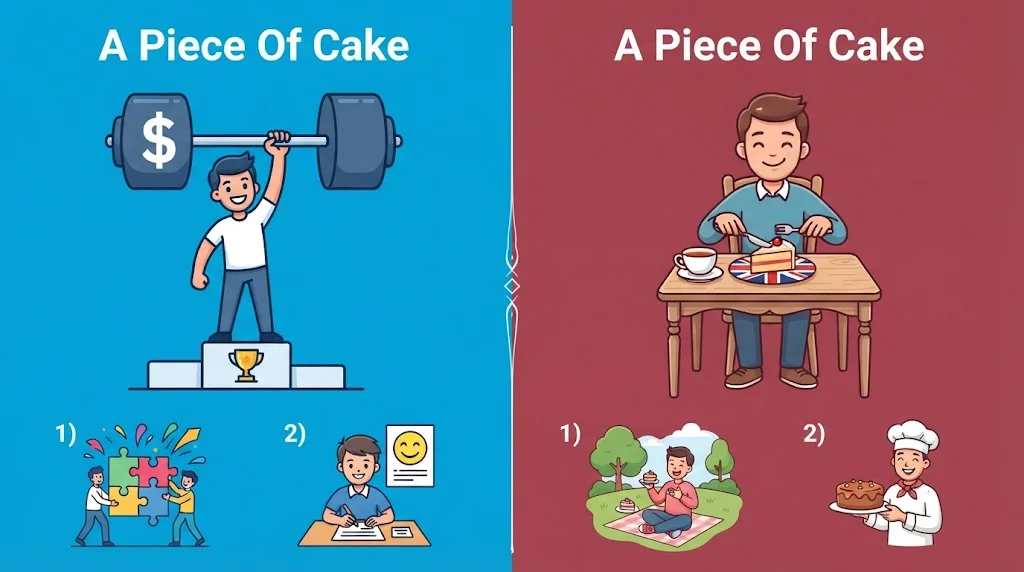
US vs UK Usage of “A Piece Of Cake”
Popularity
The phrase is extremely common in American English and is also widely understood throughout the United Kingdom. Movies, television, books, and online media have contributed to its international popularity.
Tone Perception
American speakers often use “A Piece Of Cake” as a casual expression of optimism. British speakers generally understand it the same way, although they may also choose expressions such as “easy as anything” or “dead easy” in everyday conversation.
Regional Preferences
The idiom works naturally in both US and UK English, especially in informal communication. Regional alternatives vary, but “A Piece Of Cake” remains one of the most universally recognized ways to describe an easy task.
“A Piece Of Cake” in Digital & Modern Communication
Emails
In friendly workplace emails, the phrase helps reassure colleagues that a process is straightforward.
Example:
Once you’ve updated the template, the remaining steps are a piece of cake.
Slack / WhatsApp
Team messaging platforms encourage conversational language, making this idiom feel natural.
Example:
Don’t stress about the upload—it’s a piece of cake after the first try.
Social Media
Creators frequently use the expression to make tutorials and guides feel accessible.
Example:
Organizing your files is a piece of cake with this simple workflow.
AI-Generated Summaries
Modern AI writing often favors clear, conversational language. While “A Piece Of Cake” can make summaries more engaging, it should be used selectively so that factual or professional content remains accurate and appropriately toned.
Linguistic & Communication Insight
Emotional Weight & Subtext
Although “A Piece Of Cake” literally describes dessert, native speakers immediately understand it as reassurance. The phrase carries an emotional message of confidence, optimism, and encouragement. It often reduces anxiety by suggesting that success is well within reach.
Direct vs Indirect Phrasing
Compared with statements like “This is simple,” “A Piece Of Cake” sounds warmer and more conversational. Softer alternatives such as “It should be manageable” encourage while acknowledging that experiences differ. The choice depends on how much certainty or sensitivity the speaker wants to communicate.
Professional Communication Perspective
In collaborative workplaces, the phrase can motivate teams by reducing perceived difficulty. However, experienced communicators avoid using it when discussing complex projects, sensitive issues, or work involving significant expertise because it may unintentionally undervalue the effort required.
Pragmatic Reasons for Alternatives
Professionals often replace “A Piece Of Cake” with phrases like “straightforward,” “manageable,” or “relatively simple” when communicating with clients, executives, or external stakeholders. These alternatives maintain confidence while sounding more precise, respectful, and objective.
Social Signaling
Word choice influences how others perceive expertise and empathy. Using “A Piece Of Cake” among friends or close colleagues signals friendliness and approachability. In formal environments, more measured language often communicates greater professionalism and credibility.
Tone & Context Guidance
The phrase works best when the audience already feels comfortable with informal communication and the task is genuinely uncomplicated. It becomes risky when speaking to someone facing a difficult challenge or when precision is more important than encouragement. Matching the expression to the audience, situation, and emotional context creates stronger, more effective communication.
Straightforward
Meaning: “Straightforward” describes a task, process, or explanation that is simple, clear, and easy to understand without unnecessary complexity.
Why This Phrase Works: It communicates simplicity while maintaining a professional tone suitable for formal and informal settings.
Real-World Usage Insight: Professionals frequently use this phrase in meetings, reports, and client communication because it sounds confident without being overly casual.
Best Use: Business emails, presentations, project discussions, academic writing, and workplace communication.
Avoid When: You want to sound playful or highly conversational.
Tone: Professional, neutral, confident.
US vs UK Usage: Equally common and widely accepted in both US and UK English.
Example (Email): “The onboarding process is straightforward, so you should be able to complete it before Friday.”
Easy to Accomplish
Meaning: This phrase indicates that a task can be completed without significant difficulty or specialized effort.
Why This Phrase Works: It clearly explains the level of difficulty without relying on an idiom, making it accessible for both native and non-native English speakers.
Real-World Usage Insight: It is commonly used in instructional materials, training sessions, and workplace documentation where clarity is important.
Best Use: Training manuals, educational content, professional conversations, and tutorials.
Avoid When: You want your writing to sound more natural and conversational.
Tone: Neutral, informative, supportive.
US vs UK Usage: Frequently used in both American and British English.
Example (Meeting): “Once the software is installed, updating customer records becomes easy to accomplish.”
Easily Manageable
Meaning: “Easily manageable” describes work or responsibilities that can be handled comfortably without excessive pressure.
Why This Phrase Works: It reassures people while acknowledging that some effort is still involved, making it sound realistic.
Real-World Usage Insight: Managers often use this phrase when assigning workloads or discussing project timelines.
Best Use: Performance reviews, workload discussions, planning meetings, and business communication.
Avoid When: Referring to very simple everyday activities where shorter wording feels more natural.
Tone: Professional, reassuring, balanced.
US vs UK Usage: Common across both regions, particularly in workplace communication.
Example (Meeting): “The revised schedule is easily manageable with our current team size.”
No Sweat
Meaning: “No Sweat” means that something is easy or requires very little effort. It can also mean “you’re welcome” after doing someone a favor.
Why This Phrase Works: It creates an encouraging and relaxed atmosphere while expressing confidence.
Real-World Usage Insight: Friends, teammates, and colleagues often use this expression during casual conversations and quick workplace chats.
Best Use: Informal conversations, text messages, Slack, and friendly workplace environments.
Avoid When: Writing formal reports, client proposals, or academic papers.
Tone: Casual, friendly, reassuring.
US vs UK Usage: More common in American English but well understood in the UK.
Example (Message): “Don’t worry about tomorrow’s presentation; it’s no sweat once you’ve practiced.”
Easy as Pie
Meaning: This idiom means that something is extremely easy to complete or understand.
Why This Phrase Works: It sounds warm, friendly, and familiar while emphasizing simplicity.
Real-World Usage Insight: Native speakers often use it when reassuring friends or making educational content feel approachable.
Best Use: Blogs, casual conversations, social media posts, and informal presentations.
Avoid When: Communicating with executives or in highly formal documents.
Tone: Casual, cheerful, playful.
US vs UK Usage: More frequently heard in the United States but recognized internationally.
Example (Blog): “With these five budgeting tips, saving money becomes easy as pie.”
A Breeze
Meaning: “A Breeze” describes something that is completed smoothly with little effort or difficulty.
Why This Phrase Works: It emphasizes not only ease but also how comfortably the task was completed.
Real-World Usage Insight: People often use this phrase after successfully finishing work that initially seemed difficult.
Best Use: Conversations, presentations, interviews, and workplace discussions.
Avoid When: Describing tasks that still require substantial expertise or preparation.
Tone: Relaxed, positive, conversational.
US vs UK Usage: Common in both American and British English.
Example (Conversation): “I thought the software migration would be difficult, but it was a breeze.”
Walk in the Park
Meaning: This idiom means that something is surprisingly easy or effortless.
Why This Phrase Works: It creates a vivid mental image that makes the expression memorable and engaging.
Real-World Usage Insight: Speakers often use it after completing a challenge more easily than expected.
Best Use: Friendly conversations, motivational speeches, and storytelling.
Avoid When: Discussing sensitive topics where exaggeration could seem dismissive.
Tone: Informal, expressive, optimistic.
US vs UK Usage: Widely understood in both the US and the UK.
Example (Meeting): “Compared to last year’s audit, this review should be a walk in the park.”
Child’s Play
Meaning: “Child’s Play” suggests that something is extremely easy, almost requiring no effort or advanced skill.
Why This Phrase Works: It quickly communicates a high level of simplicity using a familiar idiom.
Real-World Usage Insight: It is often used humorously, although speakers should avoid implying that another person’s work lacks value.
Best Use: Casual conversations, entertainment content, and lighthearted discussions.
Avoid When: Speaking to someone who may already be struggling with the task.
Tone: Casual, playful, sometimes exaggerated.
US vs UK Usage: Equally familiar in both regions.
Example (Social Media): “Editing short videos is child’s play once you’ve learned the keyboard shortcuts.”
Cakewalk
Meaning: “Cakewalk” refers to something that is exceptionally easy to achieve or complete, often requiring far less effort than expected.
Why This Phrase Works: It communicates confidence and simplicity while adding a touch of personality to everyday conversations.
Real-World Usage Insight: People commonly use this expression when comparing one task to another that was significantly more challenging.
Best Use: Informal workplace conversations, sports discussions, blogs, and casual storytelling.
Avoid When: Speaking in legal, academic, or highly formal business settings where idioms may sound unprofessional.
Tone: Casual, confident, slightly humorous.
US vs UK Usage: More frequently used in American English but generally understood in the UK.
Example (Meeting): “After completing the migration project, setting up the new user accounts will be a cakewalk.”
No Big Deal
Meaning: “No Big Deal” means that something is not difficult, important, or worth worrying about.
Why This Phrase Works: It reassures listeners while reducing unnecessary stress about a task or situation.
Real-World Usage Insight: Native speakers often use this phrase to comfort colleagues, friends, or family members before a routine activity.
Best Use: Friendly emails, conversations, text messages, and collaborative workplace chats.
Avoid When: Addressing serious concerns that deserve thoughtful attention.
Tone: Casual, reassuring, conversational.
US vs UK Usage: Very common in both American and British English.
Example (Message): “Updating the presentation is no big deal—I can finish it before our afternoon meeting.”
Easy Peasy
Meaning: “Easy Peasy” means that something is extremely simple and can be completed with very little effort.
Why This Phrase Works: Its playful rhythm makes it memorable and friendly, especially in informal communication.
Real-World Usage Insight: Parents, teachers, friends, and content creators often use it to make instructions feel less intimidating.
Best Use: Conversations, educational content, social media, and family settings.
Avoid When: Communicating with clients, executives, or in professional reports.
Tone: Very casual, playful, lighthearted.
US vs UK Usage: Popular in both countries, particularly in everyday spoken English.
Example (Social Media): “Organizing your desktop is easy peasy with these three quick shortcuts.”
Couldn’t Be Easier
Meaning: This expression emphasizes that a task is as simple as possible and cannot realistically become any less difficult.
Why This Phrase Works: It provides strong reassurance without relying on a figurative idiom that some learners may not understand.
Real-World Usage Insight: Businesses frequently use this phrase in marketing, product guides, and customer support because it sounds clear and confident.
Best Use: User guides, tutorials, customer service, websites, and presentations.
Avoid When: The process still involves multiple complex steps that may frustrate users.
Tone: Positive, clear, supportive.
US vs UK Usage: Common and natural in both US and UK English.
Example (Email): “Using the new dashboard couldn’t be easier thanks to the step-by-step setup wizard.”
Simple to Complete
Meaning: “Simple to Complete” describes a task that has clear steps and requires only a reasonable amount of effort.
Why This Phrase Works: It is direct, literal, and easy for international audiences to understand.
Real-World Usage Insight: Organizations often use this wording in instructions, application forms, and technical documentation to avoid ambiguity.
Best Use: Professional writing, instructional content, academic materials, and business communication.
Avoid When: You want a warmer or more conversational tone.
Tone: Neutral, professional, informative.
US vs UK Usage: Widely accepted in both regions.
Example (Email): “The registration process is simple to complete and usually takes less than five minutes.”
Requires Minimal Effort
Meaning: This phrase indicates that very little work, time, or energy is needed to finish a task successfully.
Why This Phrase Works: It sounds objective and professional while accurately describing the expected level of effort.
Real-World Usage Insight: Project managers, consultants, and technical writers often use it to set realistic expectations without exaggeration.
Best Use: Reports, proposals, planning documents, and workplace discussions.
Avoid When: Speaking casually with friends, where a more relaxed expression would sound more natural.
Tone: Professional, factual, measured.
US vs UK Usage: Frequently used in both American and British English.
Example (Meeting): “The final quality check requires minimal effort because the system performs most of the validation automatically.”
Easily Achievable
Meaning: “Easily Achievable” means that a goal or objective can realistically be accomplished without excessive difficulty.
Why This Phrase Works: It encourages confidence while remaining balanced and credible.
Real-World Usage Insight: Coaches, managers, educators, and mentors often use this phrase when setting realistic expectations and motivating others.
Best Use: Goal setting, coaching sessions, business planning, and educational feedback.
Avoid When: Referring to uncertain outcomes or highly competitive objectives.
Tone: Professional, encouraging, optimistic.
US vs UK Usage: Common in both the US and the UK, particularly in professional communication.
Example (Meeting): “With our current resources, reaching this quarter’s target is easily achievable.”
Comparison Table of 10 Best Alternatives
The alternatives below cover a range of communication styles, from highly professional to friendly and conversational. Choosing the right phrase depends on your audience, the level of formality, and whether your goal is to reassure, instruct, or motivate.
| Phrase | Meaning | Best Use | Worst Use | Tone | US vs UK Usage |
| Straightforward | Clear and uncomplicated | Business meetings, reports, emails | Casual jokes or playful conversations | Professional | Equally common in both |
| Easily Manageable | Can be handled comfortably | Project planning, workload discussions | Casual chatting with friends | Professional, reassuring | Common in both |
| Easy to Accomplish | Can be completed without much difficulty | Training materials, tutorials | Informal storytelling | Neutral | Common in both |
| A Breeze | Very easy and smooth | Conversations, presentations | Legal or academic writing | Casual | Common in both |
| Easy as Pie | Extremely easy | Blogs, social media, friendly conversations | Executive communication | Playful | More common in the US but understood in both |
| No Sweat | Requires little effort | Text messages, Slack, casual workplace chats | Formal reports | Casual | More common in the US |
| Walk in the Park | Easier than expected | Storytelling, team discussions | Sensitive situations | Informal | Widely understood in both |
| Couldn’t Be Easier | As simple as possible | Customer support, guides, tutorials | Complex procedures | Friendly, clear | Common in both |
| Requires Minimal Effort | Needs very little work | Reports, proposals, technical writing | Casual conversation | Formal, factual | Common in both |
| Easily Achievable | Realistically attainable | Goal setting, coaching, business planning | Highly uncertain objectives | Professional, encouraging | Common in both |
Conclusion
A Piece of Cake is one of the most widely recognized English idioms, used to describe tasks that are easy, straightforward, or require little effort. Its popularity comes from its ability to communicate reassurance and confidence in just a few words. Whether you’re speaking with friends, collaborating with coworkers, or creating online content, the phrase helps make conversations feel approachable and engaging. However, effective communication is about choosing language that fits the situation. In professional or formal settings, alternatives like “straightforward,” “easily manageable,” or “requires minimal effort” often provide greater clarity and credibility.
Understanding the meaning, origin, tone, and best-use scenarios of ” a piece of cake “ allows you to adapt your communication for different audiences without losing your intended message. By expanding your vocabulary with appropriate alternatives, you’ll write more naturally, speak more confidently, and improve your ability to communicate across professional, academic, and everyday situations while maintaining both clarity and authenticity.
FAQs
What does “A Piece Of Cake” mean?
A Piece Of Cake is an English idiom that means something is very easy to do or complete. It is commonly used in everyday conversations to reassure someone that a task is simple. The expression is figurative rather than literal and is widely understood by native English speakers in both casual and workplace settings.
Is “A Piece Of Cake” an idiom?
Yes. A Piece Of Cake is a classic English idiom because its meaning cannot be understood from the individual words alone. Instead of referring to dessert, it figuratively means that a task is easy. Learning this idiom helps ESL learners sound more natural in spoken and written English.
Can I use “A Piece Of Cake” in professional communication?
You can use it in relaxed workplaces, internal team chats, or conversations with colleagues. However, in formal business emails, executive presentations, legal documents, or academic writing, professional alternatives such as “straightforward” or “simple to complete” are usually more appropriate and precise.
What are the best synonyms for “A Piece Of Cake”?
Popular alternatives include Straightforward, Easy as Pie, A Breeze, No Sweat, Walk in the Park, Easily Manageable, Easy to Accomplish, Requires Minimal Effort, Couldn’t Be Easier, and Simple to Complete. The best choice depends on whether your audience expects casual, supportive, or professional language.
Is “A Piece Of Cake” common in American and British English?
Yes. The idiom is widely recognized and frequently used in both American and British English. While each region has its own informal expressions for describing easy tasks, A Piece Of Cake remains one of the most universally understood English idioms across native-speaking countries.
When should I avoid saying “A Piece Of Cake”?
Avoid using the phrase in serious, legal, medical, financial, or academic contexts where precision is important. It can also sound dismissive if someone finds the task genuinely difficult. In these situations, choosing a more balanced and professional expression helps maintain empathy and credibility.
Why is “A Piece Of Cake” so popular?
The phrase is memorable, concise, and easy to understand. It instantly communicates that something requires little effort, reducing the need for lengthy explanations. Its friendly tone also makes conversations feel more relaxed, which explains why it remains popular in speech, writing, and digital communication.
Is “Easy as Pie” the same as “A Piece Of Cake”?
They are very similar because both describe something as very easy. However, Easy as Pie sounds slightly more playful and conversational, while A Piece Of Cake is more commonly used across a wider variety of everyday situations, including informal workplace communication.
How can ESL learners use “A Piece Of Cake” naturally?
ESL learners should use the idiom when describing simple tasks, successful experiences, or giving reassurance in informal conversations. Listening to native speakers, reading authentic examples, and practicing the phrase in everyday situations will help it sound more natural and contextually appropriate.
Does using alternatives improve communication?
Yes. Using different alternatives prevents repetition and allows you to match your language to the audience and situation. Professional phrases improve business communication, while casual idioms create warmer conversations. A varied vocabulary also makes your writing more engaging, natural, and effective for both readers and AI-powered search results.


