
Imagine you’re in a meeting where someone confidently promises major changes, speaks with absolute certainty, and criticizes everyone else’s ideas. Yet when it’s time to act, nothing happens. Moments like these are exactly why the phrase “all bark, no bite” remains a popular part of everyday English.
The expression describes a person, organization, or situation that appears threatening, confident, or aggressive but ultimately lacks the willingness, ability, or intention to follow through. Whether you’re writing professionally, learning English, creating content, or communicating at work, understanding this phrase helps you interpret tone more accurately and choose alternatives that better suit different audiences.
Because language shapes perception, selecting the right expression matters. While “all bark, no bite” works well in casual conversations, it may sound too informal or judgmental in business, academic, or sensitive settings. Learning suitable alternatives allows you to communicate with greater clarity, professionalism, and emotional intelligence.
What Does “All Bark, No Bite” Mean?
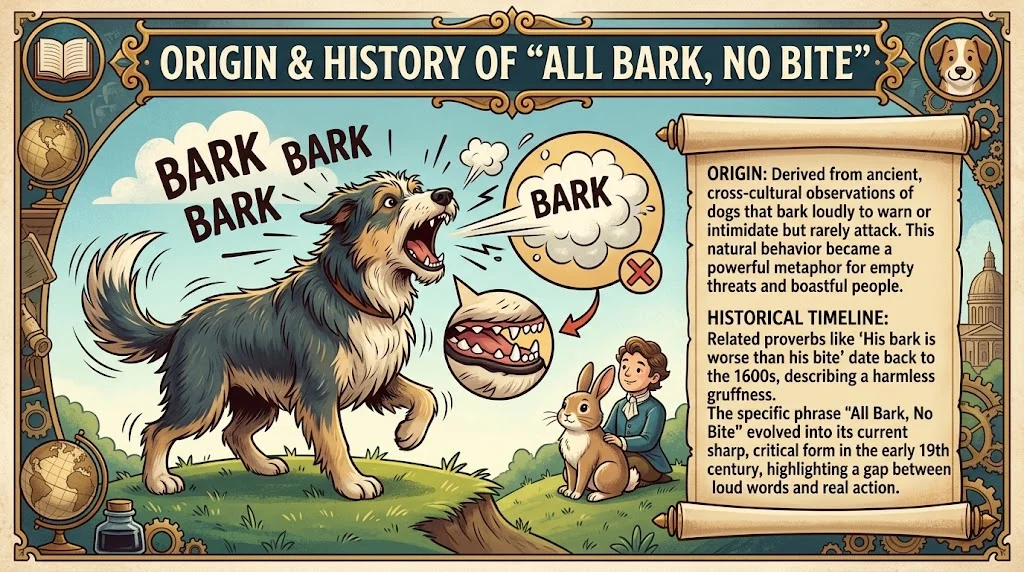
All bark, no bite refers to a person, group, or situation that appears intimidating, outspoken, or threatening but ultimately takes little or no meaningful action. People commonly use the phrase to describe someone whose words sound stronger than their actions, especially in workplace discussions, personal relationships, politics, sports, and everyday conversations.
Origin & History of “All Bark, No Bite”
The phrase “all bark, no bite” comes from observing dogs. A barking dog often sounds intimidating, warning others to stay away. However, not every barking dog actually attacks. Over time, English speakers began using this contrast as a metaphor for people whose threats or confidence exceeded their willingness to act.
The expression became widely established in English during the nineteenth century, although similar comparisons between barking and harmlessness appeared even earlier in literature and everyday speech. Its popularity grew because the image is immediately understandable across different cultures.
Today, the phrase is rarely interpreted literally. Instead, it describes behavior rather than physical aggression. It is commonly applied to outspoken managers, political figures, competitors, online commentators, sports rivals, or anyone who projects strength without demonstrating corresponding action.
Its continued popularity reflects a timeless communication principle: people judge credibility by actions rather than words. In modern workplaces and digital communication, this idea remains just as relevant as it was centuries ago.
Synonyms & Alternatives by Tone
Professional & Neutral Alternatives
- More talk than action
- Lacks follow-through
- Makes bold claims without action
- Doesn’t deliver on promises
- Big on promises, short on results
- Strong words, limited action
Polite & Supportive Alternatives
- Still building confidence
- Needs stronger execution
- Has room to improve follow-through
- More enthusiastic than consistent
- Learning to turn ideas into action
Encouraging & Reassuring Alternatives
- Actions will speak louder than words
- Focus on consistent action
- Ready to prove it through results
- Building credibility over time
- Let the work demonstrate the commitment
Casual, Playful & Idiomatic Alternatives
- Big talk, little action
- Full of hot air
- Talks a big game
- All show, no substance
- Empty threats
- Paper tiger
- Bluffing
- Just putting on a show
When Should You Use “All Bark, No Bite”?
The phrase works best when you want to describe someone whose behavior creates a stronger impression than their actual actions. It communicates the gap between appearance and reality in a concise, memorable way.
Professional Settings
In workplaces, the phrase can describe someone who frequently makes ambitious promises but rarely delivers measurable results. Because it carries a mildly critical tone, it is usually better suited to informal discussions than official reports or performance reviews. In formal business communication, alternatives such as “lacks follow-through” or “more talk than action” are often more appropriate.
Casual Conversations
Among friends and family, “all bark, no bite” is a common and easily understood idiom. It may refer to someone who complains loudly, makes dramatic threats, or acts intimidatingly while posing little real risk.
Example:
“Don’t worry about him. He’s all bark, no bite.”
Writing, Presentations, and Digital Communication
Writers use the expression to make commentary more engaging. It appears in blog posts, opinion pieces, leadership articles, sports analysis, and social media discussions because it quickly communicates a familiar idea without requiring lengthy explanation.
When It Is Especially Effective
This expression is particularly useful when:
- Someone consistently makes threats they never carry out.
- A competitor appears intimidating but performs poorly.
- A leader speaks confidently without producing results.
- An online debate involves dramatic language without meaningful action.
- You want to highlight the difference between reputation and reality in an engaging, conversational way.
When Should You Avoid “All Bark, No Bite”?
Although widely understood, “all bark, no bite” is not appropriate in every situation.
Overly Formal Situations
The idiom may sound too conversational in executive reports, academic writing, legal documents, or official correspondence. Clear, objective wording is usually more suitable.
Legal, Academic, or Sensitive Contexts
Because the phrase makes a judgment about someone’s behavior, it can appear subjective. In situations requiring factual neutrality, describe observable actions instead of relying on idioms.
Situations Where Nuance May Be Lost
Some people speak confidently while facing genuine limitations beyond their control. Calling them “all bark, no bite” may oversimplify the situation and overlook important context. When accuracy and empathy matter, more balanced language often communicates your message more effectively.
Is “All Bark, No Bite” Professional, Polite, or Casual?
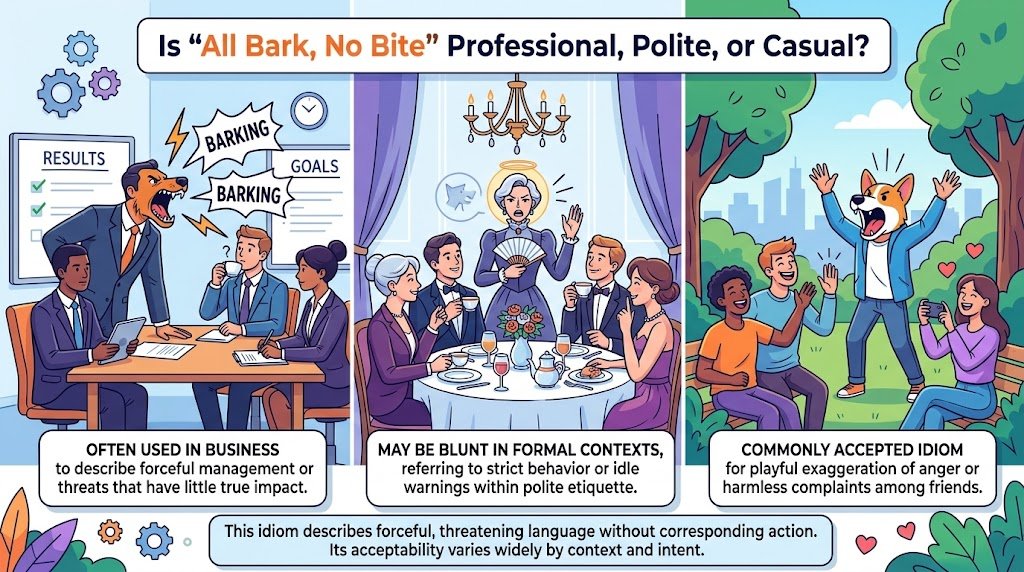
The phrase is generally considered casual, occasionally semi-professional, and only moderately polite depending on how it is used.
From a formality perspective, it belongs to conversational English rather than formal business language. It fits naturally into team discussions, presentations with an informal tone, workplace conversations, journalism, and everyday speech.
Emotionally, the expression suggests skepticism. It questions a person’s credibility by implying that their words exceed their actions. While it is less harsh than directly calling someone dishonest or incompetent, it still carries criticism.
Audience perception also matters. Colleagues who know each other well may interpret the phrase as lighthearted feedback, whereas clients, executives, or unfamiliar audiences could perceive it as unnecessarily blunt.
For professional communication, replacing the idiom with more neutral alternatives often improves clarity while maintaining respect. Expressions such as “needs stronger follow-through” or “more talk than action” deliver a similar message with less emotional weight.
Pros and Cons of Using “All Bark, No Bite”
Advantages
Clarity
The expression immediately communicates that someone’s actions fail to match their words, making it easy for most native English speakers to understand.
Efficiency
Instead of explaining a long pattern of behavior, the idiom summarizes the idea in just a few words.
Accessibility
Because it is widely recognized across English-speaking countries, readers quickly grasp its intended meaning in conversations, articles, presentations, and media.
Potential Drawbacks
Oversimplification
Human behavior is often more complex than the idiom suggests. Someone may appear inactive because of external constraints rather than unwillingness.
Tone Mismatch
In formal workplaces, legal settings, or academic writing, the phrase may sound too conversational or overly critical.
Repetition
Because the idiom is common, repeated use can make writing feel predictable. Rotating between suitable alternatives keeps communication more engaging and precise.
Real-Life Examples of “All Bark, No Bite” by Context
Emails
“The supplier sounded confident during the call, but after another missed deadline, they’re starting to seem all bark, no bite.”
Meetings
“The competitor made several bold announcements, but their recent product releases suggest they’re mostly all bark, no bite.”
Presentations
“Market leaders often appear intimidating at first, but careful analysis sometimes reveals they’re all bark, no bite when it comes to innovation.”
Conversations
“Everyone was worried about the new coach, but after meeting him, we realized he’s all bark, no bite.”
Social Media
“That account posts dramatic predictions every week, but none of them ever happen—it’s all bark, no bite.”
“All Bark, No Bite” vs Similar Expressions (Key Differences)
| Phrase | Meaning Difference | Tone Difference | Best Use Scenario |
| Talks a big game | Focuses on boasting or exaggerating ability rather than making threats. | Casual and conversational. | Sports, workplace discussions, friendly conversations. |
| Big talk, little action | Highlights a lack of follow-through without emphasizing intimidation. | Neutral to casual. | Professional feedback, blogs, everyday communication. |
| Paper tiger | Describes someone or something that appears powerful but is actually weak. | More formal and analytical. | Politics, business analysis, strategic discussions. |
| Full of hot air | Suggests someone talks excessively without substance or credibility. | Humorous and slightly sarcastic. | Informal conversations and opinion writing. |
| Empty threats | Refers specifically to threats that are unlikely to be carried out. | Direct and more serious. | Conflict resolution, negotiations, workplace discussions. |
| All show, no substance | Emphasizes appearance over genuine value or performance rather than threats alone. | Neutral to professional. | Product reviews, marketing analysis, leadership discussions. |
Common Mistakes & Misuse of “All Bark, No Bite”
Even though “all bark, no bite” is a familiar English idiom, it is sometimes used inaccurately or in situations where a different expression would communicate the message more effectively. Understanding these common mistakes helps you use the phrase with greater precision and professionalism.
Overuse
Because the expression is memorable, writers and speakers sometimes rely on it too often. Repeating the idiom throughout an article, presentation, or conversation can make your communication sound predictable. Varying your language with suitable alternatives keeps your writing engaging and demonstrates a stronger command of English.
Incorrect Context
The phrase applies only when someone’s words, threats, or appearance of confidence are stronger than their actual actions. It should not be used simply because someone fails at a task or makes a mistake.
Incorrect:
“The project failed because the team was all bark, no bite.”
This example assumes the team talked confidently without acting, which may not be true.
Better:
“The team made ambitious promises but struggled to follow through.”
Contradictory Usage
Avoid using the phrase for people who consistently take meaningful action. Someone can be outspoken and still be highly effective. In that case, describing them as “all bark, no bite” would contradict observable behavior and reduce your credibility.
Cultural Misunderstandings
Although the idiom is widely understood in English-speaking countries, ESL learners or international audiences may interpret it literally. In global business communication, replacing it with clearer wording such as “more talk than action” or “lacks follow-through” often improves understanding.
Psychological Reason People Prefer “All Bark, No Bite”
The popularity of “all bark, no bite” is rooted in how people naturally process language. The phrase communicates a complex judgment in just a few words, making it both memorable and efficient.
Cognitive Load Reduction
Our brains prefer familiar patterns that simplify information. Instead of explaining that someone repeatedly speaks confidently but rarely delivers results, the idiom instantly conveys that entire idea. This reduces the mental effort required for both the speaker and the listener.
Trust and Authority Signals
People often evaluate credibility by comparing promises with outcomes. The expression highlights this comparison, making it a quick way to question reliability without listing every example of someone’s behavior.
Attention Economy
Modern communication rewards brevity. Whether in meetings, social media posts, or conversations, concise expressions capture attention more effectively than lengthy explanations. “All bark, no bite” succeeds because it communicates an entire behavioral pattern in four simple words.
Modern Communication Habits
In fast-moving digital environments, readers often scan rather than read every sentence. Familiar idioms help audiences understand ideas immediately, which explains why the phrase continues to appear in journalism, online discussions, and business commentary.
US vs UK Usage of “All Bark, No Bite”
The idiom is well established in both American and British English, and its core meaning remains virtually identical across regions.
Popularity
In the United States, “all bark, no bite” is especially common in everyday conversation, workplace discussions, politics, sports commentary, and entertainment. It is frequently used to describe people who sound intimidating but ultimately fail to act.
British English also uses the phrase regularly, although speakers may sometimes choose alternatives such as “all mouth and no trousers” when referring to boastful behavior.
Tone Perception
American audiences generally hear the expression as mildly critical but conversational.
British audiences often interpret it similarly, though they may consider it slightly more colorful and idiomatic than straightforward descriptive language.
Regional Preferences
The idiom is widely understood throughout Canada, Australia, New Zealand, and other English-speaking regions. Because it relies on a universal image of barking dogs, it crosses regional boundaries more easily than many local idioms.
“All Bark, No Bite” in Digital & Modern Communication
Digital communication values clarity and speed, making “all bark, no bite” a phrase that still feels relevant across modern platforms.
Emails
In internal workplace emails, the idiom may be appropriate when the relationship is informal. However, messages sent to clients, executives, or external stakeholders usually benefit from more neutral alternatives such as “lacks follow-through.”
Slack and WhatsApp
Within team chats, the phrase is commonly used to describe delayed projects, competitors, or exaggerated concerns in a concise and conversational way.
Example:
“After reviewing their latest release, I think the competition is mostly all bark, no bite.”
Social Media
The expression frequently appears in discussions about politics, sports, technology, celebrity news, and business. Because social media encourages short, impactful language, the idiom fits naturally into comments and posts.
AI-Generated Summaries
Modern AI writing tools increasingly favor direct, universally understood language. While “all bark, no bite” can add personality to content, many AI summaries replace it with clearer wording such as “appears threatening but rarely acts” to improve accessibility for global audiences.
Conclusion
“All bark, no bite” remains one of the most recognizable English idioms for describing the gap between confident words and meaningful action. Its popularity comes from its simplicity, vivid imagery, and ability to communicate a familiar behavioral pattern in just a few words.
At the same time, effective communication depends on choosing language that fits your audience and purpose. In casual conversations, the idiom feels natural and expressive. In professional settings, alternatives such as “lacks follow-through,” “more talk than action,” or “strong words, limited action” often provide greater clarity while maintaining a respectful tone.
Whether you’re an ESL learner, content writer, student, or business professional, understanding both the phrase and its alternatives allows you to communicate with greater precision, build credibility, and adapt your tone to different situations. The strongest communicators know that selecting the right expression is not only about vocabulary—it is about making the intended message clear, appropriate, and effective.
Frequently Asked Questions About “All Bark, No Bite”
What does “all bark, no bite” mean in simple terms?
“All bark, no bite” means someone appears confident, aggressive, or threatening but does not take meaningful action. It describes a situation where words, promises, or warnings are stronger than actual results.
Is “all bark, no bite” an insult?
The phrase can be critical, but it is not always a serious insult. Its impact depends on the situation, relationship, and tone of voice. Among friends, it may sound humorous. In professional settings, it can sound judgmental if used directly toward a person.
Is “all bark, no bite” formal or informal?
“All bark, no bite” is mainly an informal idiom. It works well in conversations, blogs, opinion writing, and casual workplace discussions. For formal communication, alternatives such as “lacks follow-through” or “more talk than action” are usually more appropriate.
What is the opposite of “all bark, no bite”?
The opposite describes someone whose actions match or exceed their words. Possible alternatives include:
- Walks the talk
- Follows through on commitments
- Delivers results
- Takes meaningful action
- Leads by example
Can “all bark, no bite” be used for companies or organizations?
Yes, the phrase can describe organizations, competitors, or brands that make impressive claims but fail to demonstrate results. However, when discussing businesses publicly, more objective wording is often safer, such as “has not delivered on expectations” or “results have not matched claims.”
Can ESL learners use “all bark, no bite”?
Yes. ESL learners can use the phrase in informal conversations because it is widely understood by native English speakers. However, because idioms depend heavily on context, learners should avoid using them in formal emails, academic writing, or professional evaluations unless the audience is familiar with conversational English.
How do you politely say “all bark, no bite”?
More polite alternatives include:
- Has room to improve execution
- Needs stronger follow-through
- Has ambitious goals but needs consistent action
- Is still developing practical results
- Would benefit from stronger implementation
These alternatives communicate the idea without sounding dismissive.
Is “all bark, no bite” used more in the US or the UK?
The phrase is common in both American and British English. American speakers often use it in everyday conversations, sports discussions, and business commentary. British speakers understand it easily, although some may choose different expressions depending on the context.
Why is “all bark, no bite” so memorable?
The phrase works because it creates a clear contrast between appearance and reality. The simple image behind the expression makes it easy to remember, while the rhythm of the words makes it effective in conversation and writing.
Final Takeaway: Choosing the Right Alternative
“All bark, no bite” is a powerful phrase because it captures a common human behavior: the difference between what someone says and what they actually do. However, effective communication requires more than choosing a memorable expression.
For casual conversations, the idiom adds personality and clarity. For professional communication, neutral alternatives often create a stronger impression because they focus on observable behavior rather than personal judgment.
The best choice depends on your goal:
- Use “all bark, no bite” when you want a conversational and expressive tone.
- Use “more talk than action” when you want a balanced professional description.
- Use “lacks follow-through” when giving workplace feedback.
- Use “actions speak louder than words” when encouraging improvement.
- Use “doesn’t deliver on promises” when discussing measurable performance issues.
Understanding these differences helps writers, professionals, students, and English learners communicate more naturally and choose words that match the situation, audience, and intended message.
SEO Meta Description
Discover what “all bark, no bite” means, its synonyms, usage, examples, and professional alternatives to communicate more clearly and effectively.
Conclusion
“All bark, no bite” is a widely used English idiom that describes a person, group, or situation where confident words are not supported by meaningful action. Its simple wording makes it memorable, but the phrase carries a slightly critical tone that may not fit every situation.
In casual conversations, social media, and opinion-based writing, “all bark, no bite” can effectively express skepticism about exaggerated claims or empty confidence. However, professional communication often benefits from more neutral alternatives such as “lacks follow-through,” “more talk than action,” or “doesn’t deliver on promises.”
Understanding the meaning, tone, and appropriate context of this phrase helps speakers and writers communicate with greater precision. Whether you are an ESL learner, student, professional, or content creator, choosing the right expression improves clarity, builds trust, and ensures your message matches your audience and purpose.
FAQs
What does “all bark, no bite” mean?
“All bark, no bite” means someone appears threatening, confident, or aggressive but does not take meaningful action. The phrase is used when a person’s words, promises, or warnings seem stronger than their actual behavior. It often describes people who make bold statements but fail to follow through.
Is “all bark, no bite” a negative phrase?
Yes, “all bark, no bite” usually has a negative or critical meaning, but the severity depends on context. Among friends, it can sound humorous or playful. In professional situations, it may feel judgmental because it suggests someone lacks credibility, effectiveness, or the ability to act on their statements.
What are the best alternatives to “all bark, no bite”?
Common alternatives include “more talk than action,” “lacks follow-through,” “big talk, little action,” “talks a big game,” and “doesn’t deliver on promises.” The best choice depends on your audience. Professional settings usually require neutral phrases, while casual conversations allow more expressive idioms.
Can “all bark, no bite” be used in professional communication?
Yes, but it should be used carefully. The phrase is better suited for informal workplace conversations, team discussions, or commentary. In formal emails, reports, and performance reviews, alternatives like “needs stronger execution” or “lacks consistent follow-through” sound more objective and constructive.
What is the opposite of “all bark, no bite”?
The opposite describes someone whose actions match their words. Expressions such as “walks the talk,” “delivers results,” “follows through on commitments,” and “actions speak louder than words” communicate reliability, accountability, and consistency between promises and performance.
Is “all bark, no bite” common in American and British English?
Yes, the phrase is common in both American and British English. It has the same meaning in both regions, although speakers may choose different alternatives depending on context. American English often uses it in casual conversations, while British speakers may also use other idioms with similar meanings.
How do you use “all bark, no bite” in a sentence?
You can use it to describe someone whose behavior seems more intimidating than effective. For example: “The competitor made several strong statements about dominating the market, but so far they seem all bark, no bite.” The phrase is usually used after observing a pattern of words without action.
Is “all bark, no bite” suitable for academic writing?
Generally, no. Academic writing usually requires precise and objective language rather than conversational idioms. Instead of using “all bark, no bite,” writers can explain the specific issue, such as a lack of implementation, limited evidence, weak execution, or inconsistency between claims and results.
Why do people use the phrase “all bark, no bite”?
People use the phrase because it quickly communicates a complex idea: the difference between appearance and reality. It reduces a longer explanation into a memorable expression. The idiom is effective because listeners immediately understand that someone’s confidence, threats, or promises may not reflect their actual ability or intention.
What is a polite way to say “all bark, no bite”?
A more polite way to express the same idea is to focus on actions rather than personality. Examples include “needs stronger follow-through,” “would benefit from more consistent execution,” or “has ambitious goals but needs measurable results.” These alternatives communicate concerns while maintaining a respectful and professional tone.


