
Imagine you’re organizing a project at work, preparing for an important presentation, or planning a family gathering. Everyone wants the process to be simple, efficient, and free from unnecessary complications. In situations like these, you might hear someone say, “No fuss, no muss.” This familiar expression reassures people that something can be done smoothly, with little effort, and without creating confusion or extra work.
The phrase remains popular because modern communication values clarity, efficiency, and convenience. Whether you’re writing emails, speaking with colleagues, creating marketing content, or chatting with friends, choosing the right expression helps shape how your message is received. While “No Fuss, No Muss” sounds friendly and approachable, understanding its meaning, tone, and suitable alternatives allows you to communicate more naturally and professionally in different situations.
What Does “No Fuss, No Muss” Mean?
“No Fuss, No Muss” means that something can be done easily, cleanly, and without unnecessary difficulty, confusion, or inconvenience. The phrase describes a process or situation that requires minimal effort and avoids complications, making it suitable for everyday conversations, workplace discussions, advertising, and informal written communication.
Origin & History of “No Fuss, No Muss”
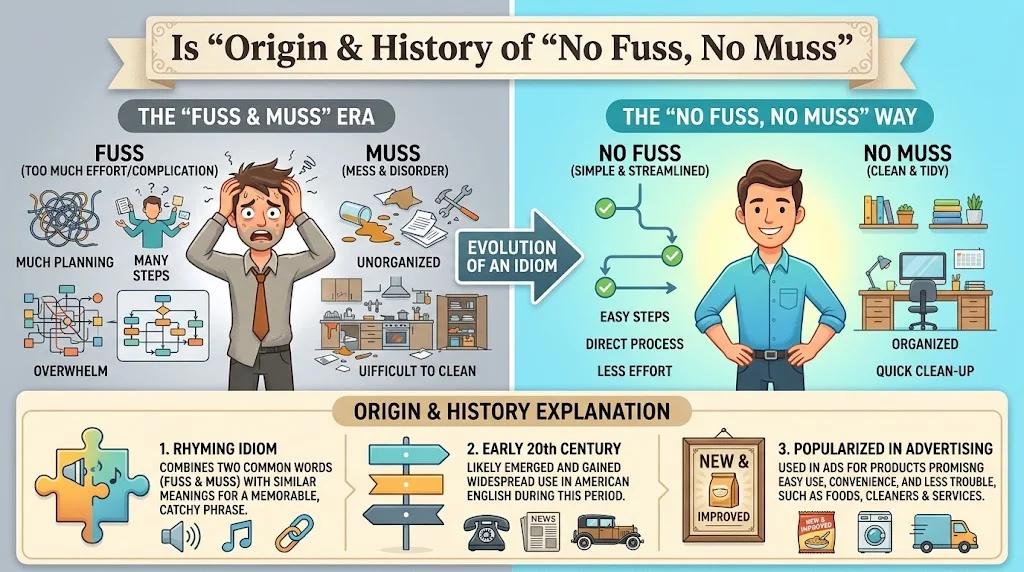
The expression “No Fuss, No Muss” has its roots in American English during the late nineteenth and early twentieth centuries. The word “fuss” had already become a common way to describe excessive excitement, unnecessary attention, or needless complication. “Muss,” meanwhile, referred to a mess, disorder, or untidy condition.
When paired together, the two rhyming words created a memorable idiom suggesting that a task could be completed without unnecessary commotion and without leaving a mess behind. Like many English expressions built around rhyme, its catchy sound helped it spread quickly through everyday speech.
During the twentieth century, advertisers embraced the phrase to promote products that promised convenience. Household cleaners, kitchen gadgets, instant foods, beauty products, and office supplies were frequently described as offering a “no fuss, no muss” experience. The phrase became closely associated with products that saved time and reduced effort.
Today, the meaning has expanded beyond physical cleanliness. It commonly describes:
- Simple processes
- Straightforward instructions
- Efficient services
- Easy-to-use products
- Hassle-free experiences
- Smooth workplace procedures
Although its original connection involved avoiding physical messes, modern speakers usually understand the expression more broadly as meaning easy, uncomplicated, and stress-free.
Synonyms & Alternatives by Tone
Professional & Neutral Alternatives
- Straightforward
- Hassle-free
- Simple process
- Easy to manage
- Efficient
- Streamlined
- User-friendly
- Smooth process
- Seamless
- Easy to follow
- Low-maintenance
- Convenient
- Practical
- Trouble-free
- Effortless
Polite & Supportive Alternatives
- We’ll make it easy
- Nothing complicated
- Easy to understand
- Simple to complete
- Designed for convenience
- We’ve simplified the process
- Easy from start to finish
- Clear and straightforward
- No unnecessary steps
- Made with simplicity in mind
Encouraging & Reassuring Alternatives
- Don’t worry
- We’ve got you covered
- It’s easier than it looks
- You’ll be fine
- Everything is taken care of
- Just follow these steps
- Stress-free
- Smooth sailing
- Quick and easy
- Simple from beginning to end
Casual, Playful & Idiomatic Alternatives
- Piece of cake
- Easy peasy
- No hassle
- Smooth sailing
- A breeze
- No sweat
- No headaches
- Easy does it
- Plain and simple
- Keep it simple
- No strings attached
- No drama
- Easy-going
- Good to go
- Done and dusted
When Should You Use “No Fuss, No Muss”?
The phrase works best when your goal is to reassure people that a task, process, or experience will be uncomplicated. Because it combines friendliness with simplicity, it fits many everyday and professional situations where reducing uncertainty is important.
Professional Settings
In workplaces, “No Fuss, No Muss” can help describe streamlined procedures, user-friendly software, simple onboarding processes, or services designed to save time. It works particularly well in marketing materials, customer support, internal communications, and presentations where the emphasis is on efficiency rather than technical detail.
Examples include:
- Introducing a simplified workflow
- Explaining an easy registration process
- Promoting a convenient product
- Describing automated services
- Encouraging customers to try a new feature
Casual Conversations
Among friends and family, the phrase naturally reassures others that an activity won’t require much effort. Whether planning dinner, organizing a trip, or helping someone solve a problem, it creates a relaxed and confident tone.
For example:
- “Just use this app—no fuss, no muss.”
- “We’ll keep the party simple. No fuss, no muss.“
Writing, Presentations, and Digital Communication
Content writers, marketers, educators, and presenters often use the phrase to make information feel approachable. It is especially effective when introducing step-by-step guides, tutorials, online tools, or products designed to simplify everyday tasks.
You may see it in:
- Blog posts
- Product descriptions
- Presentation slides
- Email campaigns
- Landing pages
- Help documentation
- Social media captions
When It Is Especially Effective
The expression is particularly useful when:
- You want to reduce hesitation.
- You want readers to feel confident about taking action.
- You are promoting convenience or efficiency.
- You are simplifying complex information.
- You want communication to sound warm and approachable rather than overly formal.
Because the phrase immediately signals ease and simplicity, it helps audiences feel that the task ahead is manageable rather than overwhelming.
When Should You Avoid “No Fuss, No Muss”?
Although “No Fuss, No Muss” is widely understood, it is not appropriate for every situation. Its informal and conversational tone can sometimes make serious topics sound too casual or dismissive.
Overly Formal Situations
Highly formal business reports, government documents, legal contracts, executive communications, and academic writing generally require more precise language. Expressions such as “streamlined process,” “efficient procedure,” or “minimal complexity” are usually better choices.
Legal, Academic, or Sensitive Contexts
When discussing legal matters, healthcare, financial advice, safety procedures, or academic research, simplicity should never come at the expense of accuracy. Using “No Fuss, No Muss” may unintentionally downplay risks or make important details seem less significant than they actually are.
Situations Where Nuance May Be Lost
Some tasks appear simple on the surface but involve meaningful decisions or careful planning. Describing them as “No Fuss, No Muss” could create unrealistic expectations.
Examples include:
- Major organizational changes
- Medical treatments
- Financial investments
- Complex software implementation
- Personal or emotional conversations
In these contexts, a more balanced explanation helps build trust and sets realistic expectations.
Is “No Fuss, No Muss” Professional, Polite, or Casual?
“No Fuss, No Muss” occupies a middle ground between casual conversation and approachable professional communication. It is generally polite, friendly, and informal, making it suitable for audiences that appreciate conversational language.
Tone Analysis
The phrase communicates confidence without sounding demanding. Instead of emphasizing speed or urgency, it highlights simplicity and ease. This positive framing often makes people feel more comfortable with a process or recommendation.
Formality Level
Its formality level is low to medium. While acceptable in many workplaces, customer-facing communications, and marketing materials, it is less appropriate for highly formal documents or official correspondence.
Emotional Subtext
Beyond its literal meaning, the expression conveys reassurance. It suggests that the speaker has anticipated potential difficulties and removed unnecessary obstacles, creating a sense of convenience and reliability.
Audience Perception
Different audiences may interpret the phrase differently:
- Professionals often see it as friendly and customer-focused.
- Students understand it as a simple way to describe easy tasks.
- ESL learners appreciate its memorable rhyme but should recognize that it is an idiom rather than literal language.
- Content writers and marketers frequently use it to communicate convenience and encourage engagement.
Used thoughtfully, “No Fuss, No Muss” strikes a balance between efficiency and warmth. However, choosing a more neutral alternative may be preferable when precision, authority, or sensitivity is the primary communication goal.
Pros and Cons of Using “No Fuss, No Muss”
Like many idiomatic expressions, “No Fuss, No Muss” offers clear advantages but also has limitations depending on the audience and context.
Advantages
Clarity
The phrase quickly communicates that something is simple, straightforward, and free from unnecessary complications. Most native English speakers immediately understand its intended meaning.
Efficiency
Instead of using a long explanation, the expression summarizes an entire idea in just a few memorable words. This makes communication faster and more engaging.
Accessibility
Its conversational tone makes information feel approachable. Businesses, educators, and writers often use it to reduce anxiety and encourage people to try something new.
Potential Drawbacks
Oversimplification
Some processes involve important details that should not be minimized. Using the phrase may unintentionally create unrealistic expectations about the amount of effort required.
Tone Mismatch
Because the expression is informal, it may sound out of place in legal documents, academic writing, executive reports, or sensitive discussions where precision and professionalism are expected.
Repetition
Using “No Fuss, No Muss” too frequently can make writing feel repetitive or overly promotional. Rotating between appropriate alternatives helps maintain variety, improves readability, and creates a more natural communication style.
Real-Life Examples of “No Fuss, No Muss” by Context
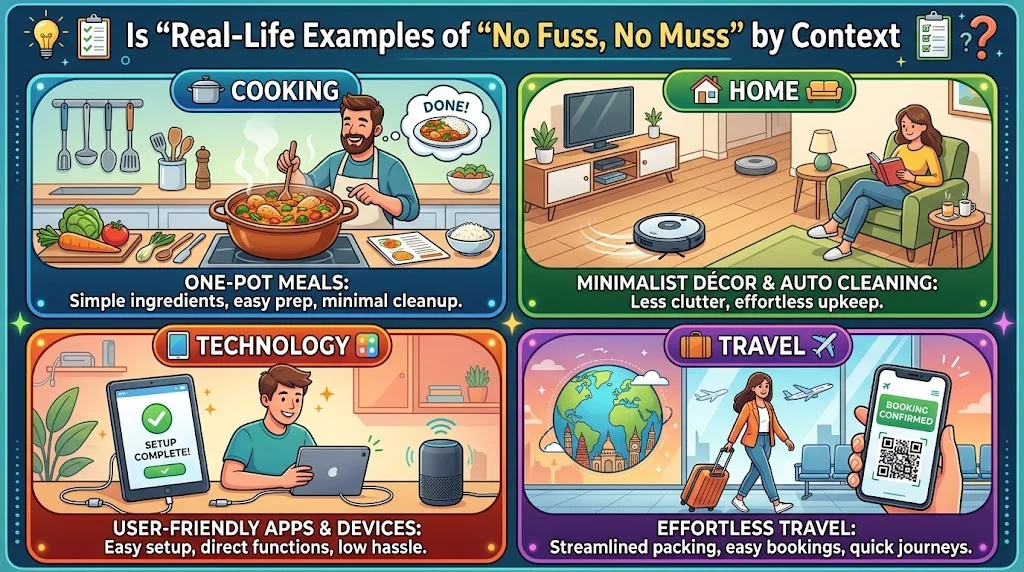
Seeing “No Fuss, No Muss” in realistic situations makes it easier to understand when the phrase feels natural and when another expression might work better. The examples below reflect everyday communication across professional and personal settings.
Emails
Customer Service
We’ve simplified the return process so you can exchange your item with no fuss, no muss. Simply follow the instructions in your confirmation email.
Internal Team Email
The updated template is ready to use. Just fill in your project details and submit it—no fuss, no muss.
Meetings
Project Update
We’ve automated the reporting process, so next month’s updates should be no fuss, no muss for everyone involved.
Manager’s Briefing
The new onboarding checklist keeps everything organized, making the first week no fuss, no muss for new employees.
Presentations
Product Launch
Our platform is designed to help teams collaborate with no fuss, no muss, allowing you to focus on results instead of administration.
Training Session
Follow these three steps, and you’ll complete the setup with no fuss, no muss.
Conversations
Friend
Just book the tickets through the app. It’s no fuss, no muss.
Parent
We’ll order dinner instead of cooking tonight—no fuss, no muss.
Social Media
Looking for an easy meal prep solution? Our recipes are quick, affordable, and no fuss, no muss.
Weekend organization tips: declutter one room at a time for a no-fuss, no-muss cleaning routine.
“No Fuss, No Muss” vs Similar Expressions (Key Differences)
Although “No Fuss, No Muss” shares similarities with several English expressions, each carries its own meaning, tone, and ideal context. Choosing the right phrase helps make communication more precise and natural.
| Phrase | Meaning Difference | Tone Difference | Best Use Scenario |
| No hassle | Focuses on avoiding inconvenience rather than avoiding both effort and mess | Neutral and conversational | Customer service, workplace communication, product descriptions |
| Piece of cake | Emphasizes that something is extremely easy | Very casual and playful | Friendly conversations, informal presentations |
| Smooth sailing | Suggests that everything continues without problems after starting | Optimistic and relaxed | Project updates, travel, teamwork |
| Straightforward | Highlights clarity and simplicity without using an idiom | Professional and neutral | Business writing, reports, instructions |
| Easy as pie | Means very easy, but with a more playful tone | Informal and lighthearted | Casual conversations and social media |
| Seamless | Emphasizes a process that feels uninterrupted and efficient | Professional and polished | Technology, software, business presentations |
Key takeaway: While “No Fuss, No Muss” combines simplicity, convenience, and ease, alternatives like “straightforward” or “seamless” are often better suited to formal communication, whereas expressions such as “piece of cake” fit casual conversations.
Common Mistakes & Misuse of “No Fuss, No Muss”
Even though the phrase is easy to understand, it is sometimes used in situations where it can confuse readers or weaken the intended message.
Overuse
Repeating “No Fuss, No Muss” throughout an article, presentation, or marketing campaign can make the writing feel repetitive. Varying your language with suitable alternatives improves readability and keeps the content engaging.
Incorrect Context
The expression should describe situations that are genuinely simple or uncomplicated. Using it for highly technical, legal, or emotionally sensitive topics may appear dismissive or unrealistic.
Less suitable:
Filing an international tax appeal is no fuss, no muss.
More suitable:
We’ve simplified the filing process, but professional guidance may still be helpful.
Contradictory Usage
Avoid pairing the phrase with descriptions that clearly involve significant effort.
Confusing example:
The migration process is no fuss, no muss, but it will require six months of planning, multiple approvals, and extensive staff training.
The message becomes inconsistent because the explanation contradicts the idiom.
Cultural Misunderstandings
Many ESL learners understand the words individually but may interpret them literally. Since “muss” is uncommon in everyday English, explaining the phrase as an idiom is often helpful when communicating with international audiences.
Psychological Reason People Prefer “No Fuss, No Muss”
The popularity of “No Fuss, No Muss” reflects how people naturally respond to messages that promise simplicity and reduced effort.
Cognitive Load Reduction
People constantly process large amounts of information. Expressions that suggest simplicity lower perceived mental effort, making tasks feel more approachable before they even begin.
Trust and Authority Signals
When businesses describe a process as “No Fuss, No Muss,” they communicate confidence in the efficiency of their product or service. If supported by genuine ease of use, this can strengthen credibility and customer trust.
Attention Economy
Modern audiences often skim emails, websites, and social media posts. Short, memorable idioms communicate value quickly, helping readers understand the key message without reading lengthy explanations.
Modern Communication Habits
Today’s communication favors speed, convenience, and clarity. Expressions that promise a smoother experience align well with digital products, online services, mobile apps, and self-service platforms where users expect efficiency.
US vs UK Usage of “No Fuss, No Muss”
Although the phrase is understood in both countries, its popularity and style differ somewhat.
Popularity
In the United States, “No Fuss, No Muss” remains a recognizable idiom and appears frequently in advertising, product descriptions, and conversational English.
In the United Kingdom, people generally understand the phrase, but alternatives such as “no hassle,” “straightforward,” or “simple and easy” tend to appear more often in everyday communication.
Tone Perception
American speakers often view the phrase as warm, reassuring, and practical.
British speakers may perceive it as slightly old-fashioned or distinctly American, though still understandable in most contexts.
Regional Preferences
For international audiences, choosing more universally understood alternatives such as “hassle-free,” “straightforward,” or “easy to use” can improve clarity, particularly in global business communication.
“No Fuss, No Muss” in Digital & Modern Communication
As communication increasingly happens online, the phrase continues to adapt to new platforms and audiences.
Emails
Businesses use “No Fuss, No Muss” to reassure customers that a process is quick and uncomplicated.
Example:
Complete your registration online—no fuss, no muss.
Slack / WhatsApp
In workplace messaging apps, the phrase creates a friendly tone while emphasizing efficiency.
Example:
I’ve already updated the spreadsheet, so today’s meeting should be no fuss, no muss.
Social Media
Brands often use the expression to promote convenience and save space while maintaining a conversational voice.
Example:
Healthy dinners in under 20 minutes—no fuss, no muss.
AI-Generated Summaries
Modern AI writing tools often replace the idiom with more direct alternatives such as:
- Hassle-free
- Simple
- Straightforward
- Easy to follow
- Streamlined
These alternatives improve clarity for international readers while preserving the original meaning.
Linguistic & Communication Insight
Understanding “No Fuss, No Muss” goes beyond its dictionary definition. Native speakers interpret not only its literal meaning but also the emotional signals it sends about confidence, simplicity, and the speaker’s attitude.
Emotional Weight & Subtext
The phrase subtly reassures listeners that potential problems have already been considered. Rather than simply describing an easy task, it suggests confidence, preparation, and convenience. This emotional reassurance often makes people more willing to accept recommendations or try something new.
Direct vs Indirect Phrasing
Compared with direct statements like “This is easy,” “No Fuss, No Muss” feels softer and more conversational. It reduces pressure by focusing on the experience instead of making absolute claims about difficulty.
For example:
- This is easy. — Direct and confident.
- No Fuss, No Muss. — Friendly, reassuring, and less forceful.
- We’ve simplified the process. — Professional and informative.
- You’ll find it straightforward. — Supportive without sounding promotional.
This subtle difference makes the idiom particularly useful when encouraging action without appearing overly persuasive.
Professional Communication Perspective
In workplace communication, the phrase often works best when describing customer experiences, internal workflows, onboarding processes, or product features. It communicates efficiency while maintaining a friendly tone.
However, professionals typically avoid it when discussing compliance, contracts, finance, healthcare, or strategic planning because those topics require greater precision and seriousness.
Pragmatic Reasons for Alternatives
Experienced communicators frequently choose alternatives based on audience expectations rather than vocabulary alone.
For example:
- Hassle-free emphasizes convenience.
- Straightforward highlights clarity.
- Seamless suggests a polished experience.
- Streamlined focuses on operational efficiency.
- Simple to follow supports instructional content.
Selecting the right alternative allows writers to balance authority, warmth, and clarity while avoiding language that may sound overly casual.
Social Signaling
Word choice communicates more than information—it also signals professionalism, confidence, and empathy.
Using “No Fuss, No Muss” tells readers that the speaker values convenience and understands common frustrations. In the right context, this builds rapport and makes communication feel approachable. In highly formal situations, however, the same phrase may unintentionally signal informality where precision is expected.
Tone & Context Guidance
Use “No Fuss, No Muss” when your goal is to reassure people, simplify communication, or highlight convenience in everyday conversations, customer communication, marketing content, and instructional writing.
Choose a more neutral alternative when accuracy, legal precision, academic rigor, or emotional sensitivity is more important than conversational warmth. Matching the phrase to the audience and situation helps ensure your message is both clear and appropriately professional.
Conclusion
“No Fuss, No Muss” remains a useful English expression because it communicates simplicity, convenience, and efficiency memorably. It helps speakers and writers explain that something can be completed without unnecessary complications, stress, or confusion. While the phrase works well in casual conversations, marketing, customer communication, and friendly professional settings, choosing the right alternative depends on the audience and purpose.
For formal situations, expressions such as “straightforward,” “streamlined,” or “efficient” may sound more professional. For casual conversations, phrases like “piece of cake” or “no hassle” may feel more natural. Understanding the tone behind each expression allows you to communicate with greater clarity and confidence.
Whether you are a professional, student, ESL learner, or content writer, knowing when to use “No Fuss, No Muss” and when to replace it with a more suitable phrase can improve your everyday communication. The key is not only understanding the meaning but also recognizing the context, audience, and emotional message behind the words.
FAQs
What does “No Fuss, No Muss” mean?
“No Fuss, No Muss” means something can be done easily without unnecessary trouble, complications, or mess. It describes a simple and convenient process that requires little effort. People commonly use this phrase when talking about easy tasks, efficient services, simple solutions, or experiences designed to save time and avoid frustration.
Is “No Fuss, No Muss” a professional phrase?
“No Fuss, No Muss” can be used in some professional situations, especially in marketing, customer service, and informal workplace communication. However, it may sound too casual for formal reports, legal documents, academic writing, or executive communication. In those settings, alternatives like “straightforward,” “efficient,” or “streamlined” are usually more appropriate.
Is “No Fuss, No Muss” formal or informal?
The phrase is generally considered informal to moderately conversational. It has a friendly and approachable tone rather than a highly professional or academic style. Native speakers often use it in everyday conversations, advertisements, product descriptions, and casual business communication where simplicity and convenience are the main focus.
Where did the phrase “No Fuss, No Muss” come from?
“No Fuss, No Muss” originated in American English. The phrase combines “fuss,” meaning unnecessary excitement or trouble, with “muss,” meaning disorder or mess. The rhyming structure made it memorable, and it became popular in advertising and everyday speech to describe products, services, and processes that were easy and convenient.
What are the best alternatives to “No Fuss, No Muss”?
Common alternatives include “hassle-free,” “straightforward,” “simple,” “seamless,” “streamlined,” “easy to follow,” and “no hassle.” The best choice depends on the situation. For professional writing, “streamlined” or “straightforward” often works better, while “no hassle” and “piece of cake” fit more casual conversations.
Can I use “No Fuss, No Muss” in an email?
Yes, you can use “No Fuss, No Muss” in emails when the tone is friendly, conversational, or customer-focused. It works well for messages about simple processes, quick solutions, or convenient services. For formal business emails, replacing it with “simple process” or “straightforward solution” may create a more professional impression.
What is the difference between “No Fuss, No Muss” and “Hassle-Free”?
Both phrases describe something easy and convenient, but their emphasis is slightly different. “No Fuss, No Muss” has a more casual and playful tone, focusing on avoiding trouble and mess. “Hassle-free” sounds more modern and professional, often appearing in business, customer service, and marketing communication.
Do Americans and British people use “No Fuss, No Muss” differently?
The phrase is understood in both American and British English, but it is more commonly associated with American usage. In the US, it appears frequently in advertising and casual speech. In the UK, speakers may understand it but often choose alternatives such as “no hassle,” “simple,” or “straightforward” in everyday communication.
Is “No Fuss, No Muss” suitable for academic writing?
Generally, “No Fuss, No Muss” is not recommended for academic writing because it is an informal idiom. Academic writing usually requires precise and objective language. Better alternatives include “a simplified approach,” “an efficient method,” or “a straightforward process,” depending on the meaning you want to express.
Why do people like using phrases like “No Fuss, No Muss”?
People prefer expressions like “No Fuss, No Muss” because they communicate simplicity quickly and reduce uncertainty. In modern communication, audiences often value messages that save time and lower perceived effort. The phrase also creates a friendly emotional response by suggesting that a process will be easy, manageable, and free from unnecessary difficulties.


