
A manager notices a heated discussion during a team meeting. A colleague interrupts repeatedly, and someone finally says, “Don’t provoke me.” The phrase immediately signals frustration and warns that the speaker is close to losing patience. “Don’t provoke me” means asking someone not to intentionally annoy, challenge, or push them into an angry reaction.
In modern communication, this phrase carries more than its literal meaning. The words we choose to express irritation, boundaries, or disagreement can shape how others perceive our confidence, professionalism, and emotional control. While “don’t provoke me” is clear and direct, it may sound confrontational in certain situations. Understanding its alternatives helps professionals, students, ESL learners, and writers communicate with better accuracy and emotional awareness.
What Does “Don’t Provoke Me” Mean?
“Don’t provoke me” means a person is asking another person to stop doing something that may cause anger, frustration, or a strong emotional reaction. The phrase is commonly used during conflicts, disagreements, arguments, or situations where someone feels intentionally challenged, irritated, or pushed beyond their comfort level.
The phrase combines “don’t,” a direct request to stop an action, with “provoke,” meaning to deliberately cause a reaction. In most situations, the intended meaning is not simply “stop talking” but rather “stop doing something that is making me angry or testing my patience.”
Origin & History of “Don’t Provoke Me”
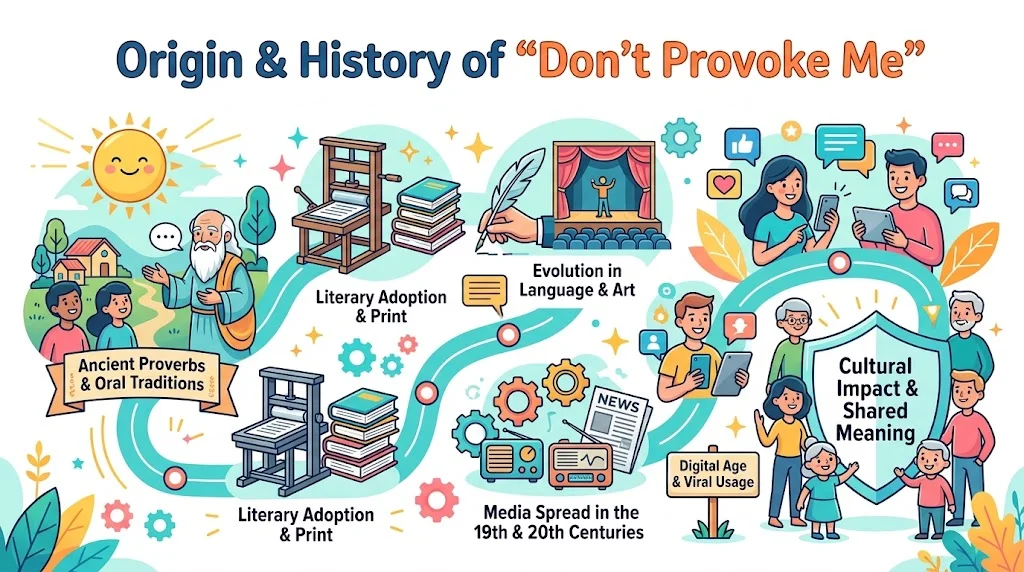
The word “provoke” comes from the Latin word provocare, meaning “to call forth” or “to challenge.” It entered English through Old French and originally referred to calling someone out, challenging them, or causing a response.
Over time, “provoke” developed a stronger emotional meaning. Instead of simply encouraging a reaction, it became associated with causing anger, irritation, or conflict. The phrase “don’t provoke me” became common in everyday English as a way to express a warning, boundary, or emotional limit.
Historically, similar expressions appeared in literature, politics, and personal conflicts when people wanted to communicate that continued pressure could lead to a negative response. Today, the phrase remains widely understood in English-speaking cultures, especially in conversations involving disagreements, teasing, competition, or emotional tension.
Synonyms & Alternatives by Tone
Choosing the right alternative depends on the situation, relationship, and desired emotional effect. Some expressions communicate a firm boundary, while others reduce tension and encourage cooperation.
Professional & Neutral Alternatives
- Please don’t push this further.
- Let’s avoid escalating this situation.
- I’d appreciate it if we could keep this constructive.
- Please respect my boundaries.
- Let’s stay focused on the issue.
- I would prefer not to continue in this direction.
- Let’s handle this calmly.
- I suggest we take a different approach.
Polite & Supportive Alternatives
- I’d appreciate your understanding.
- Could we approach this differently?
- Let’s find a better way to discuss this.
- I’d rather keep this conversation positive.
- Can we work through this together?
- I’d like us to communicate more respectfully.
- Let’s try to understand each other.
Encouraging & Reassuring Alternatives
- Let’s take a moment and reset.
- We can solve this together.
- Let’s focus on finding a solution.
- I know we can work this out.
- Let’s move forward positively.
- We’re on the same side here.
- Let’s keep the conversation productive.
Casual, Playful & Idiomatic Alternatives
- Don’t push my buttons.
- Don’t test me.
- Don’t start something.
- Don’t mess with me.
- Don’t go there.
- You’re pushing your luck.
- Careful, you’re getting close.
- Don’t poke the bear.
When Should You Use “Don’t Provoke Me”?
“Don’t provoke me” is most effective when the speaker wants to communicate a clear emotional boundary. However, the context determines whether it sounds reasonable or aggressive.
Professional Settings
In workplaces, the phrase should be used carefully. It may work in informal conversations between colleagues who understand each other’s communication style, but it can sound threatening in formal discussions.
A better professional approach is often to describe the behavior rather than accuse the person:
- “I’d prefer we keep this discussion respectful.”
- “Let’s avoid making this more difficult.”
- “I’d like to focus on resolving the issue.”
Casual Conversations
Among friends, family members, or people with a familiar relationship, “don’t provoke me” can be understood as a warning, joke, or playful challenge.
Example:
“Keep hiding my phone and don’t provoke me—I’m already running late.”
Here, the phrase may sound humorous rather than hostile.
Writing, Presentations, and Digital Communication
In written communication, tone can easily be misunderstood because readers cannot hear facial expressions or voice tone. Emails, messages, and social media posts should consider softer alternatives if the goal is cooperation.
“Don’t provoke me” works better when writing dialogue, storytelling, opinion pieces, or situations where strong emotion is intentional.
When It Is Especially Effective
The phrase is useful when:
- Someone is repeatedly crossing a personal boundary.
- A situation is becoming emotionally intense.
- A speaker wants to communicate seriousness quickly.
- The audience understands the speaker’s personality and tone.
When Should You Avoid “Don’t Provoke Me”?
Although the phrase is understandable, there are situations where it can create unnecessary tension.
Overly Formal Situations
In professional environments, interviews, negotiations, or official communication, “don’t provoke me” may appear defensive or aggressive.
A more effective option is:
- “I’d like to address this calmly.”
- “Let’s focus on finding a solution.”
Legal, Academic, or Sensitive Contexts
In legal discussions, academic writing, or sensitive conversations, emotional wording can distract from the main issue. Clear and neutral language is usually more effective.
Instead of:
“Don’t provoke me during this discussion.”
Consider:
“I would appreciate keeping this conversation respectful and focused.”
Situations Where Nuance May Be Lost
Because the phrase has emotional intensity, different audiences may interpret it differently. One person may hear it as a simple warning, while another may perceive it as intimidation.
This is especially important in:
- Cross-cultural communication
- Workplace environments
- Online discussions
- Customer service interactions
Is “Don’t Provoke Me” Professional, Polite, or Casual?
“Don’t provoke me” is generally direct and emotionally charged rather than professional or polite. Its formality level is low to medium, depending on the situation.
The phrase communicates:
- A strong personal boundary
- Frustration or irritation
- A warning against continued behavior
- A desire for the other person to stop
In casual conversations, it can sound natural. In professional environments, it may create the impression that the speaker is reacting emotionally rather than managing the situation.
The emotional subtext often suggests:
“I feel pressured, and I want this behavior to stop before my reaction becomes stronger.”
Experienced communicators often replace it with calmer alternatives because those phrases maintain authority while reducing defensiveness.
Pros and Cons of Using “Don’t Provoke Me”
Advantages
Clarity:
The phrase clearly communicates that a boundary has been reached.
Efficiency:
It expresses frustration quickly without requiring a long explanation.
Accessibility:
Most English speakers immediately understand the intended message.
Potential Drawbacks
Oversimplification:
It may not explain what specific behavior needs to change.
Tone mismatch:
The listener may interpret it as a threat rather than a request.
Repetition:
Using it frequently can make communication appear overly aggressive.
Real-Life Examples of “Don’t Provoke Me” by Context
Emails
“Please review the feedback before tomorrow’s meeting. Don’t provoke me by reopening the same issue without addressing the previous concerns.”
(While understandable, this email sounds confrontational. A professional rewrite would usually be better.)
Meetings
A team leader says:
“We’ve discussed this issue several times. Don’t provoke me by turning this into another argument instead of looking for solutions.”
Presentations
A speaker discussing workplace conflict might say:
“Constant criticism without solutions can make people feel like they are being provoked.”
Conversations
Friend:
“You’re really going to bring that up again?”
Response:
“Don’t provoke me. I’m already having a difficult day.”
Social Media
A user posts:
“I’m happy to discuss different opinions, but don’t provoke me with personal attacks.”
“Don’t Provoke Me” vs Similar Expressions (Key Differences)
The following phrases are related but differ in emotional intensity, purpose, and social impact.
| Phrase | Meaning Difference | Tone Difference | Best Use Scenario |
| Don’t provoke me | Asking someone to stop causing irritation or anger | Direct, warning, emotionally strong | Personal conflicts or heated situations |
| Don’t push my buttons | Asking someone not to intentionally trigger irritation | More casual and conversational | Friends, teasing, informal conversations |
| Don’t test me | Warning someone not to challenge patience or limits | Strong, confident, sometimes intimidating | Competitive or tense situations |
| Don’t push it | Asking someone not to continue beyond acceptable limits | Casual and firm | Everyday disagreements |
| Let’s keep this respectful | Requesting a calmer and more constructive interaction | Professional and controlled | Workplace discussions |
| Please don’t escalate this | Asking someone not to make a situation worse | Neutral and diplomatic | Conflict resolution |
Common Mistakes & Misuse of “Don’t Provoke Me”
Overuse
Using the phrase repeatedly can reduce its impact and make ordinary disagreements seem more serious than they are.
Incorrect Context
Using it with customers, managers, teachers, or unfamiliar people may damage relationships because it can sound like a threat.
Contradictory Usage
The phrase does not work well when someone wants cooperation. Saying “don’t provoke me” while asking for teamwork creates mixed signals.
Cultural Misunderstandings
Different cultures interpret direct warnings differently. Some audiences may see the phrase as confident, while others may view it as disrespectful.
Psychological Reasons People Prefer “Don’t Provoke Me”
People often choose this phrase because it quickly communicates emotional boundaries.
Cognitive Load Reduction
Short expressions help people communicate strong feelings quickly, especially during stressful moments.
Trust and Authority Signals
A clear boundary can show confidence, but overly aggressive wording may reduce trust.
Attention Economy
Modern communication rewards short, memorable phrases. Direct expressions are often used because they immediately capture attention.
Modern Communication Habits
Social media, messaging apps, and fast workplace conversations encourage shorter emotional statements instead of detailed explanations.
US vs UK Usage of “Don’t Provoke Me”
In both American and British English, “don’t provoke me” is understood clearly, but the tone may differ.
US Usage
In American English, the phrase is often associated with directness and emotional expression. It may appear in casual arguments, movies, conversations, or strong personal statements.
UK Usage
In British English, the phrase can sound more dramatic or formal depending on context. Speakers may prefer indirect expressions such as:
- “Don’t push your luck.”
- “Let’s not take this any further.”
- “I’d rather not go there.”
British communication often uses more understatement, especially in professional settings.
“Don’t Provoke Me” in Digital & Modern Communication
Emails
Written messages remove vocal tone, making the phrase appear stronger than intended.
Slack / WhatsApp
Among friends or close coworkers, it may be used jokingly:
“Don’t provoke me before my first coffee.”
Social Media
The phrase is commonly used to defend opinions or respond to criticism. However, it can increase conflict if used during online arguments.
AI-Generated Summaries
AI writing tools often replace emotionally strong phrases like “don’t provoke me” with more neutral wording because professional communication usually benefits from reduced confrontation.
Linguistic & Communication Insight
Emotional Weight & Subtext
Native speakers usually hear more than the literal meaning. “Don’t provoke me” suggests that the speaker feels challenged, irritated, or close to reacting emotionally.
The hidden message is often:
“Please stop this behavior because it is affecting my emotional state.”
Direct vs Indirect Phrasing
“Don’t provoke me” is direct and places responsibility on the other person.
A softer alternative:
“Can we approach this differently?”
Creates a more collaborative feeling.
Direct phrasing communicates urgency and boundaries. Indirect phrasing often communicates patience and willingness to cooperate.
Professional Communication Perspective
In workplaces, experienced communicators usually choose language that protects relationships while still expressing concerns. A manager may want to set limits without making employees feel attacked.
Pragmatic Reasons for Alternatives
Professionals often replace “don’t provoke me” because alternatives can:
- Reduce defensiveness
- Encourage cooperation
- Maintain authority
- Keep conversations solution-focused
Social Signaling
Word choice influences how people judge confidence, emotional control, and reliability. A person who chooses calm but firm language often appears more professional and approachable.
Tone & Context Guidance
Use “don’t provoke me” when:
- The relationship is familiar.
- A strong boundary needs to be communicated.
- The emotional context is already clear.
Avoid it when:
- You need cooperation.
- The audience is unfamiliar.
- The situation requires diplomacy.
Don’t Push My Buttons
Meaning
“Don’t push my buttons” means asking someone not to intentionally do things that irritate, frustrate, or emotionally trigger a reaction. It suggests that the other person knows or should know what behaviors annoy the speaker.
Why This Phrase Works
This phrase works because it communicates a boundary while sounding less aggressive than “don’t provoke me.” It focuses on the behavior causing frustration rather than directly accusing someone of trying to create conflict.
Real-World Usage Insight
Native speakers often use this expression in everyday conversations, especially with friends, family members, or coworkers they know well. It can be serious or playful depending on voice and context.
Best Use
- Casual conversations
- Friendly arguments
- Workplace conversations with familiar colleagues
- Situations where you want to express irritation without sounding threatening
Avoid When
- Writing formal business communication
- Speaking with customers or senior professionals
- Handling sensitive disputes where neutrality is important
Tone
Casual, conversational, slightly humorous, and less intense than “don’t provoke me.”
US vs UK Usage
In the US, “don’t push my buttons” is very common and often used casually. In the UK, it is understood but may sound slightly more informal; speakers may also use expressions like “don’t wind me up.”
Example (Email / Message / Meeting)
Message to a coworker: “I know you’re joking, but don’t push my buttons today—I’ve got three deadlines to finish.”
Don’t Test Me
Meaning
“Don’t test me” means asking someone not to challenge a person’s patience, authority, skills, or limits. It implies that the speaker believes the other person is taking a risk by continuing.
Why This Phrase Works
This phrase creates a strong impression because it communicates confidence and a clear boundary. It is shorter and more forceful than many alternatives.
Real-World Usage Insight
People commonly use “don’t test me” during competitive situations, disagreements, or moments when they feel someone is underestimating them. It often appears in movies and informal speech because of its dramatic effect.
Best Use
- Informal conversations
- Competitive situations
- Setting strong personal boundaries
- Moments where confidence needs to be shown
Avoid When
- Professional negotiations
- Academic discussions
- Situations requiring empathy and cooperation
Tone
Strong, confident, serious, and sometimes intimidating.
US vs UK Usage
In American English, “don’t test me” is widely used in everyday speech. In British English, it is understood but can sound more confrontational, especially in professional situations.
Example (Email / Message / Meeting)
Conversation between friends: “I’m fine with jokes, but don’t test me when it comes to making fun of my family.”
Don’t Push It
Meaning
“Don’t push it” means asking someone not to continue a behavior, request, argument, or action beyond what is acceptable. It suggests that the person has already gone far enough.
Why This Phrase Works
The phrase is effective because it communicates limits quickly without explaining every detail. It is commonly understood as a warning to stop before a situation becomes worse.
Real-World Usage Insight
People use this phrase in daily conversations when someone is asking for too much, continuing a joke, or ignoring a clear signal to stop.
Best Use
- Casual disagreements
- Negotiations between familiar people
- Friendly warnings
- Everyday conversations
Avoid When
- Formal workplace communication
- Customer service situations
- Serious conflicts where clarity is needed
Tone
Casual, firm, and sometimes playful.
US vs UK Usage
Both American and British speakers use “don’t push it.” In the UK, it may sometimes sound slightly more understated because British speakers often use indirect warnings.
Example (Email / Message / Meeting)
Text message: “I’ll help you move this weekend, but don’t push it by asking me to paint the whole house too.”
Let’s Keep This Respectful
Meaning
“Let’s keep this respectful” means requesting that a conversation remain polite, constructive, and free from personal attacks or unnecessary conflict.
Why This Phrase Works
This alternative works well because it focuses on improving the interaction rather than blaming the other person. It encourages cooperation while still establishing a boundary.
Real-World Usage Insight
Professionals frequently use this phrase during meetings, online discussions, and disagreements because it maintains professionalism without ignoring problems.
Best Use
- Workplace discussions
- Academic conversations
- Customer communication
- Conflict resolution
Avoid When
- A quick, casual warning is needed
- Talking with close friends who understand stronger expressions
- Situations requiring a direct command
Tone
Professional, calm, diplomatic, and collaborative.
US vs UK Usage
This phrase is common in both American and British workplaces. It fits especially well with modern professional communication styles focused on respectful discussion.
Example (Email / Message / Meeting)
Meeting comment: “I understand everyone has different opinions, but let’s keep this respectful so we can find a solution.”
Please Don’t Push This Further
Meaning
“Please don’t push this further” means asking someone to stop continuing an argument, request, or action because it may create additional problems or tension.
Why This Phrase Works
Adding “please” reduces the harshness while still communicating that a boundary has been reached. It balances firmness with politeness.
Real-World Usage Insight
This phrase is useful when someone wants to end a difficult conversation without sounding hostile. It appears often in workplace disagreements and personal discussions.
Best Use
- Professional conversations
- Difficult negotiations
- Personal boundaries
- Conflict management
Avoid When
- You need to explain the exact problem
- The other person does not understand the issue
- A playful tone is intended
Tone
Polite, serious, controlled, and slightly formal.
US vs UK Usage
Both US and UK speakers understand this phrase. British speakers may use it comfortably because it aligns with indirect ways of expressing disagreement.
Example (Email / Message / Meeting)
Email response: “I appreciate your feedback, but please don’t push this further until we have reviewed the updated information.”
Don’t Go There
Meaning
“Don’t go there” means asking someone not to mention a specific topic or continue in a particular direction because it may cause discomfort, disagreement, or emotional tension.
Why This Phrase Works
The phrase is effective because it quickly signals a sensitive boundary without requiring a detailed explanation.
Real-World Usage Insight
People often use this expression when discussing personal subjects, past conflicts, sensitive opinions, or topics they do not want to revisit.
Best Use
- Casual conversations
- Sensitive personal topics
- Friend and family discussions
- Informal communication
Avoid When
- Explaining decisions professionally
- Writing formal documents
- Situations where clarity is required
Tone
Casual, indirect, and sometimes humorous.
US vs UK Usage
Common in American English, especially in casual speech. British speakers use it too, but may choose softer alternatives depending on the relationship.
Example (Message)
Friend: “Are you going to talk about your old relationship again?”
Reply: “Don’t go there. I’m trying to enjoy my weekend.”
Don’t Mess With Me

Meaning
“Don’t mess with me” means warning someone not to challenge, disturb, disrespect, or underestimate the speaker.
Why This Phrase Works
The phrase is powerful because it communicates confidence and self-protection. It creates a clear message that the speaker does not want to be treated unfairly.
Real-World Usage Insight
This phrase is common in informal speech and entertainment but should be used carefully because it can sound aggressive.
Best Use
- Close personal relationships
- Fictional writing
- Informal conversations
- Strong personal statements
Avoid When
- Workplace communication
- Customer interactions
- Professional introductions
Tone
Bold, defensive, intense, and sometimes confrontational.
US vs UK Usage
Americans commonly use this phrase in informal speech. In British English, it can sound stronger and more dramatic.
Example (Social Media)
Post caption: “I’ve worked hard for this achievement. Don’t mess with me when it comes to protecting my goals.”
Conclusion
“Don’t provoke me” is a powerful expression that communicates frustration, emotional boundaries, and a warning against behavior that may lead to conflict. While the phrase is easy to understand, its impact depends heavily on tone, relationship, and situation. In casual conversations, it can sound natural and even playful, but in professional or sensitive settings, it may appear too aggressive or confrontational.
Understanding alternatives such as “let’s keep this respectful,” “don’t push my buttons,” “please don’t push this further,” and “let’s handle this calmly” allows speakers and writers to express the same idea with better control and clarity. Effective communication is not only about choosing the correct words but also about considering how those words affect the listener.
Whether you are writing an email, managing a workplace discussion, learning English, or creating content, choosing the right alternative helps you maintain confidence while building stronger relationships.
FAQs
What does “Don’t provoke me” mean?
“Don’t provoke me” means asking someone to stop doing something that may cause anger, frustration, or an emotional reaction. The phrase suggests that the speaker feels challenged, irritated, or pushed beyond their comfort level. It is commonly used during arguments, teasing, disagreements, or situations where someone wants another person to stop testing their patience.
Is “Don’t provoke me” rude?
“Don’t provoke me” can sound rude depending on the context, tone, and relationship between speakers. Among friends, it may be playful or harmless, but in professional settings, it can appear aggressive or threatening. Using softer alternatives like “let’s keep this respectful” or “please don’t push this further” often creates a more positive impression.
Is “Don’t provoke me” professional language?
“Don’t provoke me” is generally not considered ideal professional language because it carries emotional intensity. In workplaces, communication usually benefits from calm and solution-focused wording. Alternatives such as “let’s handle this calmly” or “I’d appreciate your understanding” communicate boundaries while maintaining professionalism and cooperation.
What are better alternatives to “Don’t provoke me”?
Better alternatives depend on the situation. Professional options include “let’s keep this respectful,” “please don’t push this further,” and “let’s focus on the issue.” Casual alternatives include “don’t push my buttons,” “don’t test me,” and “don’t push it.” The best choice depends on whether you want to sound firm, polite, or relaxed.
Can “Don’t provoke me” be used jokingly?
Yes, “don’t provoke me” can be used jokingly when the relationship is comfortable and both people understand the tone. Friends or family members may use it while teasing each other. However, without clear context, written messages may make the phrase appear more serious than intended because readers cannot hear the speaker’s voice.
What is the difference between “Don’t provoke me” and “Don’t push my buttons”?
“Don’t provoke me” is usually stronger and suggests someone is intentionally causing anger or conflict. “Don’t push my buttons” is more casual and focuses on irritating behaviors. Both express frustration, but “don’t push my buttons” often sounds lighter and is more common in everyday conversations with friends or familiar coworkers.
Is “Don’t provoke me” common in American and British English?
Yes, both American and British English speakers understand “don’t provoke me.” In American English, it may sound direct and emotionally expressive. In British English, it can sometimes feel more dramatic, and speakers may choose softer expressions like “don’t push your luck” or “let’s not take this any further” depending on the situation.
Why do people say “Don’t provoke me”?
People say “don’t provoke me” because they want to communicate a clear emotional boundary quickly. The phrase reduces the need for a long explanation and signals that continued behavior may create tension. It is often used when someone feels ignored, challenged, disrespected, or frustrated by another person’s actions.
Can “Don’t provoke me” be used in emails?
Although “don’t provoke me” can be written in emails, it should be used carefully because written communication lacks facial expressions and voice tone. In workplace emails, it may sound hostile. More professional alternatives include “I would appreciate keeping this discussion constructive” or “let’s address this respectfully.”
What is the difference between “Don’t provoke me” and “Don’t test me”?
“Don’t provoke me” focuses on preventing someone from causing anger or irritation. “Don’t test me” focuses more on challenging someone’s patience, authority, or limits. Both are strong expressions, but “don’t test me” often sounds more confident or intimidating, while “don’t provoke me” emphasizes emotional reaction.


