
Imagine you’re trying to finish an important project when a coworker keeps checking your progress every few minutes. Or perhaps a family member continues giving unsolicited advice after you’ve already explained your plan. In moments like these, you might feel tempted to say, “Get off my back.” This common English expression communicates a desire for someone to stop pressuring, criticizing, or interfering with what you’re doing. While the phrase is effective, its tone can sound blunt or confrontational depending on the situation. Understanding its meaning and knowing when to use softer or more professional alternatives can help you communicate more clearly, maintain positive relationships, and avoid unnecessary conflict in both personal and professional settings.
What Does “Get Off My Back” Mean?
Get off my back means asking someone to stop criticizing, pressuring, monitoring, or interfering with you. It is commonly used when a person feels overwhelmed by unwanted attention, repeated reminders, or persistent demands and wants more personal space or independence without further interruption.
Origin & History of “Get Off My Back”
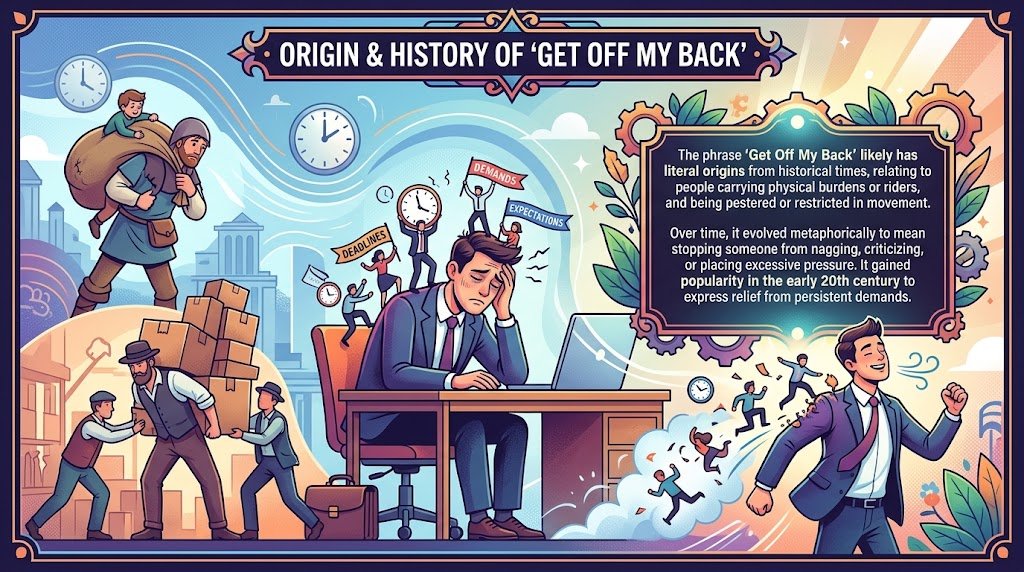
The phrase “Get off my back” comes from the literal image of carrying a heavy weight on one’s back. Throughout history, a burden on the back has symbolized physical strain, responsibility, or hardship. Over time, English speakers began using the image metaphorically to describe emotional pressure, constant criticism, or unwanted interference from another person.
The expression became especially common in American English during the twentieth century, appearing in everyday conversations, literature, television, and films. As workplace communication evolved and informal language became more accepted in casual settings, the phrase gained popularity as a direct way to express frustration.
Today, “Get off my back” remains widely recognized across English-speaking countries. Although its meaning has stayed largely consistent, modern communicators often choose softer alternatives in professional environments to reduce conflict while still expressing the same underlying message.
Synonyms & Alternatives by Tone
Professional & Neutral Alternatives
- Please give me some space to handle this.
- I appreciate your concern, but I’ve got this.
- I’ll take it from here.
- Thanks, I’ll manage this independently.
- I’d like the opportunity to handle this myself.
Polite & Supportive Alternatives
- I appreciate your help, but I need a little space.
- Thank you for checking in, but I’m okay.
- Please trust me to handle this.
- I value your input, but I’d like to try on my own.
- I need a bit more breathing room.
Encouraging & Reassuring Alternatives
- I’ve got this under control.
- Everything is on track.
- I’ll let you know if I need help.
- You can count on me to handle it.
- I’m making steady progress.
Casual, Playful & Idiomatic Alternatives
- Give me a break.
- Ease up.
- Cut me some slack.
- Back off.
- Stop breathing down my neck.
When Should You Use “Get Off My Back”?
Professional Settings
The phrase is generally not the best choice in formal workplaces because it can sound defensive or confrontational. However, in relaxed teams where colleagues communicate informally, it may be understood as lighthearted frustration. In most professional situations, replacing it with a calmer alternative helps preserve positive working relationships.
Casual Conversations
Among friends, siblings, or close family members, “Get off my back” is commonly used when someone feels constantly questioned, reminded, or criticized. Context and tone of voice determine whether it sounds humorous or genuinely annoyed.
Writing, Presentations, and Digital Communication
In emails, reports, presentations, and customer communication, the phrase is usually too informal. Instead, choose language that politely requests autonomy or explains that the situation is under control.
When It Is Especially Effective
The expression works best when:
- Someone repeatedly interferes with your work.
- You have already explained your position.
- You want to establish personal boundaries.
- The relationship is informal enough to tolerate direct language.
- The listener understands your intended tone.
When Should You Avoid “Get Off My Back”?
Avoid using the phrase in situations where professionalism, diplomacy, or emotional sensitivity matters.
Examples include:
- Formal business meetings.
- Job interviews.
- Academic writing.
- Legal discussions.
- Customer service interactions.
- Conversations with senior leaders.
- Sensitive family discussions.
- Cross-cultural communication where directness may be misunderstood.
In these contexts, more respectful alternatives communicate the same message while reducing the risk of sounding hostile.
Is “Get Off My Back” Professional, Polite, or Casual?
Professional: Generally no. The phrase is considered informal and can appear disrespectful if directed toward colleagues, managers, or clients.
Polite: Not usually. Even when the speaker intends humor, it often carries frustration or impatience.
Casual: Yes. It naturally fits conversations between friends, family members, roommates, or people with established informal relationships.
The emotional subtext is important. Native speakers usually hear more than the literal words—they recognize feelings of irritation, pressure, or a desire for independence. Because of this emotional layer, the phrase should be used thoughtfully.
Pros and Cons of Using “Get Off My Back”
Advantages
- Communicates frustration clearly without lengthy explanations.
- Quick and memorable, making the message immediately understandable.
- Widely recognized by native English speakers.
- Expresses personal boundaries directly.
- Works naturally in everyday conversation.
Potential Drawbacks
- May sound rude in professional environments.
- Can create defensiveness in the listener.
- May oversimplify a more complicated disagreement.
- Tone depends heavily on delivery, making misunderstandings more likely.
- Repeated use can make a speaker appear impatient or confrontational.
Real-Life Examples of “Get Off My Back” by Context
Emails
“I appreciate your reminders, but I’ve already submitted the report. Please get off my back while I wait for feedback.”
Meetings
“I understand everyone’s concerns, but let’s give the project team some room to finish the implementation instead of staying on their backs.”
Presentations
“Our goal isn’t to get off employees’ backs—it’s to create a system that supports accountability without unnecessary micromanagement.”
Conversations
“I know you’re trying to help, but can you get off my back for a while? I’ll figure it out.”
Social Media
“Everyone suddenly became a fitness expert in my comments. Seriously, get off my back—I missed one workout.”
“Get Off My Back” vs Similar Expressions (Key Differences)
| Phrase | Meaning Difference | Tone Difference | Best Use Scenario |
| Back off | Requests someone to stop interfering immediately | More direct and firmer | Heated conversations or setting boundaries |
| Give me a break | Expresses frustration or disbelief | Casual and humorous | Friendly conversations |
| Cut me some slack | Requests understanding rather than distance | Softer and more sympathetic | Workplace discussions, friendships |
| Stop breathing down my neck | Focuses on excessive monitoring | Strongly idiomatic and informal | Micromanagement situations |
| Leave me alone | Requests complete separation rather than reduced pressure | More serious and emotionally distant | When privacy is the priority |
| Ease up | Asks someone to reduce pressure instead of stopping completely | Relaxed and conversational | Friends, teammates, informal work settings |
Common Mistakes & Misuse of “Get Off My Back”
One common mistake is overusing the phrase whenever someone offers constructive feedback. Not every suggestion or reminder is unwanted pressure.
Another issue is using it in the wrong context, such as speaking to clients, professors, or senior managers, where it may damage relationships.
Some speakers also use it contradictorily, asking for help and then telling others to stop checking on their progress. This creates confusion about expectations.
Finally, cultural misunderstandings can occur because some English-speaking cultures accept direct language more readily than others. International audiences may perceive the phrase as harsher than intended.
Psychological Reason People Prefer “Get Off My Back”
People often choose this expression because it communicates a complex emotional state in just a few words. Instead of explaining repeated pressure, criticism, or unwanted supervision, the phrase quickly signals a desire for independence.
It also reduces cognitive load for both speaker and listener. The message is instantly recognizable, requiring little interpretation.
From a communication perspective, the phrase establishes personal boundaries while reinforcing autonomy. In today’s fast-paced communication environment, concise expressions like this are memorable and emotionally impactful.
US vs UK Usage of “Get Off My Back”

The phrase is common in both the United States and the United Kingdom, although it tends to appear more frequently in American English.
In the United States, it often expresses frustration with micromanagement, criticism, or persistent reminders in everyday conversation.
In the United Kingdom, native speakers understand the phrase easily but may sometimes prefer alternatives such as “Give me a break,” “Leave it out,” or “Ease off.” Tone expectations can also vary depending on the region and social setting.
“Get Off My Back” in Digital & Modern Communication
Emails
The phrase is generally avoided because written communication lacks vocal tone and facial expressions. Softer wording usually produces better professional outcomes.
Slack and WhatsApp
In informal team chats, the phrase may be acceptable among colleagues who already share a friendly relationship. Even then, adding context or humor helps prevent misunderstandings.
Social Media
The expression frequently appears in comments, posts, and replies where users react to criticism, unsolicited advice, or repeated opinions.
AI-Generated Summaries
Modern AI writing tools often replace “Get off my back” with more neutral alternatives to improve professionalism and reduce emotional intensity, especially in business communication.
Linguistic & Communication Insight
Emotional Weight & Subtext
Although the literal words refer to someone’s back, native speakers immediately understand the phrase as expressing emotional pressure rather than physical contact. It often conveys irritation, exhaustion, or the need for personal autonomy.
Direct vs Indirect Phrasing
“Get off my back” is highly direct. Softer alternatives such as “I’d appreciate a little space” or “I’ve got this under control” communicate the same intention while reducing confrontation and encouraging cooperation.
Professional Communication Perspective
In workplaces, the phrase may unintentionally suggest resistance to feedback or collaboration. Experienced communicators often replace it with language that emphasizes ownership without dismissing others’ concerns.
Pragmatic Reasons for Alternatives
Professionals frequently choose alternative wording because it lowers defensiveness, preserves relationships, and encourages productive dialogue. Careful phrasing can express confidence while still showing respect for colleagues and stakeholders.
Social Signaling
Word choice influences how people perceive confidence, emotional intelligence, and professionalism. A calm alternative often signals maturity and self-control, whereas a blunt expression may suggest impatience even when the speaker has valid concerns.
Tone & Context Guidance
The effectiveness of “Get off my back” depends almost entirely on context. Among close friends, it may sound playful. During workplace discussions, it can appear confrontational. Matching your language to your audience helps ensure your message is understood as intended rather than remembered for its tone.
Please Give Me Some Space to Handle This
Meaning: This phrase politely asks someone to allow you to manage a task or situation independently without constant involvement or supervision. It communicates a need for autonomy while remaining respectful.
Why This Phrase Works: It acknowledges the other person’s interest or concern without sounding dismissive. The wording helps reduce tension and encourages cooperation instead of conflict.
Real-World Usage Insight: Managers, colleagues, and clients often respond better to this phrase because it sets a clear boundary without implying blame. It is especially useful in collaborative workplaces where maintaining positive relationships matters.
Best Use: Workplace conversations, project discussions, client communication, and professional emails.
Avoid When: Immediate intervention or assistance is genuinely needed.
Tone: Professional, respectful, and confident.
US vs UK Usage: Common and natural in both American and British English, particularly in professional settings.
Example (Email / Message / Meeting): “Thanks for checking in on the report. Please give me some space to handle this, and I’ll send you the completed version by tomorrow afternoon.”
I Appreciate Your Concern, but I’ve Got This
Meaning: This phrase thanks someone for caring while reassuring them that you can manage the situation on your own.
Why This Phrase Works: Gratitude comes first, making the response feel collaborative rather than defensive. It protects relationships while reinforcing confidence.
Real-World Usage Insight: Native speakers frequently use this expression when declining unnecessary help without hurting the other person’s feelings.
Best Use: Conversations with coworkers, friends, mentors, or family members who genuinely want to help.
Avoid when: You actually require support or expect ongoing collaboration.
Tone: Warm, reassuring, and professional.
US vs UK Usage: Widely understood and commonly used in both countries.
Example (Meeting): “I appreciate your concern, but I’ve got this. I’ll update everyone once the client confirms the final requirements.”
I’ll Take It From Here
Meaning: This phrase tells others that you are ready to assume responsibility and continue without additional assistance.
Why This Phrase Works: It clearly signals ownership while allowing others to step back gracefully. The expression is concise and widely accepted in professional communication.
Real-World Usage Insight: Team leaders and project managers often use this phrase when transitioning responsibilities or concluding discussions.
Best Use: Meetings, project handoffs, customer service, and team collaboration.
Avoid When: Shared decision-making is still required.
Tone: Professional, confident, and efficient.
US vs UK Usage: Equally common in American and British English.
Example (Meeting): “Thank you for gathering the research. I’ll take it from here and prepare the presentation for Friday.”
Thanks, I’ll Manage This Independently
Meaning: This phrase politely communicates that you intend to complete the task without further involvement from others.
Why This Phrase Works: It combines appreciation with independence, making the message sound cooperative instead of dismissive.
Real-World Usage Insight: Professionals often choose this wording when they want to reassure colleagues that everything is under control without appearing defensive.
Best Use: Emails, workplace chats, academic projects, and collaborative assignments.
Avoid When: Others have responsibilities that require continued participation.
Tone: Respectful, professional, and self-assured.
US vs UK Usage: Slightly more common in formal business communication but natural in both regions.
Example (Email): “Thank you for offering additional support. I’ll manage this independently and let you know if any issues come up.”
I’d Like the Opportunity to Handle This Myself
Meaning: This phrase politely asks for the chance to solve a problem or complete a task without outside interference.
Why This Phrase Works: It frames independence as a request rather than a demand, reducing the likelihood of conflict.
Real-World Usage Insight: Managers and mentors generally respond positively because the wording demonstrates initiative and accountability.
Best Use: Performance reviews, mentoring conversations, workplace discussions, and educational settings.
Avoid when: Team collaboration is expected or mandatory.
Tone: Polite, mature, and professional.
US vs UK Usage: Frequently used in both American and British workplaces.
Example (Meeting): “I’d like the opportunity to handle this myself before we bring in additional resources.”
I Appreciate Your Help, but I Need a Little Space
Meaning: This expression thanks someone for their support while politely requesting less involvement.
Why This Phrase Works: Appreciation softens the request, making it easier for the listener to accept without feeling rejected.
Real-World Usage Insight: Native speakers often use this phrase in personal relationships where preserving trust is just as important as establishing boundaries.
Best Use: Family conversations, friendships, mentoring, and supportive workplace relationships.
Avoid When: Immediate teamwork or collaboration is essential.
Tone: Kind, respectful, and empathetic.
US vs UK Usage: Natural and widely accepted in both regions.
Example (Message): “I really appreciate your help, but I need a little space to work through this on my own today.”
Thank You for Checking In, but I’m Okay
Meaning: This phrase reassures someone that their concern is appreciated while letting them know no further action is needed.
Why This Phrase Works: It balances gratitude with reassurance, helping prevent unnecessary follow-up questions or pressure.
Real-World Usage Insight: This wording is especially common when people want to decline help without discouraging future support.
Best Use: Workplace messages, personal conversations, and wellness check-ins.
Avoid When: You are hiding a problem that should genuinely be communicated.
Tone: Friendly, reassuring, and polite.
US vs UK Usage: Very common across both American and British English.
Example (Message): “Thank you for checking in, but I’m okay. I’ll let you know if I need any assistance later.”
Please Give Me Some Space to Handle This
Meaning: This phrase politely asks someone to stop closely involving themselves and allow you enough independence to manage a situation. It expresses a need for personal control without directly criticizing the other person’s actions.
Why This Phrase Works: It creates a respectful boundary while recognizing that the other person may have good intentions. Unlike “Get off my back,” it avoids sounding irritated or aggressive.
Real-World Usage Insight: Professionals often use this wording when dealing with repeated follow-ups, unnecessary supervision, or situations where they need time to complete work without interruption.
Best Use: Workplace communication, project management, teamwork discussions, and professional conversations.
Avoid When: A person needs urgent information or when collaboration is necessary to complete a task.
Tone: Calm, professional, respectful, and solution-focused.
US vs UK Usage: This phrase is natural in both US and UK English. American speakers may use it more directly in workplace conversations, while British speakers may prefer slightly softer wording such as “I just need a bit of time to work through this.”
Example (Email / Message / Meeting): “Thanks for following up on the campaign updates. Please give me some space to handle this, and I’ll share the revised version with the team by Friday.”
I Appreciate Your Concern, but I’ve Got This
Meaning: This phrase acknowledges someone’s care or attention while explaining that you are capable of managing the situation independently.
Why This Phrase Works: It combines appreciation with confidence. The first part reduces defensiveness, while the second part clearly communicates independence.
Real-World Usage Insight: People commonly use this expression when they want to decline extra help without making the other person feel unwanted or ignored.
Best Use: Conversations with coworkers, friends, family members, mentors, or supervisors.
Avoid when: You actually need assistance or when refusing support could create problems.
Tone: Friendly, reassuring, confident, and polite.
US vs UK Usage: Common in both regions. US speakers often use “I’ve got this” as a casual confidence statement, while UK speakers may also use “I’m alright, thanks” in similar situations.
Example (Meeting): “I appreciate your concern, but I’ve got this. I’ll handle the client questions and send everyone an update afterward.”
Conclusion
“Get off my back” is a widely recognized English expression that communicates frustration with pressure, criticism, or unwanted interference. While it is effective in casual conversations, its direct tone can sound harsh in professional or sensitive situations. Understanding the meaning, emotional impact, and suitable alternatives helps speakers choose language that matches their audience and purpose.
For everyday conversations with friends or family, the phrase may feel natural and expressive. However, in workplaces, academic settings, and digital communication, alternatives such as “I appreciate your concern, but I’ve got this” or “Please give me some space to handle this” often create better results.
Strong communication is not only about choosing the right words but also about understanding how those words are received. By considering tone, context, and relationship dynamics, speakers can express boundaries clearly while maintaining respect, trust, and cooperation.
FAQs
What does “Get off my back” mean?
“Get off my back” means asking someone to stop pressuring, criticizing, monitoring, or interfering with you. It is usually used when a person feels annoyed by repeated reminders, unwanted advice, or excessive attention. The phrase suggests a desire for independence and personal space.
Is “Get off my back” rude?
“Get off my back” can sound rude depending on the situation, tone of voice, and relationship between speakers. It is considered casual and slightly confrontational. While it may be acceptable among close friends or family, it is usually avoided in professional communication because it can appear disrespectful.
Is “Get off my back” professional language?
No, “Get off my back” is generally not considered professional language. In workplaces, it may sound defensive or aggressive. Professionals often choose softer alternatives such as “I appreciate your concern, but I’ve got this” or “I’ll handle this and keep you updated.”
What are polite alternatives to “Get off my back”?
Polite alternatives include “Please give me some space to handle this,” “I appreciate your help, but I need a little space,” and “I’ll let you know if I need help.” These phrases communicate the same idea while maintaining respect and encouraging positive communication.
When should I use “Get off my back”?
You can use “Get off my back” in informal situations where the listener understands your personality and tone. It works with close friends, family members, or casual conversations. Avoid using it with clients, managers, teachers, or people you do not know well.
What is the difference between “Get off my back” and “Back off”?
“Get off my back” usually focuses on stopping repeated pressure, criticism, or monitoring. “Back off” is broader and stronger, meaning someone should move away or stop interfering immediately. Both expressions are direct, but “Back off” often sounds more aggressive.
Is “Get off my back” common in American and British English?
Yes, “Get off my back” is understood in both American and British English. It is especially common in American casual speech, movies, and everyday conversations. British speakers also use it, although they may choose alternatives like “ease off” or “give me a break” depending on the situation.
Can I use “Get off my back” in an email?
It is usually better to avoid “Get off my back” in emails because written messages lack facial expressions and voice tone. The reader may interpret it as anger or disrespect. Professional alternatives create a clearer and more cooperative message.
Why do people say “Get off my back”?
People use “Get off my back” because it quickly expresses feelings of pressure, frustration, or a need for independence. The phrase allows speakers to set a boundary without explaining a long situation. Its popularity comes from being short, familiar, and emotionally clear.
What is the closest synonym for “Get off my back”?
The closest synonyms include “Stop pressuring me,” “Leave me alone,” “Back off,” “Ease up,” and “Cut me some slack.” The best choice depends on tone. Some alternatives are softer and more professional, while others express stronger frustration.


