
A student is choosing between two presentation topics, a manager is asking a colleague which design option they prefer, or a friend is deciding where to meet for dinner. In each situation, someone may say, “It does not matter to me.” This simple phrase communicates that the speaker has no strong preference or that the outcome does not significantly affect them. However, the way it sounds can change depending on tone, relationship, and context.
In modern communication, choosing the right alternative matters because the same message can sound cooperative, indifferent, flexible, or even dismissive. Understanding the meaning, tone, and professional alternatives of “It does not matter to me” helps speakers, writers, students, and professionals communicate with more clarity and confidence.
What Does “It Does Not Matter To Me” Mean?
“It does not matter to me” means that a person has no particular preference, concern, or personal interest regarding a decision, situation, or outcome. The phrase shows that the speaker is comfortable with any available option and is commonly used in conversations, workplace discussions, emails, and everyday communication.
The phrase expresses a lack of personal preference rather than a lack of interest in everything. In many situations, it means “I am comfortable with whatever choice is made,” but the exact meaning depends heavily on tone.
For example:
- “Which restaurant should we choose?”
“It does not matter to me.”
→ The person is flexible and happy with any option. - “Should we delay the project?”
“It does not matter to me.”
→ This may sound like the person is not invested in the decision.
The words remain the same, but the listener interprets them through the speaker’s attitude, voice, and relationship with them.
Origin & History of “It Does Not Matter To Me”
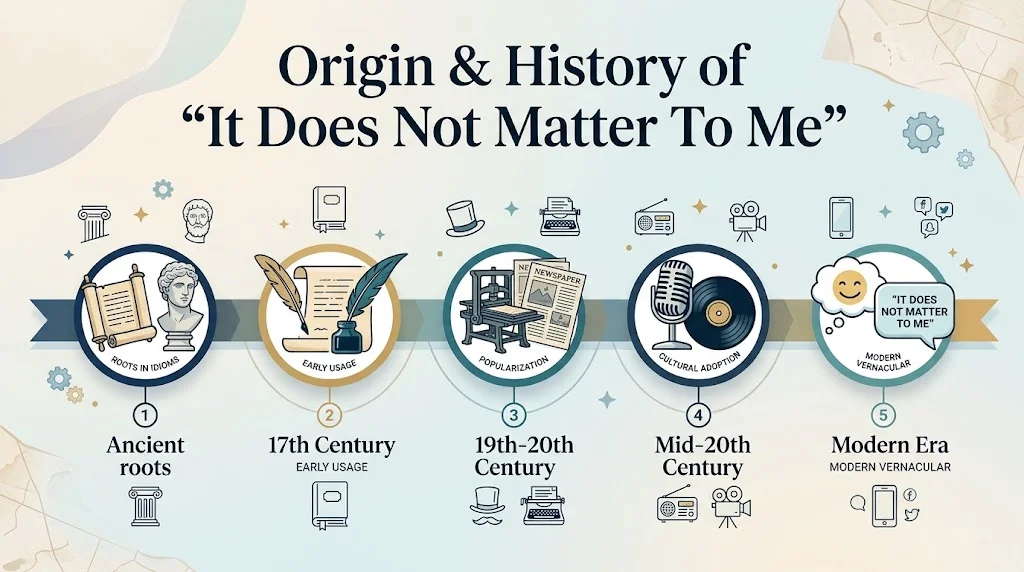
The phrase “it does not matter to me” comes from the long-established English use of “matter” as a verb meaning “to be important, significant, or of consequence.” The word “matter” developed from the Latin word materia, meaning “substance” or “material,” and later expanded in English to describe importance or significance.
Historically, expressions using “matter” in English described whether something had importance or influence. Over time, phrases such as “it matters,” “it does not matter,” and “it does not matter to me” became common ways to express personal importance or indifference.
In modern English, the phrase has evolved from a simple statement about importance into a communication tool that can signal:
- Flexibility: “I am happy with either choice.”
- Neutrality: “I do not have a strong opinion.”
- Detachment: “This decision is not important to me.”
Culturally, the phrase is widely understood in English-speaking countries, but its emotional meaning shifts with social expectations. In some contexts, being flexible is viewed positively, while in others, showing no preference may be interpreted as a lack of engagement.
Synonyms & Alternatives by Tone
Choosing an alternative depends on the message you want to send. Some expressions sound professional and cooperative, while others feel more casual or emotionally neutral.
Professional & Neutral Alternatives
- I have no preference.
- I am open to either option.
- Either option works for me.
- I am comfortable with whatever you decide.
- I have no strong preference.
- I am flexible.
- I am fine with either choice.
- I am happy to go with the group decision.
Polite & Supportive Alternatives
- I am happy with whatever works best for you.
- I will support whichever option you choose.
- I trust your judgment.
- Whatever you prefer is fine with me.
- I am comfortable following your lead.
- I am open to your suggestion.
- I am happy to accommodate your preference.
Encouraging & Reassuring Alternatives
- I am good with whatever you think is best.
- I trust your decision.
- Feel free to choose what works best.
- I am happy either way.
- Go with what you think makes the most sense.
- I support your choice.
Casual, Playful & Idiomatic Alternatives
- Either way works.
- I’m good either way.
- Whatever works.
- No worries either way.
- I don’t mind.
- Up to you.
- Your call.
- I’m easy.
- I’m not picky.
When Should You Use “It Does Not Matter To Me”?
The phrase works best when the speaker genuinely has no strong preference and wants to communicate flexibility. However, the surrounding situation determines whether it sounds helpful or uninterested.
Professional Settings
In workplaces, “it does not matter to me” can be appropriate when discussing minor choices, scheduling, or personal preferences.
Examples:
- Choosing a meeting time:
“Tuesday or Wednesday is fine. It does not matter to me.” - Selecting a design variation:
“Both versions look good. It does not matter to me which one we use.”
However, in important decisions, professionals often choose more collaborative wording:
- “I am comfortable with either option.”
- “I trust your judgment on this.”
- “I do not have a strong preference, so I am happy to follow the team’s decision.”
These alternatives show flexibility while maintaining involvement.
Casual Conversations
The phrase is very common in everyday speech.
Examples:
- “What movie should we watch?”
“It does not matter to me.” - “Do you want coffee or tea?”
“It does not matter to me.”
Among friends and family, it usually sounds natural and relaxed.
Writing, Presentations, and Digital Communication
In emails, messages, and workplace chats, the phrase should be used carefully because written communication lacks facial expressions and voice tone.
A message like:
“It does not matter to me.”
May accidentally sound cold or dismissive.
A clearer written version:
“I do not have a preference, so I am happy with whichever option works best for everyone.”
Shows cooperation and consideration.
When It Is Especially Effective
“It does not matter to me” works well when:
- The decision is minor.
- The speaker truly has no preference.
- The relationship is comfortable.
- The goal is to save time.
- The listener understands the speaker’s intention.
When Should You Avoid “It Does Not Matter To Me”?
Although the phrase is grammatically correct, there are situations where it may create the wrong impression.
Overly Formal Situations
In a formal workplace, academic, or client-facing communication, the phrase may sound too casual.
Instead of:
“It does not matter to me which proposal you choose.”
Consider:
“I am comfortable with either proposal and will support the final decision.”
Legal, Academic, or Sensitive Contexts
In situations involving responsibility, evaluation, or important decisions, the phrase may appear careless.
Examples:
- Research decisions
- Contract discussions
- Team leadership decisions
- Customer issues
In these cases, people usually expect reasoning, ownership, or a clear recommendation.
Situations Where Nuance May Be Lost
The phrase can be misunderstood when:
- Someone expects your opinion.
- The decision has consequences.
- The listener needs reassurance.
- The topic involves emotions or conflict.
For example:
“I asked because your opinion matters. Saying ‘it does not matter to me’ may sound like you do not care.”
A better approach may be:
“I do not have a strong preference, but I am interested in what you think.”
Is “It Does Not Matter To Me” Professional, Polite, or Casual?
“It does not matter to me” is a neutral phrase, but its tone depends strongly on context. It can sound professional when discussing small choices, polite when showing flexibility, or casual when used among friends.
Tone Analysis
The phrase can communicate:
- Flexibility: “I am okay with either option.”
- Indifference: “This decision is not important to me.”
- Distance: “I do not want to get involved.”
- Acceptance: “I will go along with the choice.”
Formality Level
| Context | Suitability |
| Conversation with friends | Very suitable |
| Everyday decisions | Suitable |
| Team discussions | Sometimes suitable |
| Professional emails | Use carefully |
| Formal presentations | Usually avoid |
Emotional Subtext
Native speakers often listen for the feeling behind the words.
A friendly tone:
“Honestly, it doesn’t matter to me. I’m happy either way.”
Sounds cooperative.
A flat or impatient tone:
“It doesn’t matter to me.”
May sound like:
- “I don’t care.”
- “Do whatever you want.”
- “This is not my problem.”
The phrase itself is not rude, but delivery changes perception.
Pros and Cons of Using “It Does Not Matter To Me”
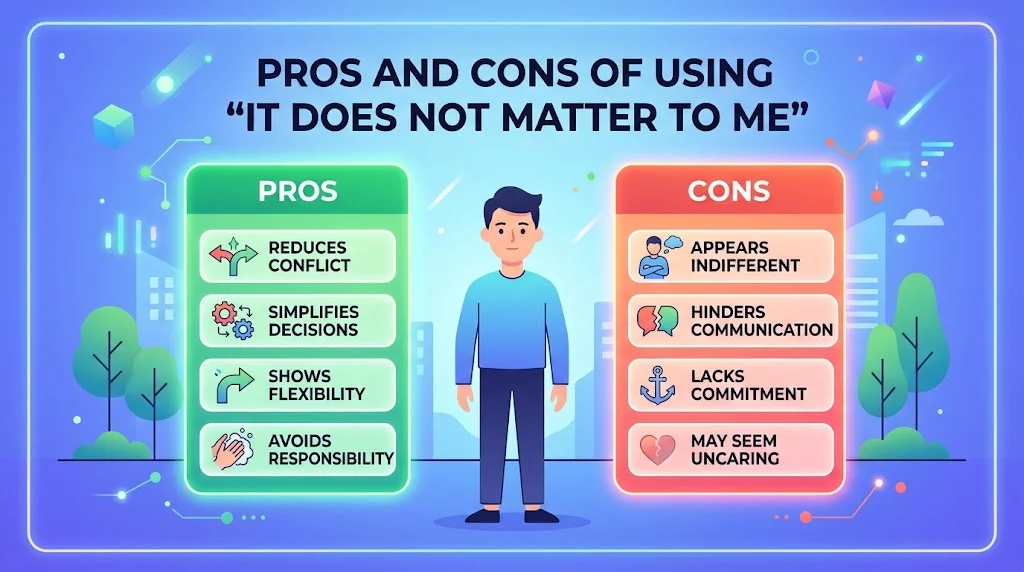
Advantages
Clarity
The phrase quickly communicates that the speaker has no preference.
Efficiency
It saves time when a decision does not require detailed discussion.
Accessibility
The expression is simple, common, and easy for English learners to understand.
Flexibility
It allows others to make decisions without unnecessary disagreement.
Potential Drawbacks
Oversimplification
The phrase may hide useful opinions when a person actually has a small preference.
Tone Mismatch
In sensitive situations, it may sound uncaring or dismissive.
Repetition
Using it too often can make someone appear disengaged from discussions.
A stronger communicator knows when to be flexible and when to provide input. Sometimes saying:
“I do not mind either option, but I slightly prefer the first one.”
Creates better collaboration.
Real-Life Examples of “It Does Not Matter To Me” by Context
The phrase “It does not matter to me” appears in many everyday situations, but the meaning changes depending on the relationship, purpose, and tone. Below are realistic examples showing how native speakers may use it.
Emails
Example:
Hi Sarah,
I reviewed both schedule options. It does not matter to me which date we choose, so I am happy to go with whatever works best for the team.
Thanks.
In a workplace email, adding a supportive phrase after “it does not matter to me” prevents the message from sounding uninterested.
Meetings
Example:
During a team meeting:
“Should we present the customer data first or the product updates?”
“It does not matter to me. Both sections are important, so I am fine with whichever order the team prefers.”
Here, the phrase shows flexibility while still showing involvement.
Presentations
Example:
A student preparing a group presentation says:
“I can handle either the introduction or the conclusion. It does not matter to me which part I present.”
This usage sounds cooperative because the speaker is offering flexibility.
Conversations
Example:
A friend asks:
“Do you want to eat at the Italian place or the new burger restaurant?”
“It does not matter to me. I’m good with either one.”
In casual conversations, the phrase usually feels natural and relaxed.
Social Media
Example:
A person posting in a group chat:
“I’m free this weekend. It does not matter to me whether we meet Saturday or Sunday.”
In digital communication, adding context helps the phrase feel friendly rather than indifferent.
“It Does Not Matter To Me” vs Similar Expressions (Key Differences)
Many English expressions communicate a similar idea, but each one carries a slightly different level of interest, politeness, and emotional involvement.
| Phrase | Meaning Difference | Tone Difference | Best Use Scenario |
| It does not matter to me | Shows that the speaker has no strong preference or personal concern | Neutral; can sound flexible or detached depending on tone | Everyday choices, minor decisions, casual discussions |
| I do not mind | Means the option is acceptable, but the speaker may still have a slight preference | Softer and more polite | Social conversations, requests, and small decisions |
| I have no preference | Clearly states that the speaker has no favorite option | Professional and neutral | Meetings, emails, workplace discussions |
| Either option works for me | Shows both choices are acceptable | Cooperative and positive | Team decisions, scheduling, and planning |
| I am fine with whatever you decide | Gives decision authority to another person | Supportive and trusting | Collaborative situations |
| It is up to you | Places the responsibility of choosing on another person | Casual; can sometimes sound like avoidance | Informal conversations |
Common Mistakes & Misuse of “It Does Not Matter To Me”
Although “it does not matter to me” is correct English, speakers sometimes use it in ways that create unintended meanings.
Overuse
Repeating the phrase too often may make a person appear disengaged.
Example:
“Where should we meet?”
“It does not matter to me.”
“What time?”
“It does not matter to me.”
“Which option do you prefer?”
“It does not matter to me.”
After several uses, the listener may feel that the speaker is avoiding participation.
A better approach:
“I am flexible, but I slightly prefer the first option.”
Incorrect Context
The phrase is not ideal when someone expects expertise or responsibility.
Example:
A manager asks:
“Which strategy should we use for this important project?”
Replying:
“It does not matter to me.”
May sound like a lack of leadership.
A better response:
“Both approaches have advantages, but I would lean toward the first option.”
Contradictory Usage
The phrase can create confusion when followed by a strong opinion.
Example:
“It does not matter to me, but we should definitely choose option A.”
The listener may wonder whether the decision actually matters.
Cultural Misunderstandings
English learners may translate the phrase directly from their first language and unintentionally sound cold.
In some cultures, showing no preference may be viewed as polite. In English-speaking environments, listeners may sometimes interpret it as a lack of interest.
Adding warmth improves clarity:
“I do not have a preference, so I am happy with whatever works best for everyone.”
Psychological Reasons People Prefer “It Does Not Matter To Me”
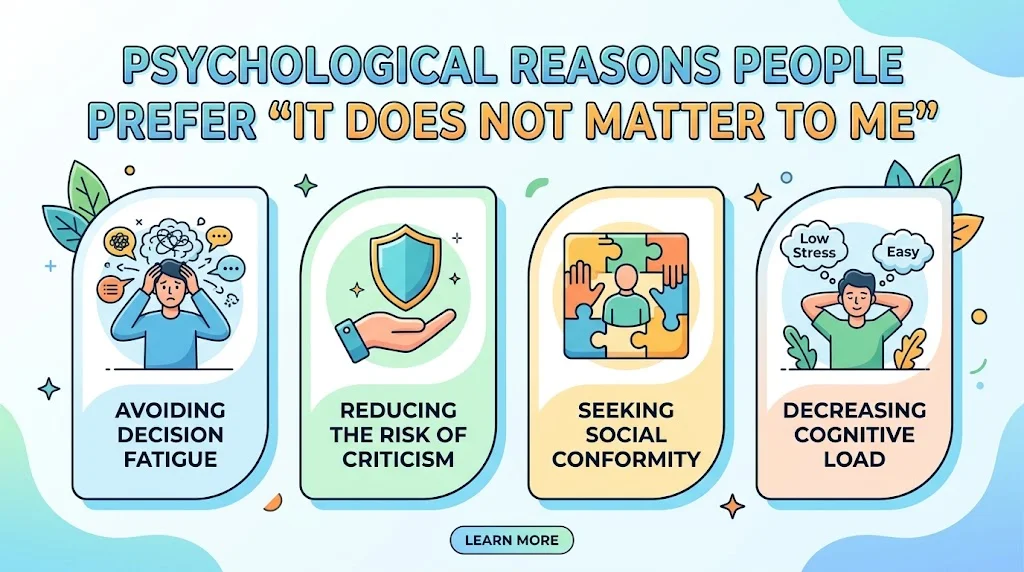
People often use this phrase because it reduces communication pressure and simplifies decision-making.
Cognitive Load Reduction
Modern life involves countless small decisions. Saying “it does not matter to me” allows people to quickly remove unnecessary choices from their attention.
For example:
- Choosing a meeting time
- Picking a restaurant
- Selecting a minor design detail
The speaker communicates:
“This decision does not require my extra mental energy.”
Trust and Authority Signals
Sometimes the phrase shows confidence in another person’s judgment.
Example:
“You know the client better than I do, so it does not matter to me which version we send.”
Here, the phrase can signal trust.
Attention Economy
In digital communication, people often prefer short responses because messages are constant and frequent. Simple phrases like:
- “Either works.”
- “I’m fine with that.”
- “No preference.”
Help people communicate quickly.
Modern Communication Habits
Remote work, messaging apps, and online collaboration have increased the need for efficient language. Short phrases are useful, but communicators must balance speed with emotional clarity.
US vs UK Usage of “It Does Not Matter To Me”
The phrase is understood in both American and British English, but its tone may vary slightly.
Popularity
In both the US and UK, speakers commonly use similar expressions:
- “I don’t mind.”
- “Either is fine.”
- “I’m happy with whatever.”
- “No preference.”
The exact phrase “it does not matter to me” is correct but may sound slightly more deliberate than everyday alternatives.
Tone Perception
US English:
American speakers may use the phrase to mean:
- “I am flexible.”
- “I am okay with any option.”
However, in a workplace setting, they may prefer:
“I’m open to either option.”
Because it sounds more collaborative.
UK English:
British speakers often prefer softer expressions such as:
- “I don’t mind.”
- “Either is fine.”
- “I’m easy.”
The phrase “it does not matter to me” can sometimes sound slightly more formal or emotionally distant.
Regional Preferences
| Region | Common Alternatives |
| United States | “Either works,” “I’m good with whatever,” “No preference” |
| United Kingdom | “I don’t mind,” “Either is fine,” “I’m easy” |
The difference is not about correctness but about conversational style.
“It Does Not Matter To Me” in Digital & Modern Communication
Digital communication removes many social signals, such as facial expressions and voice tone. Because of this, short phrases require more careful wording.
Emails
In professional emails, avoid leaving the phrase alone.
Less effective:
“It does not matter to me.”
Better:
“I do not have a preference, so I am happy to proceed with whichever option works best.”
Slack / WhatsApp
In quick messages, shorter versions are usually preferred:
- “Either works for me.”
- “I’m good with whatever.”
- “No preference.”
Example:
“Should we move the call to Thursday?”
“Either works for me. Thanks for checking.”
Social Media
Online discussions often use casual versions:
- “I don’t really mind.”
- “Either way is fine.”
- “Whatever works.”
The phrase may sound too formal depending on the platform.
AI-Generated Summaries
AI tools often use phrases like “it does not matter” when summarizing choices or preferences. However, human communication usually benefits from more context.
For example:
AI-style:
“The user stated that the option does not matter.”
Human-style:
“The user indicated they are flexible and do not have a strong preference.”
The second version captures the social meaning more accurately.
Linguistic & Communication Insight
The phrase “it does not matter to me” is a good example of how language meaning extends beyond dictionary definitions. The literal meaning is simple: something is not important to the speaker. However, native speakers often interpret additional signals based on tone, relationship, and situation.
Emotional Weight & Subtext
The phrase may communicate different emotions:
- Cooperation: “I trust the group to decide.”
- Neutrality: “I have no preference.”
- Distance: “I do not want responsibility for this decision.”
- Indifference: “This issue is not important to me.”
The listener decides the meaning through context.
Direct vs Indirect Phrasing
“It does not matter to me” is direct. It clearly removes the speaker’s preference from consideration.
Softer alternatives create more collaboration:
Direct:
“It does not matter to me.”
Indirect:
“I am open to whatever works best.”
The second option feels more supportive because it emphasizes flexibility rather than a lack of concern.
Professional Communication Perspective
In workplaces, experienced communicators often choose alternatives because they want to balance two messages:
- “I am flexible.”
- “I am still engaged.”
For example:
“I do not have a strong preference, but I trust your recommendation.”
This shows openness without appearing disconnected.
Pragmatic Reasons for Alternatives
Professionals often replace the phrase with:
- Reduce defensiveness
- Encourage teamwork
- Show respect
- Maintain authority
- Avoid sounding dismissive
Small wording changes can influence how people perceive confidence and cooperation.
Social Signaling
Language choices communicate personality and attitude.
Compare:
“It does not matter to me.”
with:
“I’m happy with whichever option works best for everyone.”
Both express flexibility, but the second signals:
- Consideration
- Team awareness
- Positive engagement
Tone & Context Guidance
Use “it does not matter to me” when:
- The decision is minor.
- The relationship is comfortable.
- You genuinely have no preference.
Choose an alternative when:
- The decision is important.
- Someone needs your expertise.
- The situation requires warmth or professionalism.
The best communicators do not simply choose correct words; they choose words that match the purpose, audience, and emotional situation.
Conclusion
“It does not matter to me” is a simple phrase, but its meaning depends greatly on tone, context, and the relationship between speakers. It can communicate flexibility, acceptance, or neutrality, but it may also sound distant or uninterested if used in sensitive situations. Understanding alternative expressions helps speakers choose words that better match their intention.
In professional communication, phrases like “I have no preference,” “I am open to either option,” and “either option works for me” often create a more cooperative impression. In casual conversations, shorter alternatives such as “I don’t mind” or “I’m good either way” sound natural and friendly.
The best communication is not only about using correct grammar; it is about choosing language that reflects your attitude. By considering tone, audience, and purpose, you can use “it does not matter to me” effectively while avoiding misunderstandings. A small change in wording can make your message clearer, warmer, and more professional.
FAQs
What does “It Does Not Matter To Me” mean?
“It does not matter to me” means that a person has no strong preference or personal concern about a choice, situation, or outcome. It usually indicates flexibility and acceptance of different options. However, depending on tone, it can also suggest indifference, so the surrounding context determines how listeners interpret the phrase.
Is “It Does Not Matter To Me” a polite phrase?
Yes, “it does not matter to me” can be polite when used in situations where you genuinely have no preference. However, in professional or sensitive conversations, it may sound less warm than alternatives like “I am open to either option” or “I am happy with whatever works best.”
Is “It Does Not Matter To Me” professional?
The phrase can be professional in certain situations, especially when discussing minor decisions such as scheduling or preferences. However, in important workplace discussions, more collaborative wording is often better because it shows involvement, such as “I do not have a strong preference” or “I trust your judgment.”
What is a better alternative to “It Does Not Matter To Me”?
The best alternative depends on the situation. Professional options include “I have no preference,” “I am flexible,” and “either option works for me.” Casual alternatives include “I don’t mind,” “I’m good either way,” and “whatever works.” Choosing the right phrase helps communicate the intended tone.
Does “It Does Not Matter To Me” mean “I don’t care”?
Not always. The phrase can mean “I have no preference” or “I am comfortable with any choice.” However, when spoken with a negative tone, it may be interpreted as “I don’t care.” Adding a supportive phrase can make the meaning clearer and more positive.
When should I use “It Does Not Matter To Me” in a conversation?
Use it when the decision is small, you genuinely have no preference, and the listener understands your intention. It works well for everyday choices like food, meeting times, or activities. Avoid using it when someone expects your opinion, expertise, or emotional support.
What is the difference between “I don’t mind” and “It Does Not Matter To Me”?
“I don’t mind” usually sounds softer and more polite because it means something is acceptable. “It does not matter to me” is more direct and can suggest that the issue has little importance to the speaker. Both phrases express flexibility, but their emotional tone is different.
Can “It Does Not Matter To Me” sound rude?
The phrase itself is not rude, but it can sound dismissive depending on the situation and delivery. If someone asks for your opinion on an important matter, saying “it does not matter to me” may suggest a lack of interest. Softer alternatives can help maintain a positive impression.
How do native English speakers use “It Does Not Matter To Me”?
Native speakers use the phrase mainly when they have no preference or want to avoid unnecessary debate. It appears in everyday conversations, workplace discussions, and written messages. Many speakers also choose alternatives like “either is fine” or “I’m happy with whatever” because they sound more conversational.
What is the difference between “It Does Not Matter To Me” and “It’s Up To You”?
“It does not matter to me” focuses on the speaker’s lack of preference, while “it’s up to you” gives decision-making responsibility to another person. Someone can use both together, but they communicate slightly different ideas: one shows neutrality, and the other transfers authority.


