Imagine reading a workplace email where someone describes a policy decision as “odious,” or seeing a news article call an action “odious.” The word immediately signals strong disapproval, but many readers may wonder whether it is too harsh, too formal, or the right choice for the situation. Understanding “odious” meaning, synonyms, and tone helps professionals, students, writers, and ESL learners choose language that communicates criticism clearly without creating unnecessary conflict.
The word “odious” describes something extremely unpleasant, offensive, hateful, or deserving of strong dislike. It carries a much stronger emotional weight than simple words like “bad” or “unpleasant.” Because of its intensity, choosing the right alternative depends on the audience, purpose, and communication setting.
In modern communication, word choice matters. A strong word can show conviction and authority, but it can also sound overly emotional if used incorrectly. Learning alternatives to “odious” allows writers and speakers to express criticism with more precision, professionalism, and empathy.
What Does “Odious” Mean?
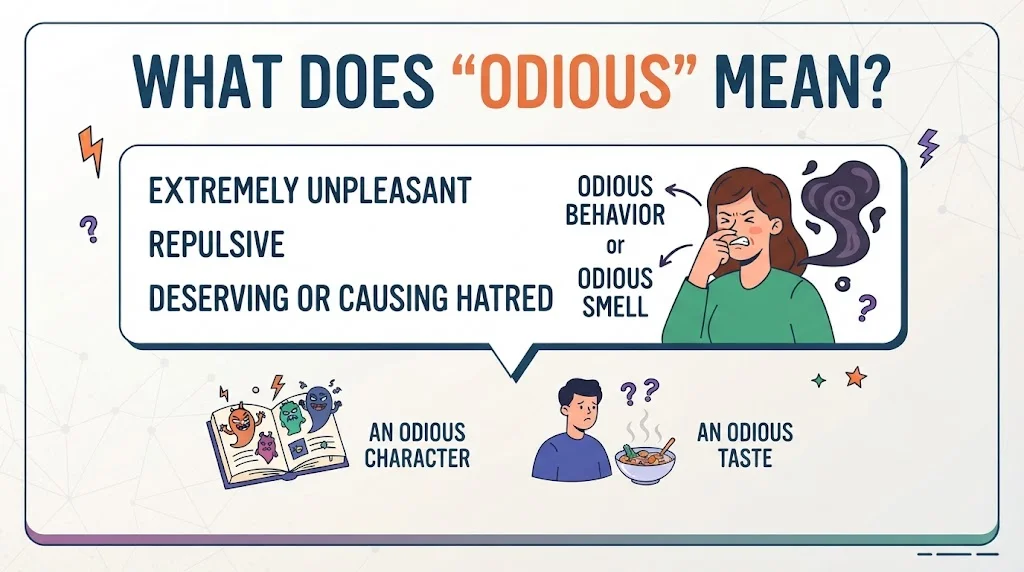
Odious means extremely unpleasant, offensive, or deserving of strong dislike. The word is commonly used to describe actions, behaviors, ideas, conditions, or situations that people strongly reject or find morally unacceptable. “Odious” often appears in formal writing, journalism, legal discussions, and serious conversations where strong criticism is intended.
The core idea behind odious is not just that something is inconvenient or disliked; it suggests that the subject causes deep negative feelings because it appears harmful, offensive, unfair, or morally wrong.
For example:
- “The company faced criticism for its odious treatment of employees.”
- “The report exposed an odious practice that harmed vulnerable communities.”
The word communicates a strong judgment, so it should be used carefully.
Origin & History of “Odious”
The word odious comes from the Latin word “odiosus,” meaning hateful or full of hatred, which developed from “odium,” meaning hatred or dislike. It entered English through Old French during the Middle Ages.
Historically, “odious” was used to describe people, actions, or behaviors that inspired hatred or disgust. Over time, the meaning became broader and began describing anything considered deeply offensive, unpleasant, or unacceptable.
In modern English, “odious” is most common in formal contexts such as:
- Political commentary
- Legal writing
- Academic discussions
- Journalism
- Social criticism
Although the word still carries the idea of hatred or strong dislike, speakers today often use it more broadly to describe something viewed as morally wrong, disturbing, or unacceptable.
Synonyms & Alternatives by Tone
Professional & Neutral Alternatives
- Unacceptable
- Offensive
- Inappropriate
- Objectionable
- Disturbing
- Harmful
- Problematic
- Unethical
- Troubling
- Concerning
Polite & Supportive Alternatives
- Unfortunate
- Disappointing
- Concerning
- Difficult
- Challenging
- Unhelpful
- Not ideal
- Less than acceptable
Encouraging & Reassuring Alternatives
- Needs improvement
- Could be handled differently
- Requires attention
- Worth reconsidering
- Better addressed another way
Casual, Playful & Idiomatic Alternatives
- Awful
- Terrible
- Horrible
- Gross
- Really bad
- Hard to tolerate
- A bad move
- Not okay
When Should You Use “Odious”?
Professional settings
“Odious” can be effective when discussing serious ethical concerns, harmful actions, or unacceptable behavior. It works best when the writer or speaker wants to express a strong but deliberate judgment.
Examples:
- A journalist describing corruption
- A researcher discussing unethical practices
- A professional writing about harmful policies
However, workplace communication often requires balance. Calling a colleague’s idea “odious” may sound personal or aggressive, while describing a harmful practice as “odious” may be appropriate.
Casual conversations
In everyday conversations, “odious” is less common because it sounds formal and intense. Most people would use words like “awful,” “terrible,” or “unacceptable.”
Example:
Instead of:
“That restaurant’s service was odious.”
Most people would say:
“That restaurant’s service was terrible.”
Writing, presentations, and digital communication
“Odious” works well in:
- Opinion articles
- Essays
- Historical analysis
- Formal presentations
- Serious social discussions
It is especially effective when the goal is to communicate strong moral disagreement.
When Should You Avoid “Odious”?
Overly formal situations
Although “odious” sounds formal, it can sometimes feel dramatic. In business communication, a calmer alternative may create a better understanding.
Instead of:
“This proposal is odious.”
Consider:
“This proposal raises serious concerns.”
Legal, academic, or sensitive contexts
In sensitive discussions, emotional language can weaken credibility. Researchers, professionals, and legal writers often prefer precise descriptions over highly charged words.
Instead of:
“An odious decision.”
A more specific option may be:
“A decision that created significant ethical concerns.”
Situations where nuance may be lost
“Odious” leaves little room for middle ground. If a situation is simply inconvenient, ineffective, or disappointing, stronger language may exaggerate the issue.
Is “Odious” Professional, Polite, or Casual?
“Odious” is a professional and formal word, but it is not usually considered polite or neutral. It communicates strong emotional judgment and suggests serious criticism.
Tone analysis
- Formality: High
- Professional suitability: Depends on context
- Emotional intensity: Strong
- Everyday usage: Low
Audience perception
Some readers may see “odious” as intelligent and precise, especially in formal writing. Others may view it as overly harsh if used in ordinary conversation.
In professional communication, the word is most effective when criticizing actions, systems, or ideas rather than attacking individuals.
Pros and Cons of Using “Odious”
Advantages
Clarity
“Odious” quickly communicates that something is more than simply unpleasant.
Efficiency
One word can express strong disapproval without requiring a long explanation.
Accessibility
Although formal, many readers understand its negative meaning from context.
Potential Drawbacks
Oversimplification
The word may label something negatively without explaining the specific problem.
Tone mismatch
Using “odious” in a casual workplace message may sound unnecessarily aggressive.
Repetition
Repeated use can reduce impact and make writing feel emotionally heavy.
Real-Life Examples of “Odious” by Context
“After reviewing the findings, we cannot support practices that create such odious conditions for employees.”
Meeting
“The team agreed that the previous process created an odious situation for customers and needed immediate improvement.”
Presentation
“The report highlights how odious working conditions affected employee retention.”
Conversation
“I found the way the company handled the situation completely odious.”
Social media
“Ignoring people’s basic rights for profit is an odious approach that deserves criticism.”
“Odious” vs Similar Expressions (Key Differences)
The following expressions are related to “odious,” but each carries a different level of intensity, formality, and emotional meaning.
| Phrase | Meaning Difference | Tone Difference | Best Use Scenario |
| Odious | Extremely unpleasant or morally offensive | Formal, intense, judgmental | Serious criticism, journalism, essays |
| Offensive | Causes anger, discomfort, or hurt | Direct but less formal | Social issues, workplace feedback |
| Unacceptable | Not allowed or approved | Professional, practical | Workplace decisions, policies |
| Disgusting | Causes strong dislike or disgust | Emotional, informal | Personal reactions, casual speech |
| Harmful | Causes damage or negative effects | Neutral, evidence-focused | Reports, research, professional discussions |
| Unethical | Violates moral standards | Formal, analytical | Business, legal, and academic contexts |
Common Mistakes & Misuse of “Odious”
Using it for minor problems
Calling a delayed meeting or a small inconvenience “odious” makes the language seem exaggerated.
Attacking people instead of behavior
“Odious” is usually better applied to actions, systems, or ideas rather than directly insulting individuals.
Ignoring audience expectations
A formal word may confuse readers who expect simple, everyday language.
Cultural misunderstandings
ESL learners may recognize the negative meaning but underestimate its emotional strength. Native speakers often perceive “odious” as a serious accusation.
Psychological Reasons People Prefer “Odious”
Cognitive load reduction
Strong words like “odious” quickly communicate emotional meaning. Readers immediately understand that the speaker strongly rejects something.
Trust and authority signals
In formal writing, precise vocabulary can signal confidence and expertise when used correctly.
Attention economy
In modern digital communication, powerful words often attract attention because they create a stronger emotional response.
Modern communication habits
People increasingly choose words that communicate quickly. However, strong language must still match the situation to maintain credibility.
US vs UK Usage of “Odious”
Popularity
“Odious” is understood in both American and British English but is more common in formal writing than in everyday speech.
Tone perception
In both regions, the word usually sounds serious, educated, and strongly negative.
Regional preferences
British writers may use “odious” more frequently in literary or political commentary, while American speakers often replace it with simpler alternatives like “offensive,” “unacceptable,” or “harmful.”
“Odious” in Digital & Modern Communication
Emails
In professional emails, “odious” should be used carefully because it can sound confrontational.
Better:
“This approach creates unacceptable risks.”
Slack / WhatsApp
Short-form communication usually favors simpler words.
Instead of:
“That policy is odious.”
Many users would write:
“That policy is unacceptable.”
Social media
The word appears more often online because social discussions frequently involve strong opinions about social, political, or ethical issues.
AI-generated summaries
AI tools may use “odious” when summarizing strongly negative topics, but human writers should review whether the intensity matches the original meaning.
Linguistic & Communication Insight
Emotional weight & subtext
The word “odious” carries more than a simple negative meaning. Native speakers often hear it as a sign of strong moral rejection, not just personal dislike.
Saying something is “odious” suggests that the speaker believes the subject violates important standards or values.
Direct vs indirect phrasing
Direct:
“This is an odious practice.”
This communicates strong condemnation.
Indirect:
“This practice raises serious concerns.”
This invites discussion and reduces defensiveness.
Experienced communicators choose between these styles depending on their goal. If the aim is persuasion, collaboration, or problem-solving, softer alternatives often work better.
Professional communication perspective
In workplaces, strong words influence how messages are received. Calling a decision “odious” may make people focus on the criticism rather than the solution.
A professional communicator may choose:
- “Unacceptable” for clear standards
- “Harmful” for evidence-based criticism
- “Concerning” for collaborative discussion
Pragmatic reasons for alternatives
Professionals often avoid emotionally intense language because they want to:
- Encourage cooperation
- Reduce conflict
- Maintain credibility
- Keep discussions productive
Social signaling
Word choice communicates personality and intention. Using “odious” can signal strong values and confidence, but using it too often may make someone appear overly critical.
Tone & context guidance
Use “odious” when:
- The issue is genuinely serious
- Strong criticism is appropriate
- The audience understands formal language
Avoid it when:
- Giving everyday feedback
- Maintaining workplace harmony
- Discussing minor problems
Unacceptable
Meaning: Unacceptable means something that cannot be approved, tolerated, or considered suitable because it fails to meet expected standards, rules, or requirements. It is one of the closest professional alternatives to “odious” when describing behavior, decisions, policies, or situations that need rejection.
Why This Phrase Works: “Unacceptable” communicates strong disagreement without sounding overly emotional. It focuses on standards and outcomes rather than personal judgment, making it useful in professional environments.
Real-World Usage Insight: Professionals often choose “unacceptable” instead of “odious” because it creates space for improvement. It identifies a problem clearly while keeping the conversation solution-focused.
Best Use: Workplace discussions, customer service issues, policy reviews, performance feedback, formal complaints, and professional communication.
Avoid when: Describing deeply harmful actions where stronger moral language is necessary, or when you need to express personal disgust or outrage.
Tone: Professional, firm, direct, practical.
US vs UK Usage: Common in both US and UK English. American workplaces frequently use “unacceptable” in performance and policy discussions, while British speakers may sometimes use “not acceptable” in similar situations.
Example (Email / Message / Meeting):
“After reviewing the customer complaints, we agree that the current response process is unacceptable and needs immediate improvement.”
Offensive
Meaning: Offensive describes something that causes anger, discomfort, or hurt because it is disrespectful, inappropriate, or insensitive. It focuses more on the impact something has on people than on whether it is morally wrong.
Why This Phrase Works: “Offensive” is easier for most audiences to understand than “odious.” It clearly explains that something has crossed a social or personal boundary.
Real-World Usage Insight: Organizations often use “offensive” when discussing language, behavior, advertising, or communication problems because it addresses audience reaction.
Best Use: Workplace behavior discussions, social issues, public statements, content reviews, and communication feedback.
Avoid When: Discussing technical problems, ineffective systems, or situations that are harmful but not necessarily offensive.
Tone: Serious, direct, socially aware.
US vs UK Usage: Widely used in both regions. US English often uses “offensive” in discussions about speech and culture, while UK English may use it similarly but sometimes with a slightly softer tone.
Example (Email / Message / Meeting):
“The marketing team removed the campaign because several customers found the wording offensive.”
Inappropriate
Meaning: Inappropriate means unsuitable, improper, or not acceptable for a particular situation, audience, or purpose. It describes behavior, language, actions, or decisions that do not fit expected standards.
Why This Phrase Works: “Inappropriate” is a diplomatic alternative because it identifies a problem without sounding like a personal attack.
Real-World Usage Insight: Managers and educators often prefer “inappropriate” because it allows correction while maintaining respectful communication.
Best Use: Workplace feedback, education, professional conversations, HR communication, and social situations.
Avoid When: Describing serious ethical violations where a stronger term is needed.
Tone: Polite, professional, corrective.
US vs UK Usage: Very common in both American and British English. It is frequently used in schools, workplaces, and official communication.
Example (Email / Message / Meeting):
“Some comments made during the meeting were inappropriate and did not support a respectful discussion.”
Objectionable
Meaning: Objectionable means something that causes disagreement, criticism, or disapproval. It suggests that people find something unacceptable or problematic.
Why This Phrase Works: “Objectionable” sounds measured and analytical. It expresses disagreement while leaving room for discussion.
Real-World Usage Insight: Legal professionals, academics, and reviewers often use this word because it presents criticism in a controlled way.
Best Use: Academic writing, reviews, formal complaints, legal discussions, and policy analysis.
Avoid it when speaking casually, because many people may find it overly formal.
Tone: Formal, controlled, analytical.
US vs UK Usage: Used in both varieties of English but appears more often in formal writing than in everyday American or British conversation.
Example (Email / Message / Meeting):
“The committee identified several objectionable points in the proposed agreement before approving the final version.”
Disturbing
Meaning: Disturbing describes something that causes worry, discomfort, concern, or emotional unease. It focuses on the reaction something creates rather than directly labeling it as morally wrong.
Why This Phrase Works: “Disturbing” communicates seriousness while sounding less aggressive than “odious.”
Real-World Usage Insight: Journalists, researchers, and professionals often use “disturbing” when they want to highlight concerns while allowing readers to form their own conclusions.
Best Use: Reports, news writing, research findings, social discussions, and serious conversations.
Avoid When: You need a precise description of a rule violation or professional standard failure.
Tone: Serious, concerned, cautious.
US vs UK Usage: Common in both regions. Both American and British speakers use it frequently when discussing troubling events or information.
Example (Email / Message / Meeting):
“The audit revealed disturbing patterns that require further investigation.”
Harmful
Meaning: Harmful means causing damage, injury, negative effects, or unwanted consequences. It focuses on measurable impact rather than emotional reaction.
Why This Phrase Works: “Harmful” is often stronger than “problematic” but more objective than “odious.” It works well when evidence supports the criticism.
Real-World Usage Insight: Professionals often prefer “harmful” because it connects criticism to outcomes rather than personal opinions.
Best Use: Healthcare, research, workplace policies, environmental discussions, education, and social issues.
Avoid When: The issue is mainly offensive or unpleasant but does not actually cause damage.
Tone: Objective, serious, evidence-based.
US vs UK Usage: Frequently used in both US and UK English, especially in academic, scientific, and professional contexts.
Example (Email / Message / Meeting):
“The review showed that the outdated process was harmful to employee productivity and customer satisfaction.”
Problematic
Meaning: Problematic means creating difficulties, concerns, complications, or possible negative consequences. It suggests that something needs attention or improvement.
Why This Phrase Works: “Problematic” is a flexible alternative because it expresses concern without immediately making a severe judgment.
Real-World Usage Insight: Modern workplaces often use “problematic” because it encourages discussion instead of creating immediate conflict.
Best Use: Meetings, project reviews, workplace feedback, academic analysis, and everyday professional communication.
Avoid When: Describing extremely serious wrongdoing where stronger wording is appropriate.
Tone: Neutral, professional, moderate.
US vs UK Usage: Very common in both varieties of English. It has become especially popular in professional and academic discussions.
Example (Email / Message / Meeting):
“The team identified several problematic areas in the current workflow that should be addressed before launch.”
Unethical
Meaning: Unethical means contrary to accepted moral principles, professional standards, or codes of conduct. It specifically relates to actions that violate ethical expectations.
Why This Phrase Works: “Unethical” provides a clear reason for criticism by connecting the issue to values and standards.
Real-World Usage Insight: Businesses and institutions often use “unethical” when discussing misconduct because it is more precise than general negative words.
Best Use: Corporate discussions, academic writing, professional standards, compliance issues, and leadership communication.
Avoid When: The problem is simply inefficient, inconvenient, or unpopular rather than morally questionable.
Tone: Formal, serious, principle-based.
US vs UK Usage: Common in both regions, especially in business, law, and academic environments.
Example (Email / Message / Meeting):
“The investigation concluded that the company’s previous practices were unethical and required immediate correction.”
Troubling
Meaning: Troubling means causing concern, worry, or uncertainty. It suggests that something deserves attention but does not always imply complete rejection.
Why This Phrase Works: “Troubling” is softer than “odious” while still communicating that something should not be ignored.
Real-World Usage Insight: Leaders often use “troubling” when they want to acknowledge a problem while keeping conversations constructive.
Best Use: Workplace communication, reports, discussions, feedback, and sensitive topics.
Avoid When: You need to communicate a clear violation or strong condemnation.
Tone: Concerned, diplomatic, thoughtful.
US vs UK Usage: Used naturally in both US and UK English. It often appears in journalism and professional discussions.
Example (Email / Message / Meeting):
“The results of the survey are troubling and show that employees need better support.”
Conclusion
Understanding “odious” meaning, synonyms, and appropriate alternatives helps you communicate criticism with accuracy and confidence. Although “odious” is a powerful word that expresses strong dislike or moral rejection, it is not always the best choice for every audience or situation. Its formal tone and emotional intensity make it effective in serious writing, journalism, and discussions about harmful actions or unacceptable behavior.
However, professional communication often requires balance. Alternatives such as “unacceptable,” “harmful,” “concerning,” and “problematic” can express criticism while encouraging dialogue and cooperation. The best word depends on your purpose, audience, and the level of emotion you want to convey.
For writers, students, professionals, and ESL learners, mastering the difference between “odious” and similar expressions improves clarity and prevents tone mistakes. Strong vocabulary is not about choosing the harshest word; it is about selecting the most accurate word. When used thoughtfully, “odious” can add precision, authority, and impact to communication.
FAQs About “Odious”
What does “odious” mean in simple English?
“Odious” means extremely unpleasant, offensive, or deserving of strong dislike. It is usually used when describing actions, behaviors, ideas, or situations that people strongly reject. The word carries a serious negative meaning and is often found in formal writing, news articles, legal discussions, and social criticism rather than everyday conversations.
Is “odious” a negative word?
Yes, “odious” is a strongly negative word. It expresses intense dislike, disapproval, or rejection. Unlike simple words such as “bad” or “unpleasant,” it often suggests that something is morally wrong, offensive, or deeply unacceptable. Because of its strong emotional impact, it should be used carefully depending on the audience and context.
What are the best synonyms for “odious”?
Common synonyms for “odious” include unacceptable, offensive, harmful, unethical, objectionable, disturbing, problematic, troubling, awful, and horrible. The best synonym depends on the situation. For professional communication, “unacceptable” or “concerning” may work better, while casual conversations may use words like “awful” or “terrible.”
Is “odious” formal or informal?
“Odious” is considered a formal word. It appears more often in academic writing, journalism, legal discussions, and serious commentary than in casual speech. Native speakers usually understand it, but many choose simpler alternatives in everyday conversations because “odious” can sound intense or overly formal.
Can “odious” be used in professional communication?
Yes, “odious” can be used professionally when discussing serious ethical issues, harmful practices, or unacceptable actions. However, it should be applied carefully. In workplace communication, words like “unacceptable,” “concerning,” or “problematic” may create a more constructive tone while still communicating criticism clearly.
What is the difference between “odious” and “offensive”?
“Odious” suggests something is extremely unpleasant or morally unacceptable, while “offensive” focuses on something that causes anger, discomfort, or hurt. An action can be offensive without being considered odious. “Odious” is usually stronger and carries a deeper sense of rejection or condemnation.
Is “odious” commonly used in American English and British English?
“Odious” is understood in both American and British English, but it is more common in formal writing than in everyday conversation. British writers may use it slightly more often in literary or political contexts, while American speakers frequently choose alternatives such as “unacceptable,” “harmful,” or “offensive” in regular communication.
What is a polite alternative to “odious”?
Polite alternatives to “odious” include concerning, unfortunate, inappropriate, problematic, or unacceptable. These words allow speakers to express disagreement without sounding overly aggressive. They are especially useful in workplaces, customer communication, education, and situations where maintaining respectful relationships is important.
Can “odious” describe a person?
Yes, “odious” can describe a person, but it is usually considered a very strong criticism. Saying someone is “odious” suggests that they are extremely unpleasant or disliked. In professional and social settings, it is often better to describe specific behaviors or actions rather than labeling a person directly.
How can writers use “odious” effectively?
Writers can use “odious” effectively when they need to express strong disapproval in a serious context. It works well in opinion articles, essays, historical writing, and discussions about unethical actions. Writers should avoid overusing it because excessive emotional language can reduce credibility and make arguments appear exaggerated.