Imagine you’re finishing an email to a client, guiding a colleague through a project, or helping a customer complete an online form. At some point, you may need to tell someone to move forward with the next step. Many people instinctively write “Please proceed.” It’s short, polite, and widely understood—but is it always the best choice?
The phrase “Please proceed” appears in workplaces, classrooms, customer service, presentations, digital platforms, and everyday conversations. It signals permission, encourages action, and helps conversations move forward. However, the exact wording you choose can influence how your message is received. In some situations, “Please proceed” sounds professional and efficient. In others, it may feel overly formal, distant, or even slightly authoritative.
Understanding the meaning, tone, and alternatives to “Please proceed” helps you communicate more naturally and effectively. Whether you’re a professional writing emails, a student preparing presentations, an ESL learner improving fluency, or a content writer aiming for authentic language, choosing the right alternative can improve clarity, build rapport, and make your communication sound more human.
This guide explores the meaning, history, tone, practical usage, and the best alternatives to “Please proceed,” helping you choose the most appropriate expression for every situation.
What Does “Please Proceed” Mean?
Please proceed is a polite expression used to give someone permission or encouragement to continue with an action, process, or conversation. It indicates that the person may move forward without hesitation and is commonly used in professional, instructional, customer service, and everyday communication to guide the next step.
Origin & History of “Please Proceed”
The expression “please proceed” combines two long-established English words with distinct historical roots.
The word “please” originates from Old French plaisir, meaning “to satisfy” or “to give pleasure,” eventually becoming a standard marker of politeness in English during the Middle English period. Over time, it evolved into one of the most recognizable courtesy words used before requests and instructions.
The verb “proceed” comes from the Latin procedere, meaning “to go forward” or “advance.” It entered English through Old French during the medieval period and was initially used in legal, religious, and formal administrative writing.
Historically, “proceed” carried a formal tone because courts, governments, and official institutions frequently used it to direct actions or continue proceedings. Phrases like “The court may proceed” or “Please proceed with your statement” reinforced its association with authority and structured communication.
As business communication expanded during the twentieth century, the phrase “Please proceed” became common in corporate emails, customer service scripts, manuals, presentations, and digital interfaces. Today, while it still retains a professional feel, it is also widely used in everyday workplace communication and online interactions.
Modern English speakers often choose alternatives depending on the relationship, desired tone, and communication channel. Collaborative workplaces, for example, may prefer softer expressions such as “Go ahead,” “Feel free to continue,” or “Whenever you’re ready.” Nevertheless, “Please proceed” remains a trusted phrase because it communicates permission clearly and efficiently.
Synonyms & Alternatives by Tone
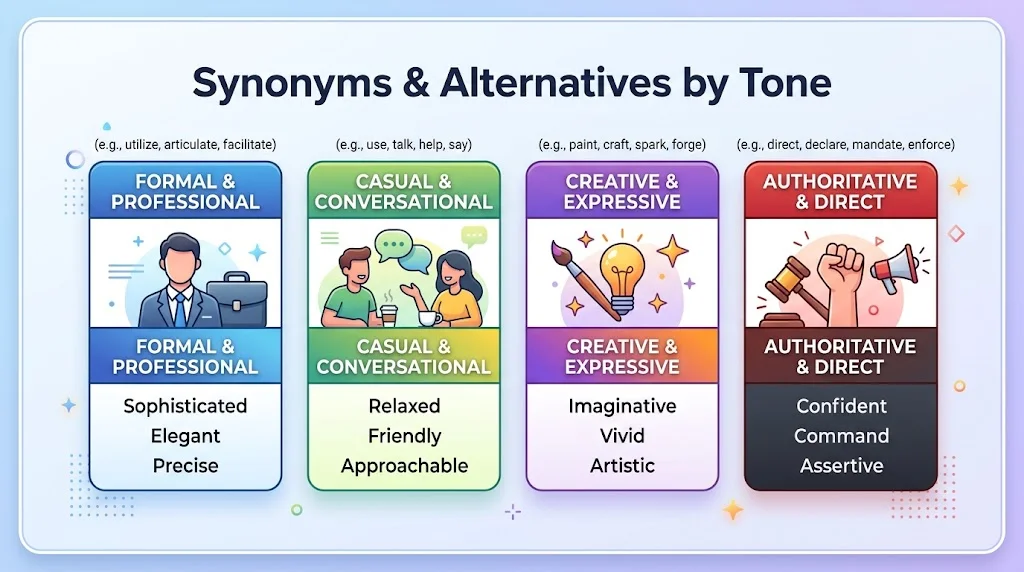
Professional & Neutral Alternatives
- Kindly proceed
- Please continue
- Continue as planned
- You may proceed
- Proceed with the next step
- Carry on
- Continue with the process
- Move forward
- Please go ahead
- Continue accordingly
Polite & Supportive Alternatives
- Feel free to continue
- Whenever you’re ready
- You’re welcome to continue
- Please feel free to proceed
- Take your time and continue
- Go right ahead
- Continue when convenient
- Please carry on
- You’re all set to continue
- Continue at your convenience
Encouraging & Reassuring Alternatives
- Go ahead
- You’re good to go
- Keep going
- You’re ready to move forward
- Everything looks good
- You can continue now
- Don’t hesitate to continue
- You’re clear to proceed
- Keep moving forward
- Let’s move ahead
Casual, Playful & Idiomatic Alternatives
- Go for it
- Crack on
- Off you go
- Knock yourself out
- Have at it
- Fire away
- Keep it rolling
- You’re all set
- Let’s keep things moving
- Onward
When Should You Use “Please Proceed”?
The phrase “Please proceed” works best when you want to give clear permission or indicate that someone can continue with an action. Its straightforward wording makes it useful across many professional and everyday situations.
Professional Settings
In business environments, “Please proceed” communicates approval without sounding overly casual. Managers, team leaders, consultants, and customer support representatives often use it after confirming information or approving a request.
Examples include:
- Approving project milestones
- Authorizing payments
- Permit to begin work
- Confirming document submissions
- Responding to client requests
Because it is concise, it reduces ambiguity and keeps communication efficient.
Casual Conversations
Outside the workplace, the phrase can still be appropriate, although native speakers often choose friendlier alternatives like “Go ahead” or “Feel free.”
For example:
- “If everyone has arrived, please proceed.”
- “Please proceed if you’re comfortable.”
In everyday conversation, softer wording may sound warmer and more natural.
Writing, Presentations, and Digital Communication
The phrase appears frequently in:
- Email replies
- Online application forms
- Customer support chats
- User instructions
- Meeting agendas
- Presentation transitions
- Website onboarding processes
- AI-generated instructions
Its clarity makes it especially valuable when guiding users through multiple steps.
When It Is Especially Effective
“Please proceed” is most effective when:
- Permission has just been granted.
- Someone is waiting for approval.
- Instructions need to remain concise.
- Multiple people require the same guidance.
- Professional neutrality is important.
When Should You Avoid “Please Proceed”?
Although versatile, “Please proceed” is not suitable for every situation.
Overly Formal Conversations
Among close colleagues or friends, the phrase may sound unnecessarily official.
Instead of:
Please proceed with your lunch.
Most native speakers would simply say:
Go ahead.
Legal, Academic, or Sensitive Contexts
While the phrase frequently appears in legal environments, it may not always provide enough precision in contracts, policies, or formal academic writing.
For example, detailed procedural instructions usually require more specific wording than simply “Please proceed.”
Situations Where Nuance May Be Lost
Sometimes people need encouragement rather than permission.
Compare:
- Please proceed.
- Whenever you’re comfortable, you can continue.
The second option acknowledges emotions and creates a more supportive atmosphere.
Similarly, in customer service, replacing “Please proceed” with “You’re all set” or “Feel free to continue” often feels more welcoming.
Is “Please Proceed” Professional, Polite, or Casual?
The phrase sits comfortably within professional and polite English, although it leans toward formal communication rather than casual conversation.
Formality Level
Moderately formal.
It sounds appropriate in:
- Corporate communication
- Meetings
- Presentations
- Customer service
- Official correspondence
It is less common in relaxed conversations among friends.
Emotional Subtext
Unlike enthusiastic expressions, “Please proceed” remains emotionally neutral.
It signals:
- Permission
- Confidence
- Organization
- Orderliness
It generally avoids expressing excitement, urgency, or personal warmth.
Audience Perception
Different audiences may interpret the phrase differently.
Professionals often appreciate its clarity and efficiency.
ESL learners benefit from its simplicity because it has one clear purpose.
Customers may perceive it as courteous, although adding a warmer phrase can improve the overall experience.
Creative teams and younger audiences may prefer friendlier alternatives that feel more conversational.
Pros and Cons of Using “Please Proceed”
Every commonly used phrase has strengths and limitations. Understanding both helps you choose the most appropriate wording.
Advantages
Clarity
“Please proceed” leaves little room for misunderstanding. The listener immediately knows they have permission to continue.
Efficiency
Its brevity makes it ideal for emails, meetings, instructions, and digital interfaces where concise communication matters.
Accessibility
The phrase is widely understood by both native and non-native English speakers, making it suitable for international communication.
Potential Drawbacks
Oversimplification
Complex situations sometimes require additional explanation instead of a simple instruction to proceed.
Tone Mismatch
Because the phrase sounds somewhat formal, it may feel distant in friendly or collaborative conversations.
Repetition
Using “Please proceed” repeatedly throughout documents, presentations, or emails can make writing sound mechanical. Rotating between natural alternatives improves readability and keeps communication engaging.
Real-Life Examples of “Please Proceed” by Context
Emails
Thank you for confirming the updated pricing. Please proceed with the purchase order at your convenience.
Meetings
If there are no additional questions, please proceed with the presentation.
Presentations
We’ve covered the background information. Please proceed to the implementation strategy.
Conversations
Everything has been approved. Please proceed whenever you’re ready.
Social Media
Registration is now open! Complete the short form, and please proceed to secure your spot.
“Please Proceed” vs Similar Expressions (Key Differences)
| Phrase | Meaning Difference | Tone Difference | Best Use Scenario |
| Go ahead | Gives informal permission to continue immediately. | Friendly, conversational | Everyday conversations, meetings |
| Please continue | Emphasizes continuing an existing action rather than starting a new one. | Neutral, polite | Presentations, discussions, speeches |
| Feel free to continue | Adds reassurance and removes pressure. | Warm, supportive | Customer service, coaching, education |
| Carry on | Encourages continuing despite interruption. | Slightly informal (UK), professional in some contexts | Team discussions, workplace conversations |
| Move forward | Focuses on progress toward a goal rather than immediate permission. | Professional, motivational | Projects, planning meetings |
| You’re good to go | Indicates everything is approved or ready. | Casual, encouraging | Internal teams, technical support, and daily communication |
Common Mistakes & Misuse of “Please Proceed”
One common mistake is overusing the phrase in emails or documentation. Repeating it several times within a single message can make your writing feel robotic. Varying your language with suitable alternatives creates a more natural reading experience.
Another issue is using it before the necessary information has been provided. Telling someone to proceed without confirming instructions, approvals, or expectations can lead to confusion and unnecessary follow-up questions.
Writers also sometimes use “Please proceed” in situations that require empathy rather than simple direction. For example, after discussing a sensitive issue, a more supportive expression such as “Whenever you’re ready” or “Take your time” may better acknowledge the other person’s feelings.
Cultural expectations can also affect interpretation. While many English-speaking workplaces view the phrase as professional and efficient, some international audiences may perceive it as more authoritative than intended. Adjusting your wording to match your audience helps maintain trust and collaboration.
Psychological Reason People Prefer “Please Proceed”
Several communication principles explain why this phrase remains popular.
Cognitive Load Reduction
The instruction is short, familiar, and easy to process. Readers immediately understand what action is expected without needing additional explanation.
Trust and Authority Signals
The phrase conveys that the speaker has reviewed the situation and is giving permission to move forward. This creates confidence in professional workflows, customer interactions, and approval processes.
Attention Economy
Modern communication values brevity. Emails, instant messages, and online forms often benefit from concise instructions that minimize unnecessary reading.
Modern Communication Habits
As workplaces increasingly rely on digital collaboration tools, people favor expressions that communicate action quickly. “Please proceed” fits neatly into fast-paced communication where efficiency and clarity are priorities.
US vs UK Usage of “Please Proceed”
Both American and British English recognize “Please proceed” as a standard, polite expression, but subtle differences exist.
In the United States, it commonly appears in business emails, customer support, software interfaces, and project management. American professionals often balance it with warmer alternatives such as “Go ahead” or “You’re all set” to create a more conversational tone.
In the United Kingdom, the phrase is also widely understood, particularly in formal settings, public services, legal contexts, and business communication. However, British speakers may naturally use expressions like “Carry on” or “Please continue” in situations where Americans might prefer “Please proceed.”
Overall, there is no significant regional barrier to understanding the phrase, making it suitable for international English communication.
“Please Proceed” in Digital & Modern Communication
Digital communication has increased the visibility of “Please proceed” because online interactions often require users to complete clear, sequential actions.
Emails
Professionals use the phrase to confirm approvals, authorize next steps, and conclude decision-making efficiently.
Slack, Microsoft Teams, and WhatsApp
In workplace messaging platforms, many teams prefer shorter alternatives like “Go ahead,” “You’re good to go,” or “Feel free.” These expressions maintain clarity while sounding more conversational.
Social Media
Brands occasionally use “Please proceed” in promotional campaigns or event registrations, although friendlier wording often improves engagement and approachability.
AI-Generated Summaries and Digital Interfaces
Many software products, chatbots, and AI assistants use “Please proceed” because it provides a universally understood instruction without unnecessary complexity. Its concise nature makes it ideal for interfaces where users need clear guidance through a process.
Linguistic & Communication Insight
Emotional Weight & Subtext
Although “Please proceed” literally grants permission to continue, native speakers often hear additional social meaning. The phrase suggests that a review, approval, or checkpoint has already occurred. It communicates confidence, structure, and orderly progress, but it also creates a degree of emotional distance because it focuses on the task rather than the person.
Direct vs Indirect Phrasing
“Please proceed” is a direct instruction wrapped in polite language. Compared with softer alternatives such as “Whenever you’re ready” or “Feel free to continue,” it places greater emphasis on action than on the recipient’s comfort. This makes it effective when clarity is essential but less suitable when reassurance or collaboration is the priority.
Professional Communication Perspective
In workplace settings, the phrase is generally interpreted as efficient, respectful, and authoritative. Managers often use it to indicate approval, while colleagues may use it to keep projects moving without unnecessary discussion. However, leaders who want to foster a more collaborative culture sometimes replace it with language that invites participation rather than simply authorizing action.
Pragmatic Reasons for Alternatives
Experienced communicators understand that word choice shapes relationships as much as it conveys information. Alternatives such as “Go ahead,” “You’re all set,” or “Feel free to continue” can reduce perceived hierarchy, soften directives, and encourage open dialogue. Choosing the right expression depends on whether your goal is to signal authority, build rapport, or create psychological safety.
Social Signaling
Language influences how people perceive competence, warmth, and trustworthiness. “Please proceed” signals professionalism and confidence, but repeated use may unintentionally create a formal or transactional atmosphere. Balancing it with more conversational alternatives helps communicators appear approachable while maintaining credibility.
Tone & Context Guidance
The most effective communicators adapt this phrase to the audience and situation. Use “Please proceed” when approval, clarity, or procedural accuracy matters. Consider friendlier alternatives when speaking with close colleagues, customers seeking reassurance, or audiences who value collaboration over formality. Matching tone to context strengthens understanding, improves engagement, and makes communication feel both professional and genuinely human.
Kindly Proceed
Meaning: “Kindly proceed” is a courteous way of asking someone to continue with a task or action. It is commonly used in formal business communication, customer service, and written instructions where professionalism is important.
Why This Phrase Works: It combines politeness with clarity, making requests sound respectful without being overly indirect.
Real-World Usage Insight: Many organizations use this phrase in approval emails, onboarding processes, and service communications because it sounds courteous while keeping instructions concise.
Best Use: Business emails, official notices, customer support, and administrative communication.
Avoid when: Chatting with friends or informal teams where it may sound overly formal.
Tone: Formal, polite, professional.
US vs UK Usage: More common in UK, South Asian, and international business English than in everyday American English.
Example (Email): “We’ve verified your documents. Kindly proceed with the final registration before Friday.”
You May Proceed
Meaning: “You may proceed” gives explicit permission for someone to continue after receiving approval.
Why This Phrase Works: It clearly removes uncertainty by confirming authorization.
Real-World Usage Insight: Managers, interviewers, moderators, and customer service representatives frequently use this phrase after confirming that all requirements have been met.
Best Use: Meetings, approvals, interviews, presentations, and formal procedures.
Avoid when: Friendly conversations where it can sound authoritative.
Tone: Professional, neutral, authoritative.
US vs UK Usage: Common and equally understood in both American and British English.
Example (Meeting): “Everything has been reviewed. You may proceed with your proposal.”
Please Continue
Meaning: “Please continue” politely asks someone to keep doing what they have already started.
Why This Phrase Works: It sounds natural, respectful, and less formal than “Please proceed.”
Real-World Usage Insight: Native speakers commonly use this expression during presentations, discussions, interviews, and storytelling after a brief interruption.
Best Use: Meetings, presentations, classroom discussions, and conversations.
Avoid When: Permitting someone to begin a completely new task.
Tone: Polite, neutral, conversational.
US vs UK Usage: Very common in both regions.
Example (Meeting): “Sorry for interrupting. Please continue with your presentation.”
Go Ahead
Meaning: “Go ahead” permits one to begin or continue an action immediately.
Why This Phrase Works: It is short, friendly, and feels natural in everyday English.
Real-World Usage Insight: Native speakers use this phrase constantly in conversations, workplaces, and customer interactions because it feels approachable and confident.
Best Use: Conversations, meetings, customer support, and workplace chats.
Avoid when: Highly formal legal or official correspondence.
Tone: Friendly, casual, professional depending on context.
US vs UK Usage: Extremely common in both countries.
Example (Conversation): “If you’re ready, go ahead and ask your question.”
Feel Free to Continue
Meaning: This phrase encourages someone to continue while emphasizing that there is no pressure or restriction.
Why This Phrase Works: It makes instructions feel supportive rather than commanding.
Real-World Usage Insight: Teachers, coaches, customer service teams, and managers often use it to create a welcoming atmosphere.
Best Use: Coaching, education, customer service, collaborative workplaces.
Avoid When: Immediate action or urgency needs to be communicated.
Tone: Warm, supportive, reassuring.
US vs UK Usage: Widely used across both regions.
Example (Meeting): “Feel free to continue whenever you’re ready.”
Continue as Planned
Meaning: This expression tells someone to keep following the existing plan without making changes.
Why This Phrase Works: It reinforces stability and confirms that no adjustments are necessary.
Real-World Usage Insight: Project managers and team leaders often use this phrase after reviewing progress and deciding that everything remains on track.
Best Use: Project management, operations, business planning, event coordination.
Avoid when starting a new activity or changing direction.
Tone: Professional, confident, reassuring.
US vs UK Usage: Equally understood in American and British workplaces.
Example (Email): “The revised budget has been approved. Please continue as planned.”
Carry On
Meaning: “Carry on” encourages someone to continue what they were already doing despite an interruption.
Why This Phrase Works: It sounds natural and conversational while keeping communication brief.
Real-World Usage Insight: British English speakers use this expression frequently in workplaces and everyday conversation.
Best Use: Meetings, discussions, presentations, and casual workplace interactions.
Avoid when: Formal written documents or legal communication.
Tone: Friendly, slightly informal.
US vs UK Usage: Much more common in the UK than in the US.
Example (Meeting): “I just needed to clarify one point. Please carry on.”
Move Forward
Meaning: “Move forward” encourages continued progress toward a goal rather than simply granting permission.
Why This Phrase Works: It focuses attention on progress, collaboration, and achieving results.
Real-World Usage Insight: Executives, consultants, and project leaders often use this phrase during planning sessions and strategic discussions.
Best Use: Business strategy, project planning, leadership communication, team meetings.
Avoid When: Giving simple procedural instructions that only require permission.
Tone: Professional, motivational, collaborative.
US vs UK Usage: Very common in both American and British business English.
Example (Meeting): “Now that everyone agrees on the timeline, let’s move forward with implementation.”
You’re Good to Go
Meaning: This phrase tells someone that everything is ready and they have approval to begin or continue.
Why This Phrase Works: It sounds positive, confident, and encouraging while clearly communicating readiness.
Real-World Usage Insight: Customer support teams, IT professionals, and managers often use it after confirming that all requirements have been met.
Best Use: Workplace chats, technical support, project approvals, and informal business communication.
Avoid when: Legal documents or highly formal correspondence.
Tone: Friendly, encouraging, professional.
US vs UK Usage: Extremely common in the US and increasingly common in the UK.
Example (Message): “The software update has finished successfully. You’re good to go.”
Conclusion
“Please proceed” is a timeless phrase that communicates permission, approval, and forward movement with clarity and professionalism. Whether you’re writing a business email, leading a meeting, responding to a customer, or guiding someone through a process, it provides a concise way to signal that the next step can begin. However, effective communication is rarely about using one phrase repeatedly. Understanding alternatives such as “Go ahead,” “Feel free to continue,” “You may proceed,” and “Whenever you’re ready” allows you to adapt your language to different audiences, relationships, and situations.
Choosing the right expression helps create the appropriate tone, whether formal, collaborative, supportive, or conversational, while reducing misunderstandings. By considering context, cultural expectations, and your audience’s needs, you can make your communication sound more natural and engaging. Ultimately, mastering “Please proceed” and its alternatives strengthens your writing, improves workplace interactions, and helps you communicate with confidence, professionalism, and authenticity in both traditional and modern digital environments.
FAQs
What does “Please proceed” mean?
“Please proceed” is a polite expression used to give someone permission or instruction to continue with an action, process, or conversation. It commonly appears in professional communication, meetings, customer service, and written instructions. The phrase indicates that any necessary approval or clarification has already been provided, allowing the recipient to move forward confidently.
Is “Please proceed” a professional phrase?
Yes. “Please proceed” is considered professional and appropriate for business emails, workplace conversations, presentations, customer support, and official correspondence. It communicates approval clearly while maintaining a respectful tone. However, in collaborative environments, warmer alternatives like “Go ahead” or “Feel free to continue” may sound more approachable.
Is “Please proceed” polite?
Yes. The inclusion of “please” makes the phrase courteous and respectful. While it is more formal than everyday conversational expressions, it remains polite across most professional and educational settings. The phrase balances directness with courtesy, making it suitable for permitting without sounding rude or demanding.
What are the best alternatives to “Please proceed”?
Some of the best alternatives include “Go ahead,” “Please continue,” “You may proceed,” “Feel free to continue,” “Move forward,” “Whenever you’re ready,” “You’re good to go,” “Carry on,” “Kindly proceed,” and “Proceed with the next step.” The ideal choice depends on your audience, purpose, and desired level of formality.
Can I use “Please proceed” in an email?
Absolutely. “Please proceed” is widely used in professional emails to approve requests, authorize work, confirm next steps, or guide recipients through a process. It is particularly effective when you want to provide clear direction while maintaining a formal and respectful tone.
When should I avoid using “Please proceed”?
Avoid using “Please proceed” in highly casual conversations where it may sound too formal or distant. It may also be less suitable in emotionally sensitive situations where supportive language such as “Take your time” or “Whenever you’re ready” better acknowledges the other person’s feelings and comfort.
Is “Please proceed” formal or informal?
“Please proceed” is generally considered moderately formal. It fits naturally in workplaces, official communication, presentations, and customer interactions. While it is understandable in everyday conversation, native English speakers often choose less formal alternatives like “Go ahead” when speaking with friends or close colleagues.
Is “Please proceed” commonly used in the US and UK?
Yes. The phrase is widely understood and accepted in both American and British English. American workplaces often pair it with conversational alternatives such as “You’re good to go,” while British English may favor expressions like “Carry on” in less formal situations. Overall, the phrase works well for international communication.
Why do professionals use “Please proceed”?
Professionals use “Please proceed” because it provides clear permission, reduces ambiguity, and keeps communication efficient. It signals that necessary checks or approvals have been completed, allowing projects or conversations to continue without confusion. Its concise wording also makes it ideal for emails, workflows, and digital communication.
How can I make “Please proceed” sound more natural?
You can make the phrase sound more conversational by choosing alternatives that match the situation. Expressions like “Go ahead,” “Feel free to continue,” “Whenever you’re ready,” or “You’re all set” often feel warmer and more collaborative while still communicating the same core message. Selecting the right wording improves clarity, builds rapport, and creates a more engaging communication style.