
Imagine your colleague confidently says, “This project is definitely going to be approved tomorrow.” Someone immediately replies, “Don’t jinx it.” Moments like this happen every day in workplaces, classrooms, sports conversations, and family discussions. Although the phrase sounds lighthearted, it carries an important social message about avoiding overconfidence or tempting bad luck. Understanding what “Don’t Jinx It” means—and knowing when to use it or choose a more suitable alternative—helps you communicate naturally, respectfully, and appropriately across different situations. Whether you’re a professional, student, ESL learner, or content writer, recognizing the tone and intent behind this common expression can improve both spoken and written communication.
What Does “Don’t Jinx It” Mean?
Don’t jinx it means asking someone not to say or assume that a positive outcome is guaranteed because doing so is believed—or jokingly suggested—to increase the chance that something will go wrong. It is commonly used in conversations about future events, predictions, achievements, or uncertain situations where people prefer to remain cautiously optimistic.
The phrase expresses a desire to avoid celebrating or predicting success too early. While many speakers do not literally believe that words cause bad luck, they use the expression as a playful reminder to stay humble and avoid making confident assumptions before the outcome is known.
People commonly say it when:
- Waiting for exam results.
- Expecting a job offer or promotion.
- Watching a sporting event.
- Anticipating successful project completion.
- Discussing travel plans or important appointments.
- Hoping technology continues working without problems.
Because the phrase is deeply rooted in everyday English, its meaning often depends on tone. It can sound humorous, cautious, supportive, or slightly superstitious depending on the situation and relationship between the speakers.
Origin & History of “Don’t Jinx It”
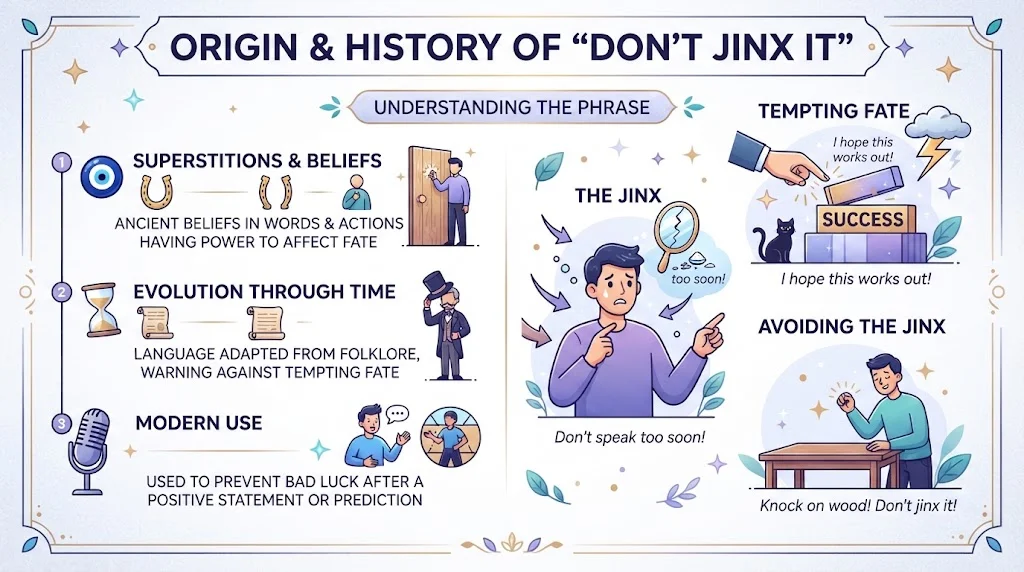
The word “jinx” entered English in the late nineteenth and early twentieth centuries, referring to a person or thing believed to bring bad luck. Linguists generally trace the popularity of the word to American English, where it became associated with superstition, especially in sports and entertainment.
Several theories explain its origin. One links it to the Greek mythological bird called the iynx, associated with magic and enchantment. Another points to early twentieth-century American slang, where “jinx” became a common way to describe bad luck or an unlucky influence. Regardless of its exact origin, the modern meaning quickly shifted from describing a source of bad fortune to the act of causing misfortune by speaking too confidently about future success.
Over time, “Don’t jinx it” evolved into a familiar conversational expression rather than a literal statement of belief. Today, many native speakers use it humorously without believing in superstition. Instead, it reflects a shared cultural preference for cautious optimism and modest expectations.
The phrase remains especially popular in sports, workplaces, schools, and online communities because uncertain outcomes naturally encourage expressions that acknowledge unpredictability.
Synonyms & Alternatives by Tone
Professional & Neutral Alternatives
- Let’s wait and see.
- It’s too early to tell.
- Let’s not assume the outcome yet.
- We’ll know soon enough.
- Let’s stay cautiously optimistic.
Polite & Supportive Alternatives
- I hope it works out.
- Fingers crossed.
- Let’s hope everything goes smoothly.
- Hopefully it all comes together.
- Wishing for the best.
Encouraging & Reassuring Alternatives
- Stay positive.
- We’re on the right track.
- Let’s keep the momentum going.
- Things are looking promising.
- Hopefully we’re almost there.
Casual, Playful & Idiomatic Alternatives
- Knock on wood.
- Don’t count your chickens before they hatch.
- Let’s not celebrate yet.
- Don’t tempt fate.
- Easy now.
When Should You Use “Don’t Jinx It”?
The phrase works best when discussing uncertain future events where optimism exists, but the final result has not yet been confirmed. It reminds people to remain realistic while keeping the conversation friendly.
Professional Settings
In workplace conversations, “Don’t jinx it” can lighten the mood during project discussions, hiring processes, sales negotiations, or product launches. However, it works best among colleagues who already have an informal relationship.
Example:
“Looks like the client is ready to sign.”
“Don’t jinx it—we still have tomorrow’s meeting.”
Casual Conversations
Friends and family frequently use the phrase while discussing vacations, sports matches, medical results, competitions, or personal achievements.
Example:
“My flight has been on time all week.”
“Don’t jinx it!”
Writing, Presentations, and Digital Communication
Although less common in formal writing, the phrase appears naturally in:
- Team chats
- Slack messages
- WhatsApp conversations
- Social media posts
- Personal blogs
- Informal emails
It helps make communication sound conversational without becoming overly serious.
When It Is Especially Effective
Use “Don’t jinx it” when:
- Success is likely but not guaranteed.
- Everyone understands the informal tone.
- You want to encourage humility.
- The conversation is relaxed.
- Humor improves group morale.
When Should You Avoid “Don’t Jinx It”?
Although common in everyday English, the phrase is not suitable for every audience or situation.
Avoid using it in:
- Legal documents.
- Academic papers.
- Medical consultations.
- Financial reports.
- Executive presentations.
- Formal client communication.
- Sensitive conversations involving illness or personal hardship.
In these situations, clearer alternatives such as “Let’s wait for confirmation” or “It’s too early to reach a conclusion” communicate caution without relying on superstition or informal language.
The phrase may also confuse ESL learners who interpret it literally rather than as an idiomatic expression.
Is “Don’t Jinx It” Professional, Polite, or Casual?
Formality: Mostly casual
Professionalism: Appropriate only in informal workplace conversations
Politeness: Generally polite when spoken playfully
Emotional Subtext: Hopeful, cautious, humorous, and slightly superstitious
Native speakers usually interpret “Don’t jinx it” as friendly rather than critical. Instead of correcting someone, the speaker gently suggests avoiding excessive confidence before events unfold.
In professional environments, the phrase works best among teammates with established rapport. In highly formal meetings or client-facing communication, more neutral wording creates greater clarity and professionalism.
Overall, the expression occupies an interesting middle ground: casual enough to sound friendly, yet widely understood across different English-speaking cultures.
Pros and Cons of Using “Don’t Jinx It”
Advantages
Clarity
- Most native English speakers immediately understand the intended meaning.
Efficiency
- The phrase communicates caution in only three words.
Accessibility
- It appears frequently in films, television, sports commentary, workplaces, and online conversations, making it widely recognizable.
Builds Rapport
- It often creates a shared moment of humor and optimism.
Encourages Humility
- It reminds people not to assume success before confirmation.
Potential Drawbacks
Oversimplification
- It may replace a more precise explanation when discussing genuine risks.
Tone Mismatch
- It can sound unprofessional in formal business communication.
Repetition
- Frequent use may make conversations sound predictable.
Cultural Differences
- Some international audiences may misunderstand the idiomatic meaning.
Real-Life Examples of “Don’t Jinx It” by Context
“Everything looks ready for tomorrow’s launch. Don’t jinx it—we still have one final system check this afternoon.”
Meeting
“We’ve hit every milestone so far.”
“Don’t jinx it. Let’s finish testing first.”
Presentation
“The early feedback has been excellent, but let’s not jinx it before the customer survey is complete.”
Conversation
“My internet hasn’t disconnected once today.”
“Don’t jinx it!”
Social Media
“Three workouts completed this week. Don’t jinx it—one more to go!”
“Don’t Jinx It” vs Similar Expressions (Key Differences)
| Phrase | Meaning Difference | Tone Difference | Best Use Scenario |
| Knock on wood | Adds a symbolic action to avoid bad luck | Playful and superstitious | Informal conversations after mentioning good fortune |
| Don’t tempt fate | Warns against inviting negative consequences | Slightly stronger and more dramatic | Risky situations or bold predictions |
| Fingers crossed | Expresses hope rather than caution | Warm and optimistic | Waiting for uncertain outcomes |
| Let’s not celebrate yet | Focuses on delaying celebration | Neutral and practical | Workplace projects and team updates |
| Don’t count your chickens before they hatch | Warns against assuming future success too early | Traditional and idiomatic | Advice about planning or expectations |
| It’s too early to tell | States uncertainty directly without superstition | Professional and objective | Business, academic, and formal discussions |
Common Mistakes & Misuse of “Don’t Jinx It”
One common mistake is overusing the phrase whenever someone shares positive news. Repeating it too often can make conversations feel predictable or dismissive instead of supportive.
Another mistake is using it in the wrong context. In formal presentations, legal discussions, academic writing, or executive meetings, the phrase may sound overly casual or unprofessional.
Some speakers also use it after an outcome has already been confirmed, which weakens its intended meaning. The phrase only makes sense while the result is still uncertain.
A further misunderstanding occurs among international English learners who interpret “jinx” literally rather than recognizing it as an idiomatic expression about avoiding premature confidence.
Finally, avoid using the phrase in emotionally sensitive situations, such as conversations about serious health conditions or personal loss, where humor or superstition may be perceived as insensitive.
Psychological Reason People Prefer “Don’t Jinx It”
The popularity of “Don’t jinx it” reflects several common communication habits rather than genuine belief in superstition.
Cognitive Load Reduction
The phrase instantly communicates caution without requiring a long explanation, making conversations faster and easier to understand.
Trust and Authority Signals
People who avoid making absolute predictions often appear more realistic and credible. Saying “Don’t jinx it” subtly encourages balanced expectations instead of certainty.
Attention Economy
Modern communication rewards short, memorable expressions. Because the phrase is concise and widely recognized, it quickly captures attention without interrupting the flow of conversation.
Modern Communication Habits
Today’s digital conversations often mix humor with practical advice. “Don’t jinx it” fits this style by expressing caution in a friendly, relatable way.
US vs UK Usage of “Don’t Jinx It”
The expression is highly recognizable in both American and British English, although its frequency and surrounding expressions differ slightly.
In the United States, “Don’t jinx it” is extremely common in sports, workplaces, entertainment, and everyday conversations. Americans frequently pair it with expressions like “Knock on wood.”
In the United Kingdom, speakers understand the phrase easily, but alternatives such as “Touch wood” are often more common when referring to avoiding bad luck.
Despite these regional preferences, the overall meaning remains consistent across both varieties of English.
“Don’t Jinx It” in Digital & Modern Communication

Digital communication has made “Don’t jinx it” even more common because it conveys emotion efficiently.
Emails
Used sparingly in informal workplace emails, the phrase adds warmth while acknowledging uncertainty.
Slack and WhatsApp
Team chats frequently include it during product launches, software releases, recruitment updates, or project deadlines.
Social Media
Users often pair the phrase with achievements that are still in progress, creating relatable and humorous posts.
Example:
“Finally finished the first draft. Don’t jinx it—I still need client approval.”
AI-Generated Summaries
Although AI writing generally favors more neutral language, conversational summaries and customer-facing content may include the phrase when an informal tone is appropriate.
Linguistic & Communication Insight
Emotional Weight & Subtext
Native speakers rarely interpret “Don’t jinx it” as a literal belief in bad luck. Instead, it communicates shared optimism mixed with caution. The phrase often strengthens social connection because everyone understands that success is not yet guaranteed.
Direct vs Indirect Phrasing
Compared with direct alternatives such as “You’re being overconfident,” “Don’t jinx it” softens the message considerably. It allows speakers to express caution without criticizing the other person’s confidence, making conversations feel more collaborative and less confrontational.
Professional Communication Perspective
In workplace settings, the phrase can build rapport among colleagues who already know one another well. However, managers, consultants, or client-facing professionals often choose clearer alternatives such as “Let’s wait for confirmation” because they communicate caution without relying on idiomatic language.
Pragmatic Reasons for Alternatives
Experienced communicators frequently replace “Don’t jinx it” with more neutral expressions when they want to:
- Reduce defensiveness.
- Maintain professionalism.
- Increase clarity for international audiences.
- Avoid cultural misunderstandings.
- Emphasize evidence over superstition.
Selecting the right alternative demonstrates emotional intelligence as well as audience awareness.
Social Signaling
Word choice influences how speakers are perceived. Using “Don’t jinx it” can make someone sound approachable, relatable, and conversational. Choosing a more formal alternative may project greater objectivity and authority, especially in professional communication.
Tone & Context Guidance
The phrase works best when uncertainty still exists, relationships are informal, and humor is welcome. It becomes less effective in high-stakes, multicultural, legal, or academic contexts where direct, literal language improves understanding. Strong communicators recognize that matching tone to audience is often more important than choosing the most familiar expression.
Let’s Wait and See
Meaning: This phrase suggests delaying conclusions until more information or an outcome becomes available. It encourages patience rather than prediction.
Why This Phrase Works: It sounds neutral, practical, and objective, making it suitable for both personal and professional communication.
Real-World Usage Insight: Native speakers often use it during project updates, interviews, negotiations, or situations where results are still uncertain.
Best Use: Business discussions, team meetings, client conversations, and everyday decisions.
Avoid When: Someone expects emotional encouragement rather than a factual response.
Tone: Professional, calm, balanced.
US vs UK Usage: Extremely common in both American and British English.
Example (Meeting): “The client seemed interested, but let’s wait and see before updating the forecast.”
It’s Too Early to Tell
Meaning: This expression means there is not yet enough evidence to reach a reliable conclusion.
Why This Phrase Works: It emphasizes facts over assumptions and avoids sounding overly optimistic or pessimistic.
Real-World Usage Insight: Frequently used by managers, teachers, doctors, analysts, and journalists discussing developing situations.
Best Use: Reports, presentations, meetings, and professional emails.
Avoid When: A casual, humorous response would fit the conversation better.
Tone: Neutral, analytical, professional.
US vs UK Usage: Equally natural across both regions.
Example (Email): “The early results are encouraging, but it’s too early to tell whether the campaign will meet its targets.”
Let’s Not Assume the Outcome Yet
Meaning: This phrase reminds people not to treat an expected result as certain before confirmation arrives.
Why This Phrase Works: It encourages realistic thinking while maintaining a collaborative atmosphere.
Real-World Usage Insight: Common in project management, planning sessions, and strategic discussions where expectations need balancing.
Best Use: Team collaboration, executive updates, and planning meetings.
Avoid When: Speaking with close friends in relaxed conversations where a lighter expression feels more natural.
Tone: Professional, diplomatic, measured.
US vs UK Usage: Widely understood and appropriate in both varieties of English.
Example (Meeting): “Everything looks positive, but let’s not assume the outcome yet until legal approval comes through.”
We’ll Know Soon Enough
Meaning: This expression reassures listeners that uncertainty will not last much longer.
Why This Phrase Works: It reduces anxiety without making promises or predictions.
Real-World Usage Insight: Often heard before exam results, interview decisions, competition outcomes, or product launches.
Best Use: Conversations where the waiting period is almost over.
Avoid When: The outcome may take weeks or months, making the reassurance feel unrealistic.
Tone: Calm, reassuring, conversational.
US vs UK Usage: Common in everyday speech throughout the English-speaking world.
Example (Conversation): “There’s nothing more we can do now—we’ll know soon enough after tomorrow’s announcement.”
Let’s Stay Cautiously Optimistic
Meaning: This phrase encourages confidence while recognizing that success is not guaranteed.
Why This Phrase Works: It balances optimism with realism, making it especially valuable in professional communication.
Real-World Usage Insight: Leaders frequently use this wording when discussing business performance, negotiations, investments, or ongoing projects.
Best Use: Leadership communication, project reviews, and stakeholder updates.
Avoid When: Someone needs celebration rather than cautious guidance.
Tone: Professional, thoughtful, optimistic.
US vs UK Usage: Equally acceptable in American and British workplaces.
Example (Presentation): “The pilot program has exceeded expectations, so let’s stay cautiously optimistic while we monitor the next phase.”
Fingers Crossed
Meaning: This expression communicates hope that everything will turn out well despite uncertainty.
Why This Phrase Works: It feels warm, supportive, and encouraging without guaranteeing success.
Real-World Usage Insight: People commonly use it before interviews, exams, medical appointments, travel, and important meetings.
Best Use: Friendly emails, text messages, and conversations.
Avoid When: Formal reports or official documents require objective language.
Tone: Friendly, optimistic, supportive.
US vs UK Usage: Extremely popular in both the US and the UK.
Example (Message): “You’ve prepared really well. Fingers crossed everything goes your way tomorrow.”
Let’s Hope Everything Goes Smoothly
Meaning: This phrase expresses a sincere wish for a successful outcome while acknowledging uncertainty.
Why This Phrase Works: It sounds supportive without appearing overly emotional or superstitious.
Real-World Usage Insight: Frequently used before launches, presentations, ceremonies, travel, and large events.
Best Use: Workplace conversations, family discussions, and community events.
Avoid When: The situation has already been resolved or confirmed.
Tone: Polite, encouraging, considerate.
US vs UK Usage: Natural and widely understood across English-speaking countries.
Example (Email): “Everyone has worked incredibly hard on this release. Let’s hope everything goes smoothly tomorrow.”
Hopefully It All Comes Together
Meaning: This expression conveys optimism that multiple moving parts will successfully align.
Why This Phrase Works: It acknowledges effort while recognizing that final success depends on several factors.
Real-World Usage Insight: Common among event planners, project managers, creative teams, and students working on deadlines.
Best Use: Collaborative projects, presentations, productions, and event planning.
Avoid When: Immediate certainty or decisive leadership is expected.
Tone: Hopeful, collaborative, conversational.
US vs UK Usage: Frequently used in both American and British English.
Example (Meeting): “We’ve completed every major task. Hopefully it all comes together during tomorrow’s client presentation.”
Wishing for the Best
Meaning: This phrase expresses sincere hope that a situation will have a positive outcome without implying certainty.
Why This Phrase Works: It sounds supportive, empathetic, and appropriate in both personal and professional conversations.
Real-World Usage Insight: Native speakers commonly use it when someone is facing an interview, medical appointment, exam, or important decision.
Best Use: Encouraging colleagues, friends, students, or family members.
Avoid When: A more direct recommendation or solution is expected.
Tone: Warm, supportive, polite.
US vs UK Usage: Equally common in American and British English.
Example (Email): “Thank you for keeping us updated. Wishing you the best as you present your proposal tomorrow.”
Stay Positive
Meaning: This phrase encourages someone to maintain an optimistic mindset during uncertainty.
Why This Phrase Works: It offers emotional encouragement without guaranteeing success.
Real-World Usage Insight: Frequently used by friends, mentors, coaches, and managers during challenging situations.
Best Use: Personal conversations, team chats, and motivational messages.
Avoid When: Someone is experiencing serious hardship where optimism alone may seem dismissive.
Tone: Encouraging, reassuring, friendly.
US vs UK Usage: Very common in both regions.
Example (Message): “You’ve done everything you can. Stay positive and see how things unfold.”
We’re on the Right Track
Meaning: This expression suggests that current progress is encouraging, even though the outcome is still unknown.
Why This Phrase Works: It builds confidence while remaining realistic.
Real-World Usage Insight: Managers often use this phrase during project updates and performance reviews.
Best Use: Business meetings, presentations, and collaborative work.
Avoid When: Clear evidence shows the project is off course.
Tone: Professional, optimistic, constructive.
US vs UK Usage: Widely used across both varieties of English.
Example (Meeting): “Customer feedback has been encouraging. We’re on the right track, so let’s keep improving.”
Let’s Keep the Momentum Going
Meaning: This phrase encourages continued effort rather than focusing solely on future results.
Why This Phrase Works: It shifts attention from predictions to consistent action.
Real-World Usage Insight: Common in leadership, coaching, sales, and sports environments.
Best Use: Team motivation and ongoing projects.
Avoid when: Work has already been completed or paused.
Tone: Motivational, energetic, collaborative.
US vs UK Usage: Common in both the US and UK, especially in workplaces.
Example (Meeting): “The first phase was a success. Let’s keep the momentum going through the final rollout.”
Conclusion
Understanding “Don’t Jinx It” is about more than learning a common English idiom—it’s about recognizing how tone, context, and audience shape effective communication. The phrase expresses cautious optimism and reminds people not to assume success before an outcome is certain. While it works naturally in casual conversations, team chats, and social media, more neutral alternatives are often better suited to formal business, academic, or client-facing communication. By choosing expressions such as “Let’s wait and see,” “It’s too early to tell,” or “Let’s stay cautiously optimistic,” you can communicate uncertainty without sounding overly superstitious or informal.
Whether you’re a professional writing emails, a student improving English fluency, an ESL learner expanding vocabulary, or a content creator looking for natural alternatives, understanding when and how to use this phrase will make your communication clearer, more confident, and more appropriate for every situation. Ultimately, selecting the right wording helps build trust, improve clarity, and create stronger connections with your audience.
FAQs
What does “Don’t Jinx It” mean?
“Don’t jinx it” means asking someone not to speak too confidently about a positive outcome before it actually happens. The phrase suggests that celebrating or predicting success too early could bring bad luck, although most modern speakers use it humorously rather than literally. It commonly expresses caution, optimism, and humility in everyday conversations.
Is “Don’t Jinx It” considered an idiom?
Yes. “Don’t jinx it” is an English idiom because its meaning cannot be understood entirely from the individual words. Rather than referring to literal bad luck, it conveys the idea of avoiding overconfidence before an uncertain outcome is confirmed. Native speakers recognize it as a common informal expression.
Is “Don’t Jinx It” professional?
The phrase is generally casual rather than professional. It works well among coworkers who have an informal relationship but may sound too conversational in executive meetings, legal documents, academic writing, or client communications. In formal settings, alternatives like “Let’s wait for confirmation” or “It’s too early to tell” are usually more appropriate.
What are the best alternatives to “Don’t Jinx It”?
Some of the strongest alternatives include “Let’s wait and see,” “It’s too early to tell,” “Let’s stay cautiously optimistic,” “Fingers crossed,” “Things are looking promising,” and “Don’t tempt fate.” The best choice depends on your audience, desired level of formality, and whether you want to sound professional, supportive, or playful.
Do native English speakers actually believe in jinxes?
Most native speakers do not literally believe that saying something positive causes bad luck. Instead, “Don’t jinx it” has become a lighthearted cultural expression that encourages modesty and recognizes that future events remain uncertain. It is often used with humor and shared understanding.
Can I use “Don’t Jinx It” in an email?
Yes, but only in informal emails with colleagues, friends, or people you know well. For professional client emails or official business correspondence, more neutral expressions such as “Let’s wait and see” or “We’ll know once everything is confirmed” provide greater clarity and professionalism.
What’s the difference between “Don’t Jinx It” and “Knock on Wood”?
Both expressions relate to avoiding bad luck, but they are used differently. “Don’t jinx it” warns someone against assuming success too early, while “Knock on wood” is typically said after mentioning good fortune as a symbolic way of hoping that luck continues. Both are informal and widely understood.
Is “Don’t Jinx It” common in both the US and the UK?
Yes. The phrase is common in both countries, although Americans tend to use “Don’t jinx it” more frequently. In British English, speakers often use “Touch wood” in similar situations. Despite this regional difference, both audiences easily understand the expression and its intended meaning.
When should you avoid saying “Don’t Jinx It”?
Avoid using the phrase in legal, academic, medical, financial, or highly formal business settings, where idiomatic language may reduce clarity. It is also best avoided in sensitive conversations involving illness, grief, or serious personal matters because it can unintentionally sound dismissive or inappropriate.
Why is “Don’t Jinx It” so popular?
The phrase remains popular because it communicates a complex idea—hope mixed with caution—in only three words. It is memorable, conversational, emotionally relatable, and easy to understand. Its flexibility makes it useful in workplaces, sports, schools, social media, and everyday discussions where outcomes are still uncertain.