
A student preparing for a professional certification notices something important: concepts that once felt difficult are becoming easier as they learn step by step, apply feedback, and build on prior knowledge. This is the essence of progressive learning a learning approach focused on gradual improvement, continuous development, and increasing understanding over time.
In modern education and professional environments, the way we describe learning matters. The phrase “progressive learning” conveys growth, adaptability, and forward movement, but different situations may call for different wording. A teacher, manager, content writer, or learner might choose alternatives such as “continuous learning,” “incremental development,” or “ongoing improvement” depending on the audience, purpose, and tone.
Understanding the meaning, alternatives, and practical use of progressive learning helps professionals communicate ideas more clearly, create better educational content, and explain personal or organizational growth in a more effective way.
What Does “Progressive Learning” Mean?
Progressive learning means a method of gaining knowledge, skills, or abilities gradually through continuous improvement, practice, and experience. The phrase describes a learning process where individuals build on existing understanding over time rather than trying to master everything at once. It is commonly used in education, workplace training, skill development, and personal growth contexts.
Progressive learning focuses on the idea that meaningful improvement happens through consistent steps. Instead of viewing learning as a single event, it treats learning as an ongoing process where knowledge becomes deeper, skills become stronger, and performance improves through repeated effort and adaptation.
Origin & History of “Progressive Learning”
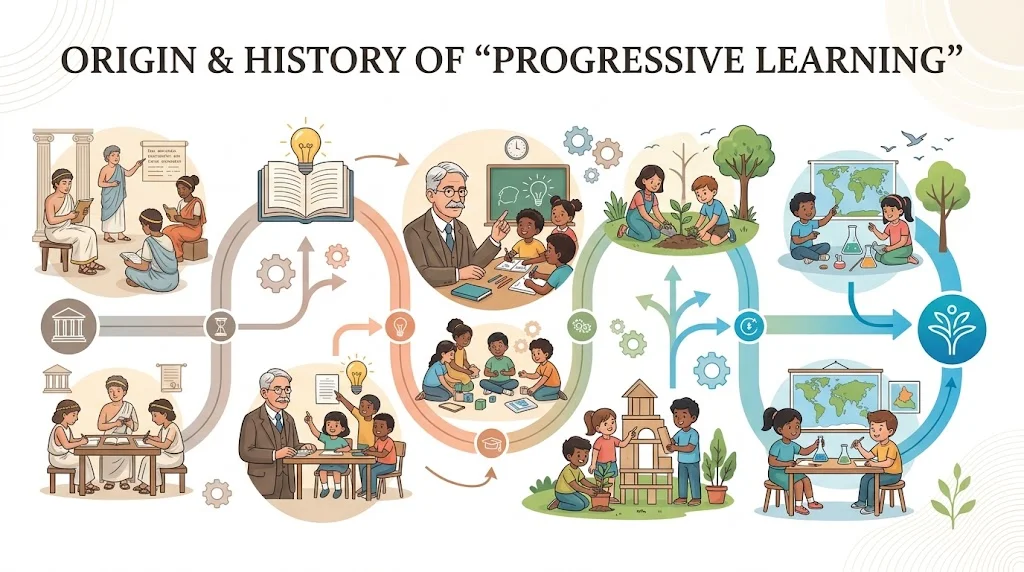
The concept behind progressive learning is connected to broader educational movements that emphasized development, experience, and learner-centered growth. The word “progressive” comes from the Latin root progressus, meaning “an advancement” or “a movement forward.” Over time, the term became associated with improvement, development, and gradual change.
In education, progressive learning gained attention through progressive education movements in the late 19th and early 20th centuries. Educators such as John Dewey promoted the idea that students learn more effectively through experience, problem-solving, and active participation rather than only memorizing information.
The meaning of progressive learning has continued to evolve. Traditionally, it referred mainly to educational methods that supported student development. Today, it is used more broadly in:
- Professional training programs
- Online education platforms
- Corporate learning strategies
- Personal skill development
- Technology-based learning systems
Modern usage reflects a shift from learning as a fixed achievement toward learning as a continuous journey of improvement.
Synonyms & Alternatives by Tone
Different alternatives to progressive learning communicate slightly different ideas. The best choice depends on whether you want to sound professional, supportive, motivational, or casual.
Professional & Neutral Alternatives
- Continuous learning
- Incremental learning
- Ongoing development
- Skill progression
- Structured learning
- Continuous improvement
- Knowledge development
- Learning advancement
- Professional growth
- Developmental learning
Polite & Supportive Alternatives
- Learning journey
- Personal development
- Growing knowledge
- Building skills over time
- Gradual improvement
- Supported learning
- Step-by-step learning
- Guided development
Encouraging & Reassuring Alternatives
- Steady progress
- Learning at your own pace
- Growing through experience
- Building confidence through learning
- Making consistent improvements
- Developing one step at a time
- Progress through practice
Casual, Playful & Idiomatic Alternatives
- Learning as you go
- Getting better over time
- Leveling up your skills
- Growing little by little
- Improving step by step
- Learning bit by bit
- Finding your rhythm
When Should You Use “Progressive Learning”?
Professional settings
Progressive learning works well in workplaces, training programs, and educational environments where the focus is on development over time.
Examples:
- Employee training plans
- Leadership development programs
- Learning and development reports
- Educational strategies
- Career growth discussions
A manager might say:
“Our new training approach encourages progressive learning by helping employees develop skills through practical experience.”
This wording sounds organized and forward-thinking without being overly informal.
Casual conversations
In everyday conversations, progressive learning may sound slightly formal. People often use simpler alternatives like:
- “I’m learning gradually.”
- “I’m improving over time.”
- “I’m building my skills step by step.”
For example:
“I’m taking a progressive learning approach with coding because I want to understand the basics before moving into advanced topics.”
The phrase works, but casual speakers may prefer more natural expressions.
Writing, presentations, and digital communication
The phrase is especially useful in:
- Blog articles about education
- Business presentations
- Training materials
- Online course descriptions
- Professional profiles
It communicates a structured approach and suggests that improvement happens through consistent effort.
When it is especially effective
Progressive learning is most effective when discussing:
- Long-term skill development
- Career advancement
- Educational strategies
- Personal improvement
- Adaptive learning methods
It works best when the audience understands that development requires time and repeated practice.
When Should You Avoid “Progressive Learning”?
Although the phrase is useful, it is not always the clearest choice.
Overly formal situations
In highly formal documents, alternatives like “continuous professional development” or “competency development” may sound more precise.
Example:
Instead of:
“The organization supports progressive learning.”
A policy document may benefit from:
“The organization supports continuous professional development initiatives.”
Legal, academic, or sensitive contexts
In research papers or legal documents, the phrase may require additional explanation because it is broad.
Academic readers may expect more specific terms such as:
- Learning progression
- Educational development
- Cognitive development
- Instructional advancement
Situations where nuance may be lost
The phrase can sometimes sound like learning happens automatically. However, real learning often requires:
- Feedback
- Practice
- Mentorship
- Reflection
- Adaptation
If precision matters, a more specific phrase may communicate the idea better.
Is “Progressive Learning” Professional, Polite, or Casual?
Progressive learning is primarily professional and educational in tone.
It is commonly associated with:
- Training organizations
- Schools and universities
- Workplace development
- Personal growth strategies
Tone analysis
The phrase creates a perception of:
- Improvement
- Forward movement
- Adaptability
- Long-term development
It does not sound casual or conversational. A native English speaker would generally expect to see it in professional writing rather than everyday speech.
Formality level
| Context | Suitability |
| Academic writing | High |
| Workplace communication | High |
| Business presentations | High |
| Casual conversations | Medium |
| Social media captions | Low to Medium |
Emotional subtext
Beyond its literal meaning, progressive learning suggests that improvement is achievable through patience and consistency.
It can make learning feel:
- Encouraging
- Organized
- Purposeful
- Future-focused
However, some audiences may find it slightly corporate or educational if used in personal conversations.
Pros and Cons of Using “Progressive Learning”
Advantages
Clarity
The phrase clearly communicates the idea of development over time.
Efficiency
It summarizes a complex concept—gradual skill improvement—in only two words.
Accessibility
Most readers can understand the general meaning without specialist knowledge.
Potential Drawbacks
Oversimplification
The phrase does not explain how learning happens. It may ignore important factors like teaching methods, motivation, or individual differences.
Tone mismatch
In casual communication, it may sound more formal than necessary.
Repetition
In educational content, repeatedly using the phrase can make writing feel mechanical. Using related alternatives improves readability.
Real-Life Examples of “Progressive Learning” by Context
Emails
“Our team’s progressive learning approach has helped new employees become confident with the software through weekly practice sessions.”
Meetings
“We should focus on progressive learning rather than expecting employees to master every tool immediately.”
Presentations
“This program follows progressive learning principles by introducing advanced concepts only after learners understand the fundamentals.”
Conversations
“I’m using progressive learning to improve my Spanish by practicing small lessons every day.”
Social media
“Progressive learning has changed how I approach new skills. Small improvements each week create long-term results.”
“Progressive Learning” vs Similar Expressions (Key Differences)
The following phrases are related to progressive learning, but each carries a slightly different meaning and emotional tone.
| Phrase | Meaning Difference | Tone Difference | Best Use Scenario |
| Continuous learning | Focuses on learning throughout life without stopping | Professional, modern, growth-focused | Workplace development, careers, lifelong learning |
| Incremental learning | Emphasizes small improvements made step by step | Technical, structured, analytical | Training programs, skill-building systems |
| Lifelong learning | Highlights learning across a person’s entire life | Inspirational, broad, personal | Education, personal growth, career discussions |
| Skill development | Focuses specifically on improving abilities | Practical, professional | Employee training, career planning |
| Learning journey | Emphasizes personal experience and growth | Supportive, friendly | Coaching, mentoring, personal stories |
| Continuous improvement | Focuses on making performance better over time | Business-oriented, strategic | Organizations, processes, and performance management |
Common Mistakes & Misuse of “Progressive Learning”
Although progressive learning is a useful phrase, it can lose effectiveness when used incorrectly. Understanding common mistakes helps writers, educators, and professionals communicate more naturally.
Overuse
Repeating progressive learning too often can make content feel robotic. Even when the concept is important, using the same phrase in every paragraph may reduce readability.
Instead, combine it with related expressions such as:
- Continuous learning
- Skill development
- Ongoing improvement
- Learning progression
- Personal growth
A strong article, presentation, or training document usually uses the main keyword naturally while adding relevant variations.
Incorrect context
A common mistake is using progressive learning when the writer actually means something more specific.
For example:
Incorrect:
“The company introduced progressive learning software.”
This is unclear because the reader may not know whether the software teaches gradually, tracks progress, or provides adaptive lessons.
Better:
“The company introduced adaptive learning software that adjusts lessons based on employee performance.”
Specific language creates stronger communication.
Contradictory usage
The phrase can create confusion if the surrounding message suggests the opposite.
For example:
“Employees must complete all advanced training immediately through progressive learning.”
Progressive learning suggests gradual development, while “immediately” creates a conflicting expectation.
A clearer message would be:
“Employees will follow a progressive learning path that introduces advanced training after foundational skills are developed.”
Cultural misunderstandings
The word progressive can have different associations depending on the audience.
In some regions, “progressive” may simply mean improvement or advancement. In others, especially in social or political discussions, it may carry additional meanings.
When writing for international audiences, explaining the intended meaning can prevent confusion.
Psychological Reasons People Prefer “Progressive Learning”
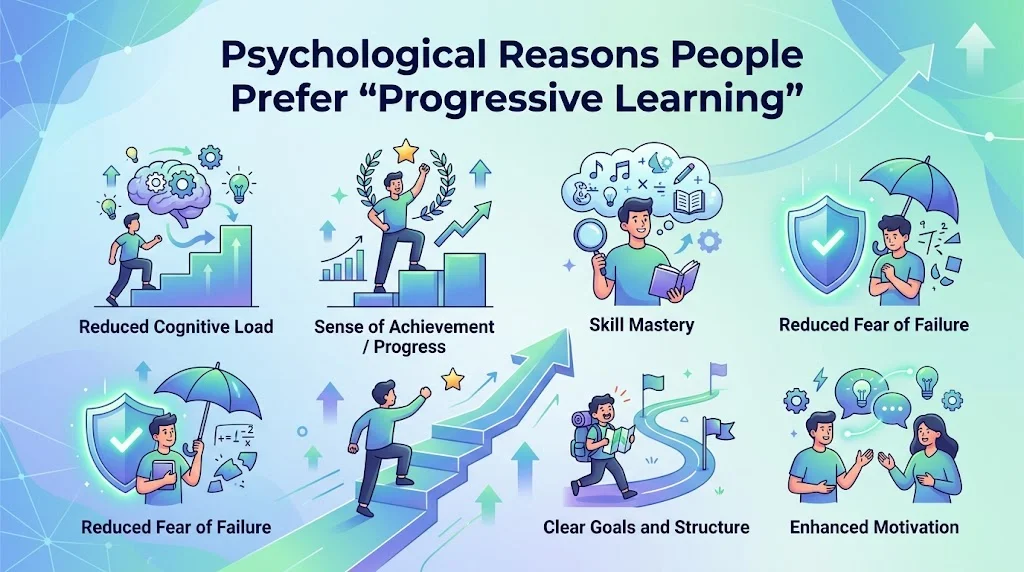
The popularity of progressive learning is not only about education. The phrase also connects with how people understand growth and improvement.
Cognitive load reduction
People often prefer ideas that feel manageable.
The concept behind progressive learning reduces mental pressure because it suggests:
- Learning happens gradually
- Mistakes are part of development
- Complex skills can be divided into smaller stages
This makes learning feel more achievable.
Trust and authority signals
In professional environments, phrases like progressive learning can signal that an organization values development rather than expecting instant expertise.
For example:
A company saying:
“We support progressive learning among employees.”
creates a different impression than:
“Employees should already know everything required.”
The first statement suggests investment, patience, and structured support.
Attention economy
Modern audiences process large amounts of information every day. Clear phrases that communicate an idea quickly are valuable.
Progressive learning works because it immediately suggests:
- Growth
- Improvement
- Future readiness
This makes it useful in:
- Online courses
- Marketing materials
- Training websites
- Educational content
Modern communication habits
Today’s learners often expect flexibility. They prefer systems that allow them to:
- Learn at their own pace
- Receive feedback
- Adjust based on progress
The phrase fits modern expectations around personalized and adaptable learning.
US vs UK Usage of “Progressive Learning”
The phrase progressive learning is understood in both American and British English, but its frequency and perception can vary.
Popularity
In the United States, the phrase is commonly associated with:
- Educational innovation
- Workplace training
- Technology-based learning platforms
- Professional development
In the United Kingdom, similar ideas are often expressed through phrases like:
- Continuous learning
- Learning development
- Professional development
- Skills progression
Tone perception
US English
American audiences may perceive progressive learning as:
- Forward-thinking
- Innovative
- Growth-oriented
It often appears in business and education marketing.
Example:
“Our progressive learning model helps employees build future-ready skills.”
UK English
British audiences may find the phrase understandable but may prefer more established educational terms.
Example:
“Our approach focuses on continuous professional development.”
This may sound slightly more traditional and formal.
Regional preferences
| Region | Common Preference |
| United States | Progressive learning, continuous learning, growth mindset |
| United Kingdom | Continuous development, professional development, learning progression |
| International business | Continuous learning, skill development |
“Progressive Learning” in Digital & Modern Communication
The way people learn has changed significantly because of technology. The phrase appears frequently in online education, workplace platforms, and digital content.
Emails
In professional emails, progressive learning works well when discussing:
- Employee onboarding
- Training programs
- Educational plans
Example:
“Our progressive learning strategy allows new team members to develop confidence before handling complex projects.”
Slack / WhatsApp
In quick workplace communication, the phrase may feel slightly formal.
A team member might naturally say:
“We’re learning this tool step by step.”
rather than:
“We’re following a progressive learning methodology.”
Shorter alternatives often sound more natural in chat-based communication.
Social media
On platforms like LinkedIn, progressive learning fits well with professional development discussions.
Example:
“Career growth is built through progressive learning, consistent practice, and staying curious.”
It communicates ambition without sounding overly technical.
AI-generated summaries
AI tools often use phrases like progressive learning because the wording efficiently describes gradual improvement.
However, human editors should check whether the phrase matches the audience.
For example:
An AI-generated business report may write:
“Employees engage in progressive learning pathways.”
A human editor may improve it:
“Employees develop skills gradually through structured training and practical experience.”
The second version feels more natural.
Linguistic & Communication Insight
Understanding progressive learning requires more than knowing its dictionary definition. The phrase also carries emotional meaning, social signals, and communication expectations.
Emotional weight & subtext
When people hear progressive learning, they usually perceive more than simply “learning.”
The phrase suggests:
- Improvement without pressure
- Development over time
- Patience and consistency
- A planned approach to growth
For learners, it can feel reassuring because it implies that expertise does not need to happen instantly.
For organizations, it signals investment in people rather than only focusing on immediate results.
Direct vs indirect phrasing
Progressive learning is relatively direct because it clearly names a learning approach.
Compare:
“We use progressive learning methods.”
This sounds structured and professional.
With:
“We help people grow naturally through experience.”
This feels warmer and more personal.
The difference is not accuracy—it is communication style.
The first emphasizes a system.
The second emphasizes human experience.
Professional communication perspective
In workplace communication, word choice affects how people interpret intentions.
Using progressive learning can communicate:
- Strategic planning
- Organizational support
- Long-term thinking
However, experienced communicators often adjust their wording depending on the audience.
For executives:
“Our progressive learning framework improves workforce capability.”
For employees:
“We provide opportunities to build skills gradually.”
The second version may feel more supportive.
Pragmatic reasons for alternatives
Professionals choose alternatives because different phrases create different reactions.
For example:
Continuous learning may sound more inclusive because it applies to everyone.
Skill development may sound more practical because it focuses on measurable improvement.
The learning journey may feel more personal because it emphasizes individual experience.
Choosing the right phrase helps reduce misunderstanding and creates stronger connections.
Social signaling
Language choices influence how people perceive credibility.
Someone using progressive learning may appear:
- Organized
- Education-focused
- Future-oriented
However, overly complex wording can sometimes create distance.
Strong communicators balance expertise with accessibility.
Tone & context guidance
Use progressive learning when you want to highlight:
✓ Long-term improvement
✓ Structured development
✓ Educational progress
✓ Professional growth
Be careful when:
✗ The audience prefers simple language
✗ The situation requires technical precision.
✗ The phrase sounds too corporate
Continuous Learning
Meaning
Continuous learning means consistently gaining new knowledge, skills, and understanding throughout a person’s career, education, or personal life. It focuses on ongoing improvement rather than reaching a final learning point.
Why This Phrase Works
This phrase works because it clearly communicates lifelong development. It is widely understood by professionals, students, and organizations.
Real-World Usage Insight
Many companies use “continuous learning” because it reflects modern workplace expectations where employees must adapt to changing tools, industries, and technologies.
Best Use
- Professional development
- Corporate training
- Career discussions
- Educational content
Avoid When
Avoid using it when you specifically need to describe gradual stages or a step-by-step learning process.
Tone
Professional, positive, modern, and widely accepted.
US vs UK Usage
Common in both regions. US businesses frequently use it in workplace development, while UK organizations often connect it with professional development frameworks.
Example (Email / Message / Meeting)
Email:
“We encourage continuous learning by providing employees with access to workshops, mentoring, and online courses throughout the year.”
Incremental Learning
Meaning
Incremental learning refers to gaining knowledge or improving skills through small, measurable steps rather than making large changes at once.
Why This Phrase Works
It highlights gradual progress and makes it feel practical and achievable.
Real-World Usage Insight
The phrase is common in technology, education, and skill-building environments where progress happens through repeated adjustments.
Best Use
- Technical discussions
- Training systems
- Learning strategies
- Data and technology contexts
Avoid When
Avoid using it in emotional or motivational writing because it may sound too analytical.
Tone
Structured, professional, and slightly technical.
US vs UK Usage
Used in both regions, especially in business and technology discussions.
Example (Email / Message / Meeting)
Meeting:
“We achieved better results through incremental learning by improving one process at a time instead of changing everything at once.”
Lifelong Learning
Meaning
Lifelong learning describes the ongoing pursuit of knowledge and skills throughout a person’s entire life.
Why This Phrase Works
It communicates curiosity, personal growth, and adaptability in a way that feels inspiring.
Real-World Usage Insight
Universities, career coaches, and professional organizations often use this phrase to encourage continued development beyond formal education.
Best Use
- Education
- Career planning
- Personal growth discussions
Avoid When
Avoid it when describing a specific short-term training program.
Tone
Inspirational, positive, and broad.
US vs UK Usage
Very common in both American and British English.
Example (Email / Message / Meeting)
Blog:
“Lifelong learning has become essential as professionals adapt to new technologies and changing workplace expectations.”
Skill Development
Meaning
Skill development focuses on improving specific abilities needed for personal, academic, or professional success.
Why This Phrase Works
It is practical and clearly connected to measurable improvement.
Real-World Usage Insight
Employers often prefer this phrase because it connects learning with performance outcomes.
Best Use
- Workplace training
- Career growth
- Professional goals
Avoid When
Avoid it when discussing broader personal learning experiences.
Tone
Professional, practical, and results-focused.
US vs UK Usage
Common in both regions.
Example (Meeting)
“This program supports skill development by helping employees improve communication and leadership abilities.”
Learning Journey
Meaning
A learning journey describes the personal experience of gaining knowledge, developing skills, and improving understanding over time. It focuses on the process of growth rather than only the final result.
Why This Phrase Works
This phrase works because it makes learning feel personal and human. It recognizes that every learner develops at a different pace and follows a unique path.
Real-World Usage Insight
Educators, coaches, and content creators often use “learning journey” because it creates an emotional connection and encourages people to view improvement as an ongoing experience.
Best Use
- Coaching conversations
- Personal development content
- Educational storytelling
- Mentoring programs
Avoid When
Avoid using it in highly technical reports or situations requiring precise measurement.
Tone
Supportive, encouraging, personal, and approachable.
US vs UK Usage
Common in both US and UK English. It is especially popular in education, coaching, and online learning environments.
Example (Blog)
“Everyone’s learning journey looks different. Some people progress quickly, while others need more time to build confidence and master new skills.”
Ongoing Development
Meaning
Ongoing development refers to continuous improvement of knowledge, skills, abilities, or professional capabilities over time.
Why This Phrase Works
This phrase sounds professional and emphasizes that development is an active process rather than a completed achievement.
Real-World Usage Insight
Organizations frequently use this expression when discussing employee growth, leadership programs, and career advancement strategies.
Best Use
- Workplace communication
- Performance reviews
- Professional development plans
- Business reports
Avoid When
Avoid using it for informal conversations because it may sound corporate.
Tone
Professional, structured, and career-focused.
US vs UK Usage
Used widely in both regions. UK workplaces often use similar wording such as “continuous professional development.”
Example (Meeting)
“Our goal is to support ongoing development by giving employees access to training, feedback, and mentorship opportunities.”
Conclusion
Progressive learning represents a practical approach to gaining knowledge, improving skills, and developing confidence through continuous progress. Instead of expecting instant mastery, it recognizes that meaningful learning happens through consistent practice, feedback, experience, and gradual improvement.
The phrase is especially valuable in education, professional development, and modern workplace communication because it highlights growth, adaptability, and long-term development. However, choosing the right alternative depends on the audience and purpose. Terms like continuous learning, skill development, and learning journey may sound more natural in different situations.
For professionals, students, educators, and content creators, understanding the meaning and usage of progressive learning helps create clearer communication. The most effective learning environments are those that encourage curiosity, patience, and improvement over time.
Ultimately, progressive learning is not only about gaining information—it is about building stronger abilities through a structured process of growth that continues throughout personal and professional life.
FAQs About Progressive Learning
What is progressive learning in simple terms?
Progressive learning is a method of developing knowledge and skills gradually over time. It involves building on previous understanding, practicing regularly, receiving feedback, and improving step by step. This approach is commonly used in education, workplace training, and personal development because it helps learners achieve long-term improvement rather than focusing only on immediate results.
Why is progressive learning important?
Progressive learning is important because it makes complex skills easier to develop by breaking improvement into manageable stages. It supports better understanding, stronger retention, and continuous growth. In modern education and workplaces, it helps people adapt to new technologies, changing requirements, and evolving professional expectations through consistent learning.
What are the best alternatives to progressive learning?
Common alternatives to progressive learning include continuous learning, incremental learning, lifelong learning, skill development, ongoing development, and learning journey. The best choice depends on context. For professional settings, continuous learning and skill development often work well, while a learning journey may be better for personal or motivational content.
Is progressive learning the same as continuous learning?
Progressive learning and continuous learning are related but slightly different. Progressive learning emphasizes gradual improvement and development through stages, while continuous learning focuses on the ongoing process of acquiring knowledge throughout life. Progressive learning highlights the method of growth, whereas continuous learning highlights the commitment to keep learning.
How does progressive learning help students?
Progressive learning helps students by allowing them to develop knowledge step by step instead of facing advanced concepts too early. It encourages confidence, practice, and deeper understanding. Students can identify weaknesses, improve gradually, and build stronger foundations, making future learning easier and more effective.
How is progressive learning used in the workplace?
In workplaces, progressive learning is used through training programs, mentoring, professional development, and skill-building activities. Companies use this approach to help employees improve gradually, adapt to new tools, and develop expertise over time. It supports employee growth while helping organizations maintain a skilled and adaptable workforce.
Is progressive learning a professional term?
Yes, progressive learning is generally considered a professional and educational term. It is commonly used in training, academic discussions, business presentations, and learning strategies. However, in casual conversations, simpler phrases like “learning step by step” or “improving over time” may sound more natural.
What is the difference between progressive learning and adaptive learning?
Progressive learning focuses on gradual improvement through structured development, while adaptive learning focuses on adjusting the learning experience according to individual needs, abilities, or performance. Adaptive learning often uses technology to personalize lessons, whereas progressive learning describes the overall process of moving from basic understanding toward advanced skills.
Can progressive learning improve professional skills?
Yes, progressive learning can improve professional skills by encouraging consistent practice, feedback, and gradual development. It allows professionals to strengthen abilities over time instead of trying to master complex skills immediately. This approach is especially useful for leadership, communication, technology, and industry-specific skills that require continuous improvement.
How can someone apply progressive learning in daily life?
Someone can apply progressive learning by setting realistic goals, practicing regularly, reviewing progress, and building new knowledge on existing skills. For example, a person learning a language can start with basic vocabulary, practice conversations, receive feedback, and gradually move toward advanced communication. Small improvements create lasting development.


