
Imagine walking into a new workplace, joining a professional meeting, or applying for a role where people already know something about you before you introduce yourself. Perhaps they have heard about your past projects, read your reviews, or received feedback from someone who worked with you. In that moment, your reputation precedes you—your previous actions and the opinions people have formed about you influence how they perceive you before direct interaction.
The phrase “Your reputation precedes you” means that people already have an impression of you because of information, experiences, or opinions shared by others. It can describe a positive reputation built through trust and achievement, but it can also refer to expectations created by past behavior.
In modern communication, this phrase remains powerful because reputation plays a major role in professional networking, online identity, leadership, hiring decisions, and personal relationships. However, the phrase’s meaning can change depending on tone. In some situations, it sounds like a compliment; in others, it may feel like a warning. Choosing the right alternative helps speakers and writers communicate respect, professionalism, encouragement, or caution more clearly.
What Does “Your Reputation Precedes You” Mean?
“Your reputation precedes you” means that people already know about your character, abilities, achievements, or behavior before meeting or interacting with you directly. The phrase is commonly used when someone’s previous actions or public image influence others’ expectations in workplaces, social settings, professional networks, and everyday conversations.
The phrase communicates the idea that a person’s past behavior creates an impression that travels ahead of their actual presence. This reputation may come from personal experiences, recommendations, online reviews, professional achievements, social media activity, or word-of-mouth communication.
In simple terms, it means:
People have formed an opinion about you before they get to know you personally.
The phrase does not automatically mean the reputation is positive or negative. The surrounding context determines whether it expresses admiration, curiosity, concern, or caution.
Examples:
- “Your reputation precedes you. Everyone has heard about the successful campaign you led.”
- “Your reputation precedes you, so people are expecting a high standard from your presentation.”
In professional environments, the phrase often highlights the importance of consistency, credibility, and how personal actions influence future opportunities.
Origin & History of “Your Reputation Precedes You”

The expression “your reputation precedes you” comes from the older idea that a person’s name, achievements, or character can become known before they arrive somewhere. The wording follows a traditional English structure where “precede” means “to come before something in time or order.”
The concept has historical roots in social communication long before modern technology. In communities where people relied heavily on personal recommendations and reputation, a person’s character often traveled through stories, introductions, and relationships before any direct meeting occurred.
The phrase also connects with the Latin idea “fama praecedit”, meaning that fame or reputation goes ahead of someone. While the exact modern English phrase does not have one confirmed creator, it developed naturally from centuries of cultural emphasis on honor, reputation, and social standing.
Over time, the meaning expanded. Originally, reputation was mostly connected to personal honor, family name, or public recognition. Today, it includes:
- Professional reputation
- Online presence
- Customer reviews
- Workplace credibility
- Social media identity
- Personal branding
Modern communication has made the idea even more relevant because digital information can create impressions before people ever meet face-to-face.
Synonyms & Alternatives by Tone
Professional & Neutral Alternatives
- Your reputation speaks for itself
- Your track record is well known
- Your previous work has made an impression
- People are familiar with your achievements
- Your experience is recognized
- Your credibility is already established
- Your past results are well respected
- Your professional record is impressive
- Your work has earned recognition
- Your contributions are widely acknowledged
Polite & Supportive Alternatives
- I’ve heard wonderful things about you
- Your work has been highly recommended
- People speak highly of your efforts
- Your positive reputation has reached others
- Your achievements have been noticed
- Many people appreciate your work
- Your dedication is well recognized
- Your efforts have made a strong impression
Encouraging & Reassuring Alternatives
- Your hard work has earned respect
- Your efforts have built a strong reputation
- Your achievements have created trust
- Your consistency has made people confident in you
- Your reputation reflects your commitment
- Your success has gained recognition
Casual, Playful & Idiomatic Alternatives
- You’re already famous around here
- Everyone knows your name
- Your name gets there before you do
- You’re already known in these circles
- People have been talking about you
- You’ve made quite a name for yourself
- Your name carries weight
When Should You Use “Your Reputation Precedes You”?
The phrase works best when the speaker wants to acknowledge that someone’s previous actions have created expectations. It is especially effective when discussing credibility, achievements, recognition, or professional influence.
Professional Settings
In workplaces, the phrase can be used when welcoming someone with an established background.
Examples:
- Introducing an experienced consultant
- Welcoming a respected speaker
- Recognizing an employee’s achievements
- Discussing someone’s industry reputation
Example:
“Your reputation precedes you. We have heard great feedback about the way you manage complex projects.”
In this context, it usually functions as a compliment.
Casual Conversations
Among friends or acquaintances, the phrase can create a sense of familiarity.
Example:
“Your reputation precedes you—I heard you’re the person everyone asks for travel advice.”
The meaning depends heavily on tone. A friendly voice makes it sound positive, while a serious tone can make it sound like a warning.
Writing, Presentations, and Digital Communication
The phrase can work well in:
- Introduction emails
- Professional biographies
- Conference introductions
- Networking messages
- Social media posts
However, writers should consider the audience. Some readers may find it slightly formal or dramatic compared with simpler alternatives like “I’ve heard great things about your work.”
When It Is Especially Effective
Use the phrase when you want to emphasize:
- A person’s previous success
- Their established credibility
- The impact of their work
- The expectations created by their reputation
It is most powerful when the reputation being referenced is clear and positive.
When Should You Avoid “Your Reputation Precedes You”?
Although the phrase is widely understood, it is not suitable for every situation.
Overly Formal Situations
In highly formal communication, such as legal documents, official reports, or academic writing, the phrase may sound too conversational or subjective.
Instead, clearer wording may be better:
- “The individual has an established professional record.”
- “Previous evaluations demonstrate strong performance.”
Legal, Academic, or Sensitive Contexts
The phrase can create ambiguity because reputation can be positive or negative. In sensitive situations, readers may wonder whether it refers to praise or criticism.
For example:
“Your reputation precedes you.”
Without additional context, someone may ask:
“Is that a compliment or a concern?”
Situations Where Nuance May Be Lost
The phrase can oversimplify a person’s identity by focusing only on what others know about them.
A person may have:
- A professional reputation but a different personal identity
- A public image that does not reflect their full abilities
- A reputation based on outdated information
In these situations, more precise language creates better understanding.
Is “Your Reputation Precedes You” Professional, Polite, or Casual?
“Your reputation precedes you” is generally professional and polite, but it can range from formal to slightly dramatic depending on the situation.
Tone Analysis
The phrase often carries:
- Respect: It acknowledges someone’s previous achievements.
- Recognition: It suggests others already value their work.
- Expectation: It implies people may already have standards based on their reputation.
Formality Level
The phrase is:
- More formal than everyday expressions like “I’ve heard good things about you.”
- Less formal than the language used in official reports or academic writing.
It fits well in:
- Business introductions
- Networking conversations
- Professional events
- Leadership discussions
Emotional Subtext
Native speakers often hear more than the literal meaning. The phrase may suggest:
- “People trust your abilities.”
- “Your previous actions have created an impression.”
- “Others are paying attention to your work.”
However, depending on delivery, it can also imply:
- “People have expectations of you.”
- “People already have opinions about you.”
Audience Perception
Professionals often interpret the phrase positively when it is followed by praise or specific recognition.
For example:
“Your reputation precedes you. Your team’s results have been impressive.”
This feels supportive.
But:
“Your reputation precedes you.”
Said without explanation may sound mysterious or slightly intimidating.
Pros and Cons of Using “Your Reputation Precedes You”
Advantages
Clarity
The phrase quickly communicates that someone’s previous actions influence current perceptions.
Efficiency
It expresses a complex idea in only a few words.
Accessibility
Most English speakers understand the meaning immediately, making it useful across professional and social contexts.
Strong Recognition
The phrase gives importance to someone’s achievements and credibility.
Potential Drawbacks
Oversimplification
A reputation does not always represent the complete reality of a person’s abilities or character.
Tone Mismatch
Some audiences may find it too dramatic, especially in casual conversations.
Repetition
Because the phrase is common, frequent use may make communication feel less personal.
For professional communication, adding specific details often creates more impact:
Instead of:
“Your reputation precedes you.”
Consider:
“I’ve heard excellent feedback about your leadership style and project results.”
This feels more genuine and specific.
Real-Life Examples of “Your Reputation Precedes You” by Context
The phrase “Your reputation precedes you” appears in many real-world situations where someone’s previous work, behavior, or achievements influence how others approach them. The context and tone determine whether it sounds like praise, recognition, curiosity, or caution.
Emails
Professional emails often use the phrase when introducing someone who already has recognition in a particular field.
Example:
“Hi Sarah, welcome to the project team. Your reputation precedes you, and we’ve heard great things about your ability to lead creative campaigns. We’re excited to work with you.”
In this situation, the phrase creates a respectful first impression and acknowledges previous success.
Meetings
In meetings, the phrase is commonly used when welcoming a new colleague, consultant, speaker, or partner.
Example:
“Before we begin, I’d like to welcome Daniel. Your reputation precedes you, especially after the successful product launch your team managed last year.”
Here, the phrase highlights credibility and builds trust among participants.
Presentations
Speakers may use it when introducing experts or industry professionals.
Example:
“Many of you already know Maria’s work. Her reputation precedes her, and her research has influenced how companies approach customer experience.”
This usage positions the person as knowledgeable and respected.
Conversations
In everyday conversations, the phrase can be friendly or humorous depending on delivery.
Example:
“Your reputation precedes you—I’ve heard you’re the person everyone goes to when they need career advice.”
The phrase creates familiarity and shows that someone’s positive qualities are already recognized.
Social Media
On social platforms, the phrase can appear in professional announcements, event promotions, or appreciation posts.
Example:
“Excited to welcome a new industry expert to our panel. Their reputation precedes them, and we’re looking forward to hearing their insights.”
For social media, simpler alternatives often feel more natural because online audiences usually prefer direct and conversational language.
“Your Reputation Precedes You” vs Similar Expressions (Key Differences)
Although several English expressions communicate the idea that people already know about someone, each phrase has a slightly different meaning, emotional effect, and level of formality.
| Phrase | Meaning Difference | Tone Difference | Best Use Scenario |
| Your reputation precedes you | People already have an impression based on your past actions or achievements | Professional, respectful, slightly formal | Introductions, networking, and leadership settings |
| I’ve heard great things about you | Others have shared positive opinions about you | Warm, friendly, conversational | First meetings, emails, personal introductions |
| Your name carries weight | Your identity has influence or authority | Strong, confident, professional | Business, industry discussions, and leadership contexts |
| You’ve made a name for yourself | You have built recognition through effort or success | Positive, casual, encouraging | Career conversations, personal achievements |
| Your track record speaks for itself | Your results demonstrate your abilities without explanation | Professional, confident, evidence-focused | Work evaluations, business discussions |
| People speak highly of you | Others have expressed admiration or respect | Polite, supportive, approachable | Recommendations, introductions, feedback |
Meaning Differences
The biggest difference between these expressions is what they emphasize.
“Your reputation precedes you” focuses on the fact that information about someone arrives before the person does.
“Your track record speaks for itself” focuses more on measurable results.
“I’ve heard great things about you” focuses on personal recommendations and positive opinions.
“You’ve made a name for yourself” highlights the process of building recognition over time.
Tone Differences
Some alternatives sound more formal, while others feel more personal.
- Professional environments often favor “Your track record speaks for itself.”
- Friendly introductions often use “I’ve heard great things about you.”
- Leadership discussions may use “Your name carries weight.”
- Casual conversations may use “You’ve made a name for yourself.”
Best-Use Scenarios
Choosing the right phrase depends on your purpose:
- Use “Your reputation precedes you” when recognizing an established reputation.
- Use “I’ve heard great things about you” when creating warmth.
- Use “Your track record speaks for itself” when emphasizing achievements.
- Use “People speak highly of you” when focusing on relationships and trust.
Common Mistakes & Misuse of “Your Reputation Precedes You”
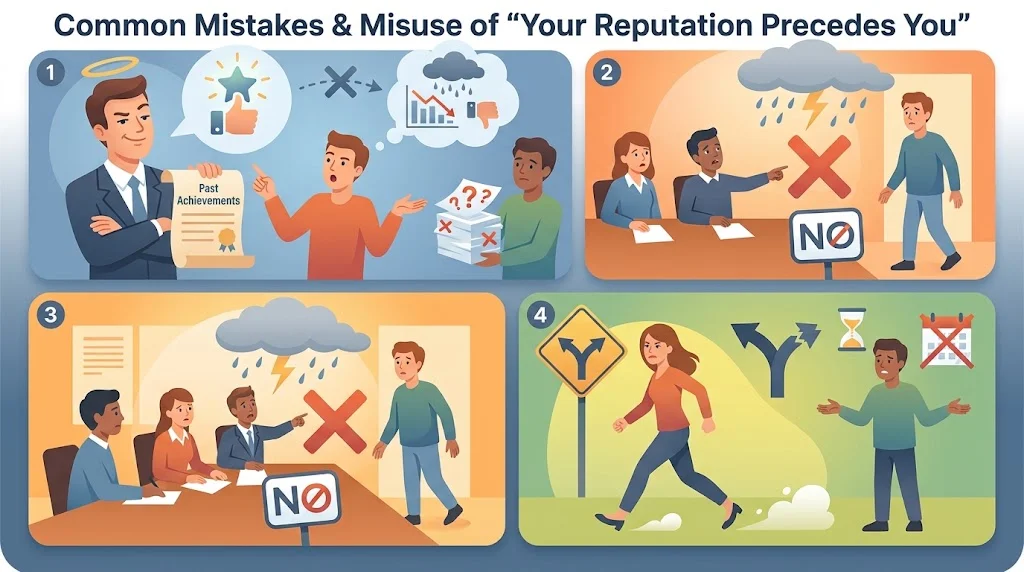
Although the phrase is widely understood, incorrect usage can create confusion or an unintended impression.
Overuse
Using the phrase too often can make communication sound generic. Since it is a familiar expression, repeating it without adding specific details may reduce its impact.
Instead of:
“Your reputation precedes you.”
A stronger approach:
“Your reputation precedes you. The customer retention strategy you created has received excellent feedback.”
Specific examples make the compliment more meaningful.
Incorrect Context
The phrase should usually refer to a known reputation. Using it when nobody has heard of the person can sound exaggerated.
Less effective:
“Your reputation precedes you” to someone entering a completely new environment with no previous recognition.
Better:
“I’m excited to learn more about your work.”
Contradictory Usage
The phrase can become confusing when followed by unclear or negative information.
Example:
“Your reputation precedes you, but nobody knows what to expect.”
The listener may not understand whether the reputation is positive or negative.
Cultural Misunderstandings
Some English learners may interpret the phrase literally and assume it always means praise.
However, native speakers understand that it depends on context and tone. A serious expression or negative follow-up can change the meaning completely.
Psychological Reasons People Prefer “Your Reputation Precedes You”
The popularity of this phrase is connected to how humans process information and make decisions.
Cognitive Load Reduction
People naturally use previous information to form expectations. Reputation helps individuals quickly understand who they are dealing with without needing a long explanation.
In professional environments, reputation saves time because people often rely on:
- Recommendations
- Previous results
- Reviews
- Professional networks
Trust and Authority Signals
A strong reputation acts as a social signal. When someone says:
“Your reputation precedes you.”
They are often communicating:
- “Others trust your abilities.”
- “Your work has created recognition.”
- “You have already earned credibility.”
This makes the phrase especially common in leadership and business communication.
Attention Economy
Modern communication moves quickly. People often make decisions based on limited information, including:
- Online profiles
- Reviews
- Public achievements
- Professional visibility
Because of this, reputation has become more influential in areas such as hiring, networking, and digital branding.
Modern Communication Habits
Social media and online platforms have increased the importance of reputation because people can learn about someone before direct interaction.
A person’s:
- LinkedIn profile
- Portfolio
- Published work
- Online discussions
Can create an impression before a conversation begins.
US vs UK Usage of “Your Reputation Precedes You”
The phrase is understood in both American and British English, but the tone can differ slightly.
Popularity
In both regions, the phrase is familiar, especially in professional environments.
In the US, it is commonly used in:
- Business introductions
- Networking events
- Workplace conversations
- Media interviews
In the UK, it is also understood but may sometimes sound slightly more formal or traditional.
Tone Perception
US Usage
American speakers often use the phrase as a positive compliment.
Example:
“Your reputation precedes you. We’ve heard excellent things about your leadership.”
It sounds enthusiastic and encouraging.
UK Usage
British speakers may use it with a little more restraint. Depending on context, it can sound polite, formal, or slightly humorous.
Example:
“Your reputation precedes you. I understand you’re the person to call for difficult projects.”
Regional Preferences
In everyday British conversations, alternatives like:
- “I’ve heard good things about you.”
- “People speak highly of you.”
May sound more natural.
In American professional settings, “Your reputation precedes you” is often accepted as a confident introduction.
Conclusion
“Your reputation precedes you” remains a powerful expression because it captures an important truth about communication: people often form opinions based on past actions, achievements, and experiences before direct interaction begins. The phrase is especially useful in professional settings where credibility, trust, and recognition influence relationships and opportunities.
However, the effectiveness of this phrase depends on context, audience, and intention. While it can be a meaningful compliment, it may sound too formal or unclear in casual situations. Alternatives such as “I’ve heard great things about you,” “Your track record speaks for itself,” or “People speak highly of you” can create a warmer or more specific message.
Understanding the tone behind “Your reputation precedes you” helps professionals, students, writers, and English learners communicate more naturally. The right phrase does more than share information—it shapes perception, builds trust, and strengthens connections in personal, professional, and digital communication.
FAQs
What does “Your reputation precedes you” mean?
“Your reputation precedes you” means that people already know about your character, skills, achievements, or behavior before meeting you. Your previous actions, professional history, or public image have created an impression that influences how others see you. The phrase is often used when someone has earned recognition or respect before entering a new situation.
Is “Your reputation precedes you” a compliment?
Yes, “Your reputation precedes you” is usually a compliment when used in a positive context. It often suggests that someone has a respected background, strong achievements, or a good professional reputation. However, tone matters because the phrase can also sound neutral or negative if the speaker refers to an unfavorable reputation.
Is “Your reputation precedes you” professional?
Yes, the phrase is considered professional and appropriate in many workplace situations. It is commonly used during introductions, networking events, meetings, and formal conversations. However, in some business contexts, a more specific phrase like “Your track record is impressive” may sound clearer and more evidence-based.
What are the best alternatives to “Your reputation precedes you”?
Popular alternatives include “I’ve heard great things about you,” “Your track record speaks for itself,” “People speak highly of you,” “Your work has made an impression,” and “Your credibility is already established.” The best alternative depends on whether you want to sound professional, friendly, supportive, or casual.
Can “Your reputation precedes you” have a negative meaning?
Yes, the phrase can have a negative meaning depending on context and tone. While it often refers to a positive reputation, it can also suggest that someone is already known for mistakes, controversy, or difficult behavior. Adding specific details helps listeners understand whether the statement is praise or criticism.
When should you use “Your reputation precedes you”?
Use the phrase when someone’s previous achievements, experience, or behavior are already known by others. It works well in professional introductions, conferences, networking conversations, and workplace discussions. It is most effective when the reputation being mentioned is clear and positive.
Is “Your reputation precedes you” common in American and British English?
Yes, the phrase is understood in both American and British English. American speakers often use it as an enthusiastic compliment, especially in professional settings. British speakers also use it but may sometimes prefer softer expressions like “I’ve heard good things about you,” depending on the level of formality.
What is the difference between “Your reputation precedes you” and “I’ve heard great things about you”?
“Your reputation precedes you” sounds more formal and focuses on an established reputation. “I’ve heard great things about you” feels warmer and more personal, focusing on recommendations or positive feedback from others. The first emphasizes recognition, while the second emphasizes connection and friendliness.
Can I use “Your reputation precedes you” in an email?
Yes, you can use it in professional emails, especially when welcoming someone, introducing a colleague, or starting a business relationship. However, adding a specific reason makes the message more authentic. For example, mentioning a person’s successful project or expertise creates a stronger impression than using the phrase alone.
Why is reputation important in modern communication?
Reputation is important because people often make decisions based on limited information, including online profiles, reviews, recommendations, and previous experiences. In professional and digital environments, reputation influences trust, credibility, and opportunities. A strong reputation can create positive expectations before direct communication begins.


