
A project manager notices that a new workplace policy has created both better productivity and new challenges for employees. A student realizes that social media can build connections while also creating distractions. In both situations, people are describing “two sides of the same coin” — a phrase used when two different aspects, results, or experiences are closely connected and come from the same situation.
The expression helps people explain complexity without presenting something as completely good or completely bad. In modern communication, it is often used to show balance, fairness, and deeper understanding. However, choosing the right alternative matters because some expressions sound more professional, more supportive, or more casual depending on the audience and context.
Understanding the meaning, tone, and alternatives of “two sides of the same coin” helps professionals, students, writers, and ESL learners communicate ideas more clearly and naturally.
What Does “Two Sides Of The Same Coin” Mean?
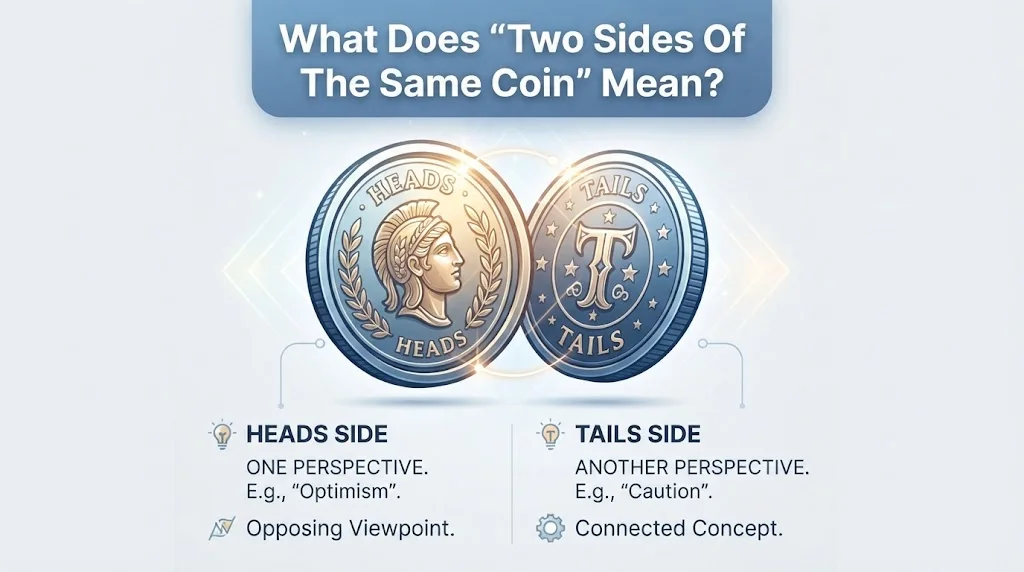
“Two sides of the same coin” means that two different aspects, outcomes, or characteristics are connected because they come from the same situation or source. The phrase is commonly used when two things appear different but are closely related, often highlighting that advantages and disadvantages can exist together.
The expression suggests that something cannot be fully understood by looking at only one perspective. It encourages people to consider multiple viewpoints, especially when discussing decisions, relationships, technology, business strategies, or social issues.
For example, remote work can be seen as more flexible for employees while also creating communication challenges for teams. These are different experiences, but they are connected parts of the same change.
Origin & History of “Two Sides Of The Same Coin”
The phrase “two sides of the same coin” comes from the physical reality of coins having two different faces that belong to the same object. One side may show a national symbol, while the other side may show a different design, but both sides represent the same coin.
The exact origin of the expression is difficult to trace to a single person or moment. However, the idea has existed in many cultures through similar concepts: two connected opposites, complementary perspectives, or different parts of one whole.
The phrase became widely popular in English during the 20th century as a way to describe situations where positive and negative consequences exist together. Over time, it moved beyond literal comparisons and became a common communication tool in business, education, journalism, and everyday conversations.
Today, people use it to discuss topics such as technology, leadership, relationships, personal growth, and social change because modern issues are rarely completely simple.
Synonyms & Alternatives by Tone
Choosing the right alternative depends on your audience, purpose, and desired emotional effect. Some replacements sound more professional, while others feel warmer, more conversational, or more persuasive.
Professional & Neutral Alternatives
- Two aspects of the same issue
- Two perspectives of the same situation
- Different sides of the same situation
- A balanced view of the situation
- A complex relationship between two factors
- Connected but contrasting elements
- Complementary perspectives
- Interrelated factors
Polite & Supportive Alternatives
- Different perspectives on the same matter
- A balanced way to look at it
- There are benefits and challenges involved
- It has both strengths and limitations
- Each perspective brings something valuable
- Both points of view matter
- There are multiple ways to understand this
Encouraging & Reassuring Alternatives
- Every challenge brings an opportunity
- Growth and difficulty often come together
- Every change has opportunities and challenges
- It is a learning experience from different angles
- The situation has both lessons and benefits
- Challenges and progress often go hand in hand
Casual, Playful & Idiomatic Alternatives
- The good and the bad come together
- It’s a give-and-take situation
- There’s a bright side and a downside
- It cuts both ways
- You win some, you lose some
- It’s a mixed bag
- It’s a trade-off
When Should You Use “Two Sides Of The Same Coin”?
Professional Settings
In professional communication, “two sides of the same coin” works well when explaining balanced viewpoints. Managers, consultants, and team leaders often use it when discussing decisions that involve both advantages and limitations.
Examples:
- Explaining the benefits and risks of artificial intelligence adoption
- Discussing employee flexibility versus collaboration challenges
- Presenting business growth opportunities alongside operational difficulties
The phrase can make communication feel thoughtful because it avoids extreme opinions.
Casual Conversations
In everyday conversations, the expression helps people acknowledge that situations are complicated.
Examples:
- “Being your own boss is two sides of the same coin. You get freedom, but you also carry more responsibility.”
- “Technology is two sides of the same coin. It connects people but can also create distractions.”
It sounds natural when discussing personal experiences, choices, and life decisions.
Writing, Presentations, and Digital Communication
The phrase is especially effective in:
- Blog articles
- Opinion pieces
- Presentations
- Educational content
- Social media discussions
Writers use it because it quickly signals that they will discuss both sides of a topic rather than only one viewpoint.
When It Is Especially Effective
The phrase works best when:
- A topic has clear advantages and disadvantages
- You want to show fairness
- You are comparing connected outcomes
- You want to introduce a balanced discussion
It is particularly useful for topics where people may have strong opinions because it creates space for a more reasonable conversation.
When Should You Avoid “Two Sides Of The Same Coin”?
Although the phrase is widely understood, it is not suitable for every situation.
Overly Formal Situations
In highly formal documents, such as legal agreements, scientific research papers, or official policies, the phrase may sound too conversational.
Instead, use clearer alternatives such as:
- “The issue involves multiple factors.”
- “The situation presents both advantages and limitations.”
- “The findings reveal competing considerations.”
Legal, Academic, or Sensitive Contexts
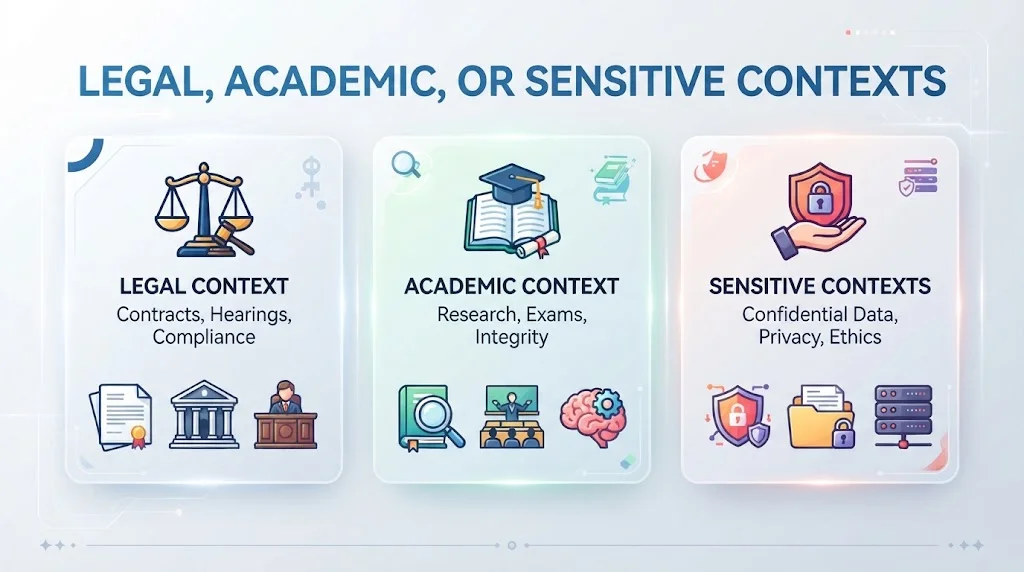
The phrase can sometimes oversimplify serious issues. Some topics require careful explanation rather than a quick comparison.
For example, sensitive social issues, medical discussions, or legal matters often need precise language because two opposing views may not have equal importance or evidence.
Situations Where Nuance May Be Lost
Avoid using the phrase when it suggests that two sides are automatically equal.
For example:
- A benefit and a serious risk may both exist, but they may not have the same impact.
- Two opinions may differ, but one may have stronger evidence.
In these cases, more specific wording creates clearer communication.
Is “Two Sides Of The Same Coin” Professional, Polite, or Casual?
“Two sides of the same coin” is generally professional-friendly but slightly conversational. It is common in workplace discussions, presentations, interviews, and articles because it communicates balance without sounding overly technical.
Tone Analysis
The phrase usually creates these impressions:
- Thoughtful: It suggests the speaker recognizes complexity.
- Balanced: It avoids presenting only one viewpoint.
- Accessible: Most audiences understand it easily.
- Reflective: It encourages deeper consideration.
Formality Level
The expression sits in the middle of the formality scale:
- More professional than casual slang like “it cuts both ways”
- Less formal than phrases like “interrelated factors” or “competing considerations”
Emotional Subtext
Native speakers often hear an implied message:
“Both things can be true at the same time.”
It signals fairness and maturity, especially when discussing controversial or complicated topics.
Audience Perception
In workplace communication, the phrase can make a speaker appear balanced and reasonable. However, repeated use may feel predictable because it is a familiar expression.
Pros and Cons of Using “Two Sides Of The Same Coin”
Advantages
Clarity
The phrase quickly explains that two connected realities exist together.
Example:
“Automation is two sides of the same coin: it improves efficiency but changes job responsibilities.”
The listener immediately understands that the topic has multiple dimensions.
Efficiency
Instead of explaining a long comparison, the phrase provides a shortcut for introducing complexity.
Accessibility
Because it is a common expression, it works well for general audiences, international readers, and ESL learners.
Potential Drawbacks
Oversimplification
The phrase can make complex issues seem simpler than they really are.
Tone Mismatch
In sensitive discussions, it may sound like you are reducing important differences between two viewpoints.
Repetition
Because the expression is popular, using it too frequently can make writing feel less original.
Experienced writers often choose alternatives when they want a fresher or more precise message.
Real-Life Examples of “Two Sides Of The Same Coin” by Context
Understanding an expression becomes easier when you see how native speakers use it in realistic situations. “Two sides of the same coin” often appears when someone wants to acknowledge both the benefits and difficulties connected to a decision, trend, or experience.
Emails
Example:
Hi Sarah,
I think the new hybrid schedule is two sides of the same coin. It gives employees more flexibility, but it also requires stronger communication between teams. We should focus on improving collaboration while keeping the benefits of remote work.
Thanks,
Daniel
In workplace emails, the phrase helps writers sound balanced rather than overly positive or negative.
Meetings
Example:
During a team discussion, a manager says:
“The new software system is two sides of the same coin. It will save us time in the long term, but the learning curve may slow us down during the first few weeks.”
Here, the phrase helps acknowledge concerns while still supporting change.
Presentations
Example:
A business presenter explains:
“Artificial intelligence is two sides of the same coin. It allows companies to work faster, but it also requires employees to develop new skills.”
In presentations, this phrase is effective because it introduces a balanced argument quickly.
Conversations
Example:
A friend says:
“Working from home is two sides of the same coin. I enjoy having more control over my schedule, but sometimes I miss the social side of the office.”
In casual conversations, the phrase sounds natural when discussing personal experiences.
Social Media
Example:
A LinkedIn post says:
“Technology has changed how we learn. It is two sides of the same coin: information is easier to access, but staying focused has become more challenging.”
On social media, the expression works well because it encourages discussion and invites different opinions.
“Two Sides Of The Same Coin” vs Similar Expressions (Key Differences)
Several English expressions communicate the idea of contrast or connection, but each carries a slightly different meaning and tone. Choosing the right phrase depends on whether you want to emphasize balance, conflict, compromise, or opportunity.
| Phrase | Meaning Difference | Tone Difference | Best Use Scenario |
| Two sides of the same coin | Two connected aspects of the same situation, often with positive and negative elements | Balanced, thoughtful, professional-friendly | Explaining complex situations, decisions, or trends |
| A double-edged sword | Something that creates both benefits and problems, often with a stronger warning | More serious, cautionary | Discussing risks of technology, policies, or choices |
| It cuts both ways | A situation affects people in opposite ways or has advantages and disadvantages | Casual, conversational | Everyday discussions and informal opinions |
| Pros and cons | A clear list of advantages and disadvantages | Neutral, practical | Reports, decision-making, reviews, planning |
| Give and take | A situation requiring compromise from both sides | Cooperative, friendly | Relationships, teamwork, negotiations |
| A mixed bag | Something containing both good and bad elements without a clear overall result | Casual, informal | Reviews, personal opinions, experiences |
Key Differences Explained
“Two Sides Of The Same Coin” vs “A Double-Edged Sword”
Both phrases describe positive and negative effects, but the emphasis is different.
“Two sides of the same coin” focuses on connection and balance.
Example:
“Remote work is two sides of the same coin. It offers flexibility but requires better self-management.”
“A double-edged sword” highlights possible danger or unintended consequences.
Example:
“Social media can be a double-edged sword because it connects people but can also spread misinformation.”
Use “double-edged sword” when the negative side deserves stronger attention.
“Two Sides Of The Same Coin” vs “It Cuts Both Ways”
The phrase “it cuts both ways” is more conversational and often suggests that an argument applies equally in opposite directions.
Example:
“Working independently gives you freedom, but it also means you have to solve more problems yourself. It cuts both ways.”
It sounds more casual than “two sides of the same coin.”
“Two Sides Of The Same Coin” vs “Pros And Cons”
“Pros and cons” is more direct and analytical.
Example:
“Let’s review the pros and cons of the new marketing strategy.”
It is commonly used in professional planning because it clearly separates advantages and disadvantages.
“Two sides of the same coin” is more expressive and focuses on the relationship between the two sides.
“Two Sides Of The Same Coin” vs “Give And Take”
“Give and take” focuses on cooperation, adjustment, and compromise.
Example:
“Successful teamwork requires give and take from everyone involved.”
Unlike “two sides of the same coin,” it is not necessarily about positive and negative outcomes.
“Two Sides Of The Same Coin” vs “A Mixed Bag”
“A mixed bag” suggests a combination of good and bad results, but it does not always imply that the two parts are connected.
Example:
“The conference was a mixed bag. Some sessions were excellent, while others were disappointing.”
The phrase is more casual and less analytical.
Common Mistakes & Misuse of “Two Sides Of The Same Coin”
Although the expression is simple, people sometimes use it incorrectly or in situations where another phrase would communicate better.
Overuse
Because the phrase is memorable, writers often repeat it too frequently.
Example of weak writing:
“Remote work is two sides of the same coin. Technology is two sides of the same coin. Leadership is also two sides of the same coin.”
Using the phrase once is effective. Repeating it reduces impact.
Incorrect Context
The expression works when two elements are connected. It does not work well for completely unrelated things.
Incorrect:
“My vacation and my favorite movie are two sides of the same coin.”
A vacation and a movie may both be enjoyable, but they are not naturally connected aspects of one situation.
Better:
“Freedom and responsibility are two sides of the same coin.”
Contradictory Usage
The phrase should describe connected differences, not two identical ideas.
Incorrect:
“Success and success are two sides of the same coin.”
There must be some contrast or a different perspective.
Cultural Misunderstandings
ESL learners may translate the phrase directly into their native language and use it too often. While the meaning is understandable, native speakers usually choose alternatives depending on the situation.
For example:
- Professional writing may require “advantages and limitations.”
- Friendly conversation may use “it cuts both ways.”
- Persuasive writing may use “a complex trade-off.”
Psychological Reason People Prefer “Two Sides Of The Same Coin”
The popularity of this phrase is connected to how humans process information and communicate complicated ideas.
Cognitive Load Reduction
People naturally prefer language that simplifies difficult concepts. The phrase allows speakers to summarize a complicated relationship in a few words.
Instead of explaining:
“Every technological advancement creates new opportunities while also introducing new challenges.”
A person can say:
“Technology is two sides of the same coin.”
The listener immediately understands the general idea.
Trust and Authority Signals
Balanced language often creates a perception of fairness. When someone acknowledges both benefits and problems, audiences may view them as more thoughtful and credible.
For professionals, this communication style can build trust because it avoids extreme claims.
Attention Economy
Modern audiences consume information quickly. Expressions like “two sides of the same coin” work because they communicate a complex idea familiarly and memorably.
This is why the phrase appears frequently in:
- Articles
- Business presentations
- News discussions
- Social media posts
Modern Communication Habits
Digital communication rewards short phrases that carry meaning quickly. Idioms help people express opinions efficiently while maintaining a conversational tone.
However, expert communicators know when to replace familiar expressions with more precise wording.
US vs UK Usage of “Two Sides Of The Same Coin”
The phrase is understood in both American and British English and has a similar meaning in both regions.
Popularity
The expression is common in:
- Business discussions
- Education
- Journalism
- Everyday speech
Both US and UK speakers recognize it easily.
Tone Perception
In the United States, the phrase often sounds practical and explanatory.
Example:
“Innovation and uncertainty are two sides of the same coin.”
In the UK, it can sound slightly more reflective or analytical.
Example:
“Change and disruption are often two sides of the same coin.”
Regional Preferences
American speakers may more frequently choose alternatives such as:
- “pros and cons”
- “trade-off”
- “It cuts both ways”
British speakers commonly use:
- “Give and take”
- “mixed bag”
- “double-edged sword”
However, there is significant overlap, and the phrase itself is widely accepted in both varieties of English.
“Two Sides Of The Same Coin” in Digital & Modern Communication
Emails
In professional emails, the phrase works best when explaining balanced decisions.
Example:
“The updated process is two sides of the same coin. It improves accuracy but requires additional training.”
For formal corporate communication, alternatives like “benefits and challenges” may sometimes sound clearer.
Slack / WhatsApp
In quick messages, the phrase can make discussions feel thoughtful.
Example:
“Remote work is definitely two sides of the same coin. Less commuting is great, but staying connected takes effort.”
Because chat communication is informal, shorter alternatives may also feel natural.
Social Media
Content creators often use the phrase to encourage discussion.
Example:
“AI tools are two sides of the same coin. They help creators work faster, but they also change how we think about originality.”
The phrase performs well online because it invites people to consider multiple viewpoints.
AI-Generated Summaries
AI tools often use “two sides of the same coin” because it is an efficient way to summarize balanced arguments.
However, human writers should avoid relying on it repeatedly because frequent use can make content feel generic.
Stronger writing often combines the phrase with a specific explanation:
Instead of:
“AI is two sides of the same coin.”
A better version:
“AI is two sides of the same coin: it helps teams automate routine work, but it also requires people to rethink skills and workflows.”
Linguistic & Communication Insight
Emotional Weight & Subtext
Native speakers usually understand more than the literal meaning of “two sides of the same coin.” The phrase carries a message of balance, maturity, and recognition that reality is often complicated.
When someone uses it, listeners often interpret it as:
- “There is more than one way to see this.”
- “The situation has benefits and drawbacks.”
- “We should avoid a simple judgment.”
The phrase often creates a calmer and more reasonable tone.
Direct vs Indirect Phrasing
Compared with direct statements, the phrase softens disagreement.
Direct:
“This decision has serious disadvantages.”
More balanced:
“This decision is two sides of the same coin.”
The second version feels less confrontational because it acknowledges both perspectives.
Professional Communication Perspective
In workplaces, the phrase can be useful when leaders need to explain change.
Example:
“Automation is two sides of the same coin. It improves efficiency, but employees need support during the transition.”
This approach can reduce defensiveness because it recognizes concerns rather than dismissing them.
Pragmatic Reasons for Alternatives
Experienced communicators often replace the phrase when they want a more specific effect.
They may choose:
- “Trade-off” to emphasize decision-making
- “Benefits and challenges” sounds clearer
- “Double-edged sword” to highlight risk
- “Give and take” to emphasize cooperation
The best phrase depends on the message’s goal.
Social Signaling
Word choice influences how audiences perceive a speaker.
Using balanced expressions can signal:
- Fairness
- Emotional intelligence
- Professional awareness
- Openness to different viewpoints
However, using the wrong phrase can create the opposite effect. In sensitive situations, vague balance language may appear as if someone is avoiding a clear position.
Tone & Context Guidance
Use “two sides of the same coin” when you want to show the connection between two outcomes.
Choose another phrase when you need:
- Stronger warning
- More technical precision
- A clearer list of advantages and disadvantages
- A more emotional or personal tone
Conclusion
“Two sides of the same coin” remains one of the most effective expressions for explaining situations that contain connected but contrasting elements. Whether you are discussing business decisions, personal experiences, technology, or social changes, the phrase helps communicate that reality is often complex rather than simply positive or negative.
Its popularity comes from its ability to create balance, encourage thoughtful discussion, and show awareness of multiple viewpoints. However, choosing the right alternative can make your communication more precise. Professional situations may require phrases like “benefits and challenges” or “trade-off,” while casual conversations may sound more natural with “it cuts both ways” or “a mixed bag.”
Understanding the meaning, tone, and context behind this expression allows writers, students, professionals, and ESL learners to communicate more effectively. The best language choices not only share information; they also show judgment, empathy, and awareness of the audience.
FAQs
What does “two sides of the same coin” mean?
“Two sides of the same coin” means that two different aspects, results, or experiences are connected because they come from the same situation. The phrase is often used when something has both advantages and disadvantages, showing that a complete understanding requires looking at more than one perspective.
Is “two sides of the same coin” a professional phrase?
Yes, “two sides of the same coin” is generally considered professional-friendly. It works well in meetings, presentations, articles, and workplace discussions. However, in highly formal documents such as legal writing or academic research, clearer phrases like “advantages and limitations” or “multiple factors” may be more appropriate.
What are the best synonyms for “two sides of the same coin”?
Common alternatives include “a double-edged sword,” “it cuts both ways,” “pros and cons,” “trade-off,” “benefits and challenges,” “different perspectives,” and “strengths and limitations.” The best synonym depends on whether you want to emphasize balance, risk, compromise, or different viewpoints.
Is “two sides of the same coin” positive or negative?
The phrase is usually neutral. It does not suggest that something is completely good or bad. Instead, it highlights that a situation has connected advantages and disadvantages. The emotional meaning depends on the context and the speaker’s intention.
Can I use “two sides of the same coin” in academic writing?
Yes, but it depends on the type of academic writing. In essays or opinion-based assignments, it can be effective. In research papers or highly formal analyses, more precise wording such as “the relationship between two factors” or “advantages and limitations” may create a stronger academic tone.
What is another way to say “two sides of the same coin” professionally?
Professional alternatives include “two aspects of the same issue,” “different perspectives on the same situation,” “benefits and challenges,” “strengths and limitations,” and “connected but contrasting elements.” These options often sound more precise in reports, presentations, and business communication.
What is the difference between “two sides of the same coin” and “a double-edged sword”?
Both expressions describe situations with positive and negative effects, but they have different focuses. “Two sides of the same coin” emphasizes connection and balance, while “a double-edged sword” highlights risks or possible negative consequences. The second phrase usually sounds more cautionary.
Is “two sides of the same coin” common in American and British English?
Yes, the phrase is widely understood in both American and British English. American speakers often use it in business and everyday discussions, while British speakers may use it in analytical or reflective conversations. The meaning remains the same across both varieties.
Why do people use the phrase “two sides of the same coin”?
People use this phrase because it quickly communicates a complex idea. It helps reduce a complicated explanation into a familiar expression while showing balance and fairness. It is especially useful when discussing topics where benefits and challenges exist together.
Can “two sides of the same coin” be overused?
Yes, like many common idioms, it can lose impact when repeated too often. Writers and speakers should avoid using it for every comparison. Choosing specific alternatives, such as “trade-off” or “benefits and challenges,” can make communication clearer and more original.


