
A couple stands before their family and friends, exchanging wedding vows and promising a lifelong commitment. Among the most recognized phrases in that moment is “Till Death Do Us Part,” a traditional expression that represents a promise of staying together throughout life. Although it is strongly connected with marriage, the phrase also carries broader ideas of loyalty, commitment, and long-term dedication.
In modern communication, the phrase can sound deeply meaningful, romantic, formal, or even old-fashioned depending on the audience and situation. Choosing the right alternative matters because different expressions create different impressions. A professional message, personal conversation, wedding speech, or creative piece may require a softer, clearer, or more contemporary way to express the same idea.
Understanding the meaning, tone, and alternatives of “Till Death Do Us Part” helps writers, students, professionals, and English learners communicate commitment more naturally and effectively.
What Does “Till Death Do Us Part” Mean?
“Till Death Do Us Part” means a promise or commitment that two people will remain together for the rest of their lives until one person dies. The phrase is most commonly used in marriage vows and expresses lifelong dedication, loyalty, and emotional commitment between partners.
The core idea behind “Till Death Do Us Part” is permanence. It communicates that a relationship is intended to continue through all stages of life rather than ending when circumstances become difficult.
Although the phrase is traditionally associated with weddings, people may also use it symbolically when discussing deep loyalty, lifelong friendships, family bonds, or strong personal commitments.
Origin & History of “Till Death Do Us Part”
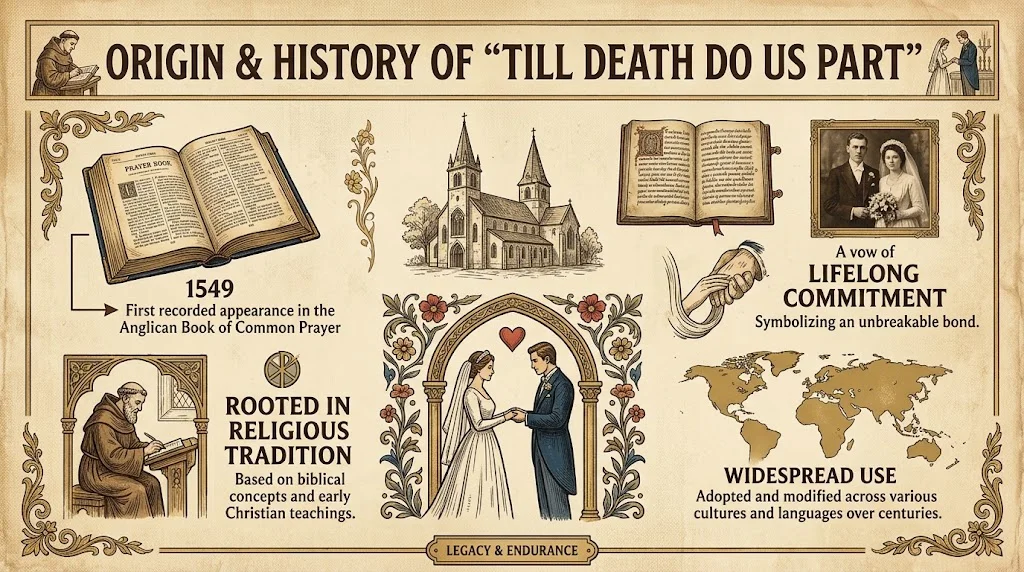
The phrase “Till Death Do Us Part” has its roots in traditional Christian marriage ceremonies, especially the wording found in older English wedding vows. One of the most influential sources is the Book of Common Prayer, which includes marriage vow language expressing lifelong unity between spouses.
The idea behind the phrase existed before its exact modern wording. Many cultures have long included marriage promises focused on loyalty, permanence, and commitment throughout life. The phrase became widely recognized because religious wedding ceremonies repeated it for generations.
Over time, its meaning expanded beyond religious settings. Today, many people use it in literature, films, speeches, and everyday conversations to represent extreme loyalty or lasting dedication. However, modern audiences may interpret it differently. Some view it as a powerful symbol of devotion, while others consider it traditional or overly absolute.
The evolution of the phrase reflects changing attitudes toward relationships. Earlier interpretations emphasized lifelong obligation, while modern usage often focuses more on emotional commitment, trust, and choosing to remain together.
Synonyms & Alternatives by Tone
Different situations require different ways of expressing lifelong commitment. While “Till Death Do Us Part” is emotionally powerful, it may not always fit every audience. The following alternatives offer options based on tone, formality, and context.
Professional & Neutral Alternatives
- For the rest of our lives
- A lifelong commitment
- A lasting commitment
- A commitment that endures
- A long-term commitment
- A permanent partnership
- A lifelong bond
Polite & Supportive Alternatives
- Always by your side
- Standing together through life
- Sharing a lifetime
- Supporting each other for years to come
- Together through every stage of life
- A bond that lasts a lifetime
Encouraging & Reassuring Alternatives
- Together through thick and thin
- Always there for each other
- Through every challenge and joy
- Side by side for life
- A promise to stay together
Casual, Playful & Idiomatic Alternatives
- Forever and always
- Together forever
- For good
- Partners for life
- Sticking together no matter what
- In it for the long haul
When Should You Use “Till Death Do Us Part”?
Professional Settings
In professional environments, “Till Death Do Us Part” is usually too emotional or personal unless the context involves relationships, culture, storytelling, or creative communication.
For example, a wedding planner, speechwriter, relationship counselor, or content creator may use the phrase naturally. However, business communication usually benefits from alternatives such as “a lasting partnership” or “a long-term commitment.”
Casual Conversations
The phrase works well in personal conversations when discussing marriage, relationships, or strong emotional bonds. It can communicate seriousness and affection.
Example:
“They have been together for 40 years. They truly believe in staying together until the end.”
In casual speech, many people now prefer shorter expressions like “forever together” or “partners for life” because they feel more natural.
Writing, Presentations, and Digital Communication
The phrase can be effective in:
- Wedding speeches
- Romantic writing
- Social media captions
- Novels and storytelling
- Personal reflections
- Relationship discussions
Writers often choose it when they want to create emotional impact. However, digital audiences may respond better to simpler alternatives depending on the platform.
When It Is Especially Effective
“Till Death Do Us Part” works best when:
- The audience understands traditional expressions
- The message involves marriage or lifelong relationships
- A strong emotional statement is needed
- The writer wants a classic or dramatic tone
When Should You Avoid “Till Death Do Us Part”?
Although the phrase is widely understood, it is not suitable for every situation.
Overly Formal Situations
In business reports, professional emails, or workplace discussions, the phrase may feel too personal or dramatic. A more neutral phrase usually communicates the message better.
Legal, Academic, or Sensitive Contexts
Legal and academic writing requires precision rather than emotional language. The phrase may create ambiguity because it expresses an idea rather than a measurable commitment.
For example, a legal agreement would normally use specific terms about responsibilities, rights, and obligations instead of symbolic expressions.
Situations Where Nuance May Be Lost
The phrase suggests absolute permanence. In some conversations, that level of certainty may feel unrealistic, especially when discussing changing relationships, partnerships, or personal growth.
Using a softer alternative can allow room for complexity while still expressing dedication.
Is “Till Death Do Us Part” Professional, Polite, or Casual?
“Till Death Do Us Part” is primarily emotional and traditional rather than professional. Its meaning is clear, but its tone depends heavily on context.
Tone Analysis
The phrase carries:
- High emotional intensity
- Strong commitment
- Traditional values
- A sense of permanence
It is more formal than everyday conversation but less suitable for professional communication.
Formality Level
The phrase is:
- Formal in wedding ceremonies
- Neutral-to-traditional in writing
- Too personal for most workplace communication
Emotional Subtext
Native speakers often hear more than the literal meaning. The phrase suggests:
- Loyalty
- Sacrifice
- Trust
- Deep attachment
- A serious promise
Because of this emotional weight, using it casually may sound exaggerated.
Audience Perception
Different audiences may interpret it differently:
- Older generations may see it as a respected traditional expression.
- Younger audiences may see it as romantic but somewhat old-fashioned.
- Professional audiences may view it as inappropriate outside personal contexts.
Pros and Cons of Using “Till Death Do Us Part”
Advantages
Clarity
The phrase clearly communicates lifelong commitment and leaves little doubt about the intended meaning.
Emotional Impact
Few expressions communicate dedication as strongly as this phrase. It creates a sense of seriousness and devotion.
Accessibility
Because it is widely recognized, most English speakers understand the idea immediately.
Potential Drawbacks
Oversimplification
Real relationships often involve complexity, and the phrase presents commitment in absolute terms.
Tone Mismatch
Using it in the wrong setting can make communication feel overly dramatic or outdated.
Repetition
Because the phrase is common in wedding contexts, repeated use may reduce its impact.
Real-Life Examples of “Till Death Do Us Part” by Context
The phrase “Till Death Do Us Part” appears most naturally in emotional or personal situations. Its meaning stays consistent, but the effect changes depending on where and how it is used.
Emails
Example:
“As we celebrate your wedding anniversary, I hope you continue to enjoy the love and commitment you promised to each other when you said, ‘Till Death Do Us Part.’”
In an email, the phrase works best when the message is personal, such as congratulations, family communication, or relationship-related writing. It would usually feel inappropriate in a business email unless the topic directly involves relationships or storytelling.
Meetings
Example:
“Our team has worked together through difficult projects and unexpected challenges. While we are not saying ‘Till Death Do Us Part,’ the goal is to build a partnership that lasts.”
In professional meetings, the phrase is generally used humorously or figuratively. A business speaker might use it to create a memorable point, but it should be balanced with a professional tone.
Presentations
Example:
“Strong partnerships are built on trust, communication, and a willingness to grow together. A successful collaboration is not about saying ‘Till Death Do Us Part,’ but about creating value that lasts.”
Presentations may use the phrase as a comparison or storytelling device. It can help audiences connect emotionally but should not replace clear information.
Conversations
Example:
“My grandparents were married for more than 60 years. They truly lived by the idea of ‘Till Death Do Us Part.’”
In everyday conversation, the phrase often appears when discussing long-lasting relationships, family examples, or personal values.
Social Media
Example:
“Celebrating another year with my best friend and life partner. Forever grateful for the promise we made: ‘Till Death Do Us Part.’”
On social media, the phrase is commonly used in anniversary posts, wedding photos, and romantic captions. However, many users now prefer shorter alternatives like “forever and always” because they feel more modern.
“Till Death Do Us Part” vs Similar Expressions (Key Differences)
Many expressions communicate commitment, loyalty, or lasting connection, but each one creates a slightly different emotional effect. Choosing the right phrase depends on whether the goal is romance, professionalism, reassurance, or casual communication.
| Phrase | Meaning Difference | Tone Difference | Best Use Scenario |
| Forever and always | Expresses lasting affection without the direct reference to death or permanence. | Softer, romantic, and more modern. | Romantic messages, social media captions, personal conversations. |
| For the rest of our lives | Focuses on shared time together rather than a formal promise. | Warm, sincere, and less traditional. | Wedding speeches, personal writing, relationship discussions. |
| Together through thick and thin | Highlights staying together during difficulties rather than a lifelong commitment alone. | Supportive, friendly, and encouraging. | Conversations about friendship, family, and relationships. |
| Partners for life | Emphasizes teamwork and companionship rather than a traditional vow. | Modern, positive, and inclusive. | Relationships, business partnerships, and personal statements. |
| A lifelong commitment | Describes dedication over time without emotional or religious wording. | Professional, neutral, and mature. | Formal writing, workplace discussions, relationship counseling. |
| Side by side forever | Focuses on companionship and emotional closeness. | Poetic, affectionate, and personal. | Romantic writing, cards, and speeches. |
Common Mistakes & Misuse of “Till Death Do Us Part”
Although the phrase is familiar, it can lose effectiveness when used incorrectly.
Overuse
Using “Till Death Do Us Part” repeatedly can make writing feel predictable. Because it is strongly connected with wedding vows, frequent use may reduce its emotional impact.
A writer discussing commitment several times may benefit from alternatives such as:
- A lifelong bond
- Forever together
- A lasting commitment
Incorrect Context
The phrase may sound inappropriate in professional or casual situations where the emotional intensity does not match the topic.
For example:
“Our company will work with this software provider until death do us part.”
This statement may sound humorous but exaggerated because the phrase is designed for human relationships rather than ordinary business decisions.
Contradictory Usage
The phrase communicates permanence. Pairing it with uncertain or temporary ideas can create confusion.
Example:
“This is our temporary partnership, but it is till death do us part.”
The meanings conflict because one suggests a short-term arrangement while the other suggests lifelong dedication.
Cultural Misunderstandings
Not every culture views marriage commitment expressions in the same way. Some audiences may appreciate the tradition, while others may find it too absolute or connected to older social expectations.
Writers should consider their audience before using highly traditional phrases.
Psychological Reasons People Prefer “Till Death Do Us Part”
The popularity of “Till Death Do Us Part” is connected to how humans understand commitment, trust, and emotional security.
Cognitive Load Reduction
People naturally prefer familiar phrases because they communicate complex ideas quickly. Instead of explaining years of loyalty and dedication, the phrase immediately signals lifelong commitment.
A short traditional expression can carry a large amount of shared cultural meaning.
Trust and Authority Signals
Traditional phrases often create a sense of seriousness. When someone uses “Till Death Do Us Part,” listeners may perceive strong intention, reliability, and emotional investment.
The phrase acts as a signal that the speaker is discussing a meaningful promise rather than a casual relationship.
Attention Economy
Modern communication is filled with short messages competing for attention. Familiar expressions stand out because people recognize them instantly.
A phrase with strong emotional associations can create more engagement than a simple statement like:
“We plan to stay together forever.”
Modern Communication Habits
Today’s audiences often prefer language that feels personal and natural. While traditional expressions remain powerful, many people choose alternatives that sound less formal and more conversational.
For example:
- “Forever and always” feels more intimate.
- “Partners for life” feels more modern.
- “Through every stage of life” feels supportive and realistic.
US vs UK Usage of “Till Death Do Us Part”
The phrase is understood in both American and British English, but cultural perception can vary.
Popularity
In both the US and UK, “Till Death Do Us Part” remains strongly associated with traditional wedding ceremonies. However, everyday usage has declined as people increasingly choose more conversational expressions.
Tone Perception
United States
American speakers often view the phrase as:
- Romantic
- Traditional
- Dramatic
- Common in weddings and entertainment
It frequently appears in movies, songs, wedding speeches, and social media.
United Kingdom
British speakers generally recognize the phrase in the same way but may perceive it as slightly more traditional or formal, especially because of its connection with older wedding language.
Regional Preferences
Modern speakers in both countries often prefer:
- Forever and always
- For the rest of our lives
- Partners for life
These alternatives maintain emotional meaning while sounding more natural in everyday communication.
“Till Death Do Us Part” in Digital & Modern Communication

Digital communication has changed how people express commitment. Traditional phrases remain popular, but users often adapt them to match modern platforms.
Emails
In personal emails, the phrase can express warmth and emotion.
Good use:
“Wishing you both a lifetime of happiness and a love that truly reflects the promise of ‘Till Death Do Us Part.’”
Avoid using it in routine professional emails because it may appear overly emotional.
Slack / WhatsApp
In private chats, people may use the phrase jokingly or affectionately.
Example:
“You are officially my coffee partner for life — basically till death do us part.”
Digital conversations often shorten traditional expressions to make them playful and casual.
Social Media
The phrase remains popular in:
- Wedding announcements
- Anniversary posts
- Romantic captions
- Relationship milestones
However, many younger users combine it with modern wording:
“Forever and always ❤️”
Rather than using the full traditional phrase.
Linguistic & Communication Insight
Emotional Weight & Subtext
The literal meaning of “Till Death Do Us Part” is simple: two people promise to remain together until death separates them. However, native speakers often understand additional emotional layers.
The phrase suggests:
- Deep loyalty
- Serious commitment
- Permanence
- Personal sacrifice
- Strong emotional connection
Because of this emotional weight, it is rarely a neutral phrase.
Direct vs Indirect Phrasing
“Till Death Do Us Part” is direct and absolute. It communicates a strong promise without leaving much room for interpretation.
Softer alternatives create different impressions:
- “For the rest of our lives” sounds warm and realistic.
- “Partners for life” sounds collaborative.
- “Together through thick and thin” focuses on support during challenges.
Experienced communicators often choose softer wording when they want to express commitment without creating pressure.
Professional Communication Perspective
In workplace communication, the phrase may be interpreted as:
- Creative when used intentionally
- Too emotional when used seriously
- Memorable in storytelling contexts
Professionals usually select a language that balances confidence with flexibility.
For example:
Instead of:
“We are committed to this partnership until death do us part.”
A business writer may choose:
“We are committed to building a long-term partnership based on trust and shared goals.”
The second version maintains authority while sounding more appropriate.
Pragmatic Reasons for Alternatives
Professionals often avoid absolute phrases because they can create unintended meanings. Alternatives help writers:
- Reduce emotional pressure
- Encourage collaboration
- Sound approachable
- Match different audiences
A skilled communicator understands that the strongest phrase is not always the most dramatic one. The best choice depends on purpose, audience, and situation.
Social Signaling
Word choice influences how people perceive the speaker.
Using “Till Death Do Us Part” can signal:
- Tradition
- Strong devotion
- Serious intention
Using “Partners for life” can signal:
- Equality
- Cooperation
- Modern values
Language not only communicates information; it also communicates identity, expectations, and relationships.
Tone & Context Guidance
Use “Till Death Do Us Part” when you want:
- Emotional impact
- Traditional meaning
- A memorable statement
Consider alternatives when you want:
- Professional clarity
- Modern wording
- Greater flexibility
The best communicators choose words that fit both the message and the audience.
For the Rest of Our Lives
Meaning: “For the rest of our lives” means remaining together or committed for the entire period of a person’s lifetime. It expresses long-term dedication without the formal or dramatic feeling of “Till Death Do Us Part.”
Why This Phrase Works: It sounds natural, warm, and modern while still communicating a serious commitment. It focuses on shared experiences and time together rather than the idea of separation through death.
Real-World Usage Insight: Native speakers often choose this phrase when they want to express love, loyalty, or partnership more softly. It works especially well in personal writing because it feels sincere without sounding old-fashioned.
Best Use: Wedding speeches, anniversary messages, personal letters, relationship discussions, and emotional writing.
Avoid When: A highly traditional wedding vow style or religious ceremony wording is expected.
Tone: Warm, romantic, sincere, and gentle.
US vs UK Usage: Common in both American and British English. American speakers often use it in romantic messages, while British speakers may use it in speeches and personal writing.
Example (Email / Message / Meeting):
“I’m grateful for everything we have built together, and I look forward to sharing the rest of our lives with you.”
Conclusion;
“Till Death Do Us Part” remains one of the most recognized expressions of lifelong commitment, especially in marriage and traditional relationship contexts. Its meaning is powerful because it communicates loyalty, dedication, and the intention to remain together throughout life. However, the phrase carries a formal and emotional tone that may not suit every situation.
Modern communication often requires more flexible alternatives, such as “for the rest of our lives,” “partners for life,” or “a lifelong commitment,” depending on the audience and purpose. Choosing the right expression helps create clearer, more natural communication while preserving the intended emotion.
Whether used in wedding vows, personal messages, creative writing, or cultural discussions, “Till Death Do Us Part” continues to represent a deep human desire for trust, connection, and lasting relationships. Understanding its tone and alternatives allows speakers and writers to communicate commitment with greater accuracy and impact.
FAQs
What does “Till Death Do Us Part” mean?
“Till Death Do Us Part” means that two people promise to remain together for the rest of their lives until death separates them. The phrase is most commonly associated with marriage vows and represents lifelong commitment, loyalty, and dedication. It expresses a strong intention to maintain a relationship through all stages of life.
Is “Till Death Do Us Part” only used for marriage?
No, “Till Death Do Us Part” is not limited exclusively to marriage, although weddings are its most common use. People may also use it symbolically in literature, movies, or conversations to describe extreme loyalty and lifelong dedication. However, outside romantic contexts, it can sound dramatic or overly traditional.
Is “Till Death Do Us Part” a professional phrase?
Generally, “Till Death Do Us Part” is not considered a professional phrase. It carries strong emotional and personal meaning, making it better suited for relationships, speeches, and creative writing. In workplace communication, alternatives such as “a lasting commitment” or “a long-term partnership” usually sound more appropriate and balanced.
What are the best alternatives to “Till Death Do Us Part”?
The best alternatives depend on tone and context. Popular options include “forever and always,” “for the rest of our lives,” “partners for life,” “a lifelong commitment,” and “together through thick and thin.” Each alternative expresses commitment differently, from romantic and emotional to professional and neutral.
Is “Till Death Do Us Part” formal or casual?
“Till Death Do Us Part” is considered a formal and traditional expression, especially because of its connection with wedding ceremonies. In everyday conversation, it may sound serious or old-fashioned. Many modern speakers choose softer alternatives like “forever and always” or “partners for life” for casual communication.
Why do people still use “Till Death Do Us Part”?
People continue using “Till Death Do Us Part” because it carries strong emotional meaning and cultural familiarity. The phrase quickly communicates lifelong loyalty, trust, and commitment. Its traditional connection with marriage ceremonies also gives it a sense of seriousness and importance that simpler expressions may not provide.
What is the difference between “Till Death Do Us Part” and “Forever and Always”?
The main difference is tone and meaning. “Till Death Do Us Part” emphasizes a formal lifelong promise, often connected with marriage. “Forever and Always” expresses affection and lasting love in a softer, more modern way. The second phrase feels less traditional and is commonly used in personal messages and social media.
Can “Till Death Do Us Part” be used in writing?
Yes, “Till Death Do Us Part” can be used in writing, especially in wedding speeches, romantic stories, personal letters, and emotional content. Writers should consider their audience because the phrase creates a strong traditional feeling. For professional or academic writing, a clearer and more neutral alternative may work better.
Is “Till Death Do Us Part” the same in US and UK English?
The meaning of “Till Death Do Us Part” is the same in both US and UK English. Both cultures recognize it as a traditional marriage expression. However, British speakers may sometimes perceive it as slightly more formal or traditional, while American usage often appears more frequently in popular culture and wedding-related content.
What is a modern way to say “Till Death Do Us Part”?
Modern alternatives to “Till Death Do Us Part” include phrases like “for the rest of our lives,” “partners for life,” “always by your side,” and “together through every stage of life.” These expressions maintain the idea of commitment while sounding more natural, flexible, and suitable for today’s communication styles.


