
A student receives a rejection letter from a dream university, a professional misses out on a promotion, or a business owner watches a carefully planned project fail. In moments like these, people often say, “What is meant to be is meant to be,” to express acceptance, patience, and the belief that some outcomes are beyond control. The phrase suggests that certain events will happen as they are supposed to, even when the result differs from what someone expected.
In modern communication, this expression remains popular because it provides emotional comfort without requiring a long explanation. However, its meaning can change depending on tone, audience, and situation. In professional environments, more neutral alternatives may sound clearer, while in personal conversations, the original phrase can feel supportive and reassuring.
Understanding the meaning, alternatives, and appropriate use of “What is meant to be is meant to be” helps writers, professionals, students, and English learners communicate with better emotional awareness and precision.
What Does “What Is Meant To Be” Mean?
“What is meant to be is meant to be” means that certain events or outcomes are believed to happen naturally or inevitably, regardless of personal plans or efforts. The phrase is commonly used to express acceptance of situations, especially when facing uncertainty, disappointment, change, or unexpected results.
The phrase communicates the idea that some things cannot be fully controlled and that people should accept outcomes that occur. It does not necessarily mean that people should stop trying; instead, it often suggests recognizing limits, adapting to circumstances, and moving forward.
People commonly use this expression after:
- A relationship ends unexpectedly
- A career opportunity does not happen
- A planned goal changes direction
- A decision produces an unexpected outcome
- Life circumstances create a new path
For some people, the phrase reflects faith, destiny, or a belief in a larger plan. For others, it is simply a practical way of accepting reality and reducing stress about things outside their control.
Origin & History of “What Is Meant To Be”
The exact origin of “What is meant to be is meant to be” is difficult to trace to a single source because it developed from long-standing human ideas about fate, destiny, and acceptance.
The expression is connected to older philosophical and cultural beliefs that some events are predetermined or guided by forces beyond human control. Similar ideas appear in ancient Greek concepts of fate, religious traditions that discuss divine plans, and philosophical discussions about accepting circumstances.
The modern English version became more common through everyday conversation rather than formal literature. It grew in popularity because it offers a simple way to respond to uncertainty and disappointment.
Over time, the meaning has shifted slightly. Earlier interpretations often focused strongly on destiny or unavoidable outcomes. Today, many speakers use it more casually to mean:
- “Accept what happened and move forward.”
- “Some things cannot be controlled.”
- “Another opportunity may come.”
- “This outcome may lead somewhere unexpected.”
In contemporary communication, the phrase is often less about absolute fate and more about emotional resilience and acceptance.
Synonyms & Alternatives by Tone
Professional & Neutral Alternatives
- Some things happen for a reason
- We have to accept the outcome
- We should focus on what we can control
- This may be the right direction
- Everything happens in its own time
- We can learn from this experience
- We will see how things develop
- The outcome was beyond our control
- We should move forward with the situation
- This may lead to a different opportunity
Polite & Supportive Alternatives
- Everything will work out
- The right opportunity will come along
- Things will fall into place
- Trust the process
- Give it time and see what happens
- Better things may be ahead
- This could be a new beginning
- Sometimes unexpected changes lead to good results
Encouraging & Reassuring Alternatives
- Keep going; the right path will become clearer
- Every setback can teach us something valuable
- A different opportunity may be waiting
- This is not the end of the journey
- The future can bring new possibilities
- Stay positive and keep moving forward
Casual, Playful & Idiomatic Alternatives
- It is what it is
- Que sera sera
- Everything happens somehow
- That is just how life goes
- Whatever happens, happens
- Go with the flow
- Let things unfold naturally
- What will be will be
When Should You Use “What Is Meant To Be Is Meant To Be”?
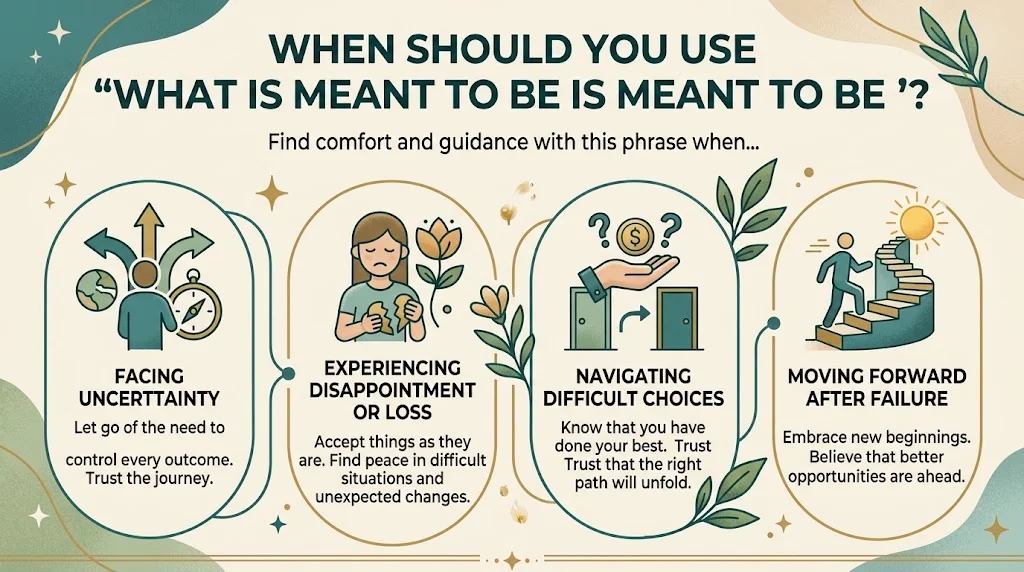
Professional Settings
In workplaces, the phrase can be appropriate when discussing situations involving uncertainty, such as:
- A missed business opportunity
- A rejected proposal
- A project that did not succeed
- A career transition
However, professionals should consider the audience before using it. Some colleagues may appreciate its optimistic message, while others may prefer a more practical response focused on solutions.
For example:
Appropriate:
“Although we did not win the contract, what is meant to be is meant to be. Let’s review what we learned and improve our next proposal.”
Less effective:
“What is meant to be is meant to be, so there is nothing we can do.”
The second example may sound passive because it avoids responsibility.
Casual Conversations
The phrase works naturally among friends and family because personal situations often involve emotions rather than detailed analysis.
Examples include:
- Comforting someone after a breakup
- Supporting a friend after rejection
- Discussing unexpected life changes
In personal conversations, the phrase usually communicates empathy and acceptance.
Writing, Presentations, and Digital Communication
The phrase can work well in:
- Personal blogs
- Social media posts
- Inspirational content
- Informal messages
In formal reports, academic writing, or business documents, clearer alternatives are usually better because the phrase can sound subjective.
When It Is Especially Effective
The expression works best when:
- Someone needs emotional reassurance
- The situation cannot be changed
- The speaker wants to reduce anxiety
- The audience understands the emotional meaning
It is most powerful when combined with action-oriented thinking:
“What is meant to be is meant to be, but we can still prepare for the next opportunity.”
When Should You Avoid “What Is Meant To Be Is Meant To Be”?
Overly Formal Situations
Avoid using the phrase in highly formal contexts such as:
- Legal documents
- Corporate policies
- Academic research
- Financial reports
These situations require evidence-based language rather than expressions about destiny or fate.
Legal, Academic, or Sensitive Contexts
The phrase may appear insensitive when someone expects accountability, explanation, or practical support.
For example:
A person discussing workplace discrimination may not find “what is meant to be is meant to be” helpful because the situation requires action rather than acceptance.
Situations Where Nuance May Be Lost
The phrase can sometimes suggest:
- A lack of effort
- Avoidance of responsibility
- Acceptance without improvement
A stronger communicator considers whether the listener needs comfort, motivation, or a solution.
Is this expression Professional, Polite, or Casual?
“What is meant to be is meant to be” is generally a casual-to-neutral expression. It is not considered highly professional language, but it can appear in workplace conversations when used thoughtfully.
Tone Analysis
The phrase carries:
- Acceptance: It suggests making peace with an outcome.
- Optimism: It implies that future possibilities may exist.
- Emotional support: It often comforts people during uncertainty.
Formality Level
The expression is:
- Casual: Personal conversations, messages, social media
- Neutral: Informal workplace discussions
- Less suitable: Official communication and professional documents
Emotional Subtext
Native speakers often hear more than the literal meaning. The phrase may communicate:
- “Do not blame yourself.”
- “This situation may have a purpose.”
- “Something else may happen in the future.”
However, depending on context, it may also sound like:
- “There is no point trying.”
- “The situation cannot be changed.”
The surrounding words and tone determine the interpretation.
Pros and Cons of Using “What Is Meant To Be Is Meant To Be”
Advantages
Clarity
The phrase communicates acceptance quickly without requiring a detailed explanation.
Efficiency
It allows people to express a complex emotional idea in a short sentence.
Accessibility
Because the expression is widely understood, it works well among different age groups and backgrounds.
Potential Drawbacks
Oversimplification
Some situations require deeper discussion, problem-solving, or accountability.
Tone Mismatch
A phrase that comforts one person may frustrate another if they need practical advice.
Repetition
Because it is commonly used, frequent repetition can make it sound automatic or less sincere.
Real-Life Examples by Context
Emails
Example:
“Thank you for considering my application. Although I was not selected, what is meant to be is meant to be. I appreciate the opportunity to interview and learn more about your team.”
Meetings
Example:
“Losing that client was disappointing, but what is meant to be is meant to be. Let’s focus on improving our strategy for future projects.”
Presentations
Example:
“Not every idea becomes a successful product immediately. Sometimes what is meant to be is meant to be, and unexpected changes create better opportunities.”
Conversations
Example:
“I know you were excited about that job, but what is meant to be is meant to be. Another opportunity may come that fits you even better.”
Social Media
Example:
“Some chapters close so new ones can begin. What is meant to be is meant to be.”
“What Is Meant To Be” vs Similar Expressions (Key Differences)
The following expressions are often used in similar situations, but each carries a slightly different meaning and emotional tone.
| Phrase | Meaning Difference | Tone Difference | Best Use Scenario |
| What is meant to be is meant to be | Suggests acceptance of a natural or destined outcome | Reflective, emotional, reassuring | Personal changes, uncertainty, life decisions |
| Everything happens for a reason | Suggests that events have a purpose behind them | More optimistic and philosophical | Comforting someone after disappointment |
| It is what it is | Accepts reality without focusing on future meaning | Casual, sometimes detached | Everyday problems and minor frustrations |
| Trust the process | Encourages patience while continuing effort | Motivational and supportive | Career growth, learning, projects |
| Que sera sera | Means the future will happen regardless of worry | Playful, traditional, relaxed | Informal conversations |
| Things will work out | Suggests confidence that future results will improve | Positive and encouraging | Supporting someone emotionally |
Common Mistakes & Misuse
Overuse
Using the phrase too often can make it appear like a generic response rather than genuine support.
Incorrect Context
Avoid using it when someone needs practical solutions, responsibility, or immediate action.
Contradictory Usage
The phrase should not be combined with messages that suggest complete control over every outcome. Its meaning depends on accepting uncertainty.
Cultural Misunderstandings
Some cultures interpret destiny-focused language differently. Certain audiences may appreciate it deeply, while others may prefer direct problem-solving language.
Psychological Reasons People Prefer “What Is Meant To Be”
Cognitive Load Reduction
When people face uncertainty, the phrase simplifies complex emotions. It reduces the mental pressure of constantly analyzing “what went wrong” or “what could have happened.”
Trust and Authority Signals
The expression can create a sense of confidence and emotional stability. Speakers often use it to show acceptance during difficult moments.
Attention Economy
Modern communication rewards short, memorable phrases. Expressions like this work because they communicate a complete emotional message quickly.
Modern Communication Habits
In digital conversations, people often prefer short supportive statements instead of lengthy explanations. This phrase fits that communication style.
US vs UK Usage
Popularity
The phrase is understood in both American and British English, although its frequency depends more on personal style than geography.
Tone Perception
In the US, it often sounds like an encouraging statement connected with optimism or personal growth.
In the UK, it may sound slightly more understated or philosophical, especially when used in everyday conversation.
Regional Preferences
American speakers may also use alternatives like:
- “Everything happens for a reason.”
- “Things will work out.”
British speakers may more commonly use:
- “What will be will be.”
- “It is what it is.”
Both regions understand the phrase, but cultural expectations about directness and emotional expression influence how it is received.
in Digital & Modern Communication
Emails
In personal emails, the phrase can provide warmth and emotional closure. In professional emails, it should usually be paired with a practical next step.
Slack / WhatsApp
The phrase works naturally in short messages because digital communication often relies on quick emotional signals.
Example:
“Sorry, the plan did not work out. What is meant to be is meant to be. We’ll find another option.”
Social Media
The phrase is popular in captions because it fits inspirational and reflective content.
AI-Generated Summaries
AI tools often select phrases like this when summarizing emotional acceptance because the expression represents resilience, uncertainty, and adaptation. However, human writers should consider whether the phrase matches the intended audience and context.
Linguistic & Communication Insight
Emotional Weight & Subtext
The literal meaning of “What is meant to be is meant to be” focuses on inevitability, but native speakers often interpret additional emotional messages behind it. It can suggest acceptance, hope, patience, or emotional recovery.
The phrase is powerful because it does not simply describe an event; it frames how someone should emotionally respond to that event.
Direct vs Indirect Phrasing
The expression is indirect because it does not directly explain what happened or what action should follow.
Compare:
Direct:
“We cannot change the decision, so we should focus on our next opportunity.”
Indirect:
“What is meant to be is meant to be.”
The direct version provides a clearer action plan. The indirect version provides emotional comfort.
Professional Communication Perspective
In workplaces, experienced communicators often adjust their wording based on the listener’s needs.
A manager supporting an employee may choose:
“Although this opportunity did not happen, let’s focus on what we learned and prepare for the next one.”
This sounds collaborative and solution-focused.
Pragmatic Reasons for Alternatives
Professionals often choose alternatives because they want to:
- Reduce defensiveness
- Encourage teamwork
- Show accountability
- Balance optimism with realism
Social Signaling
Word choice influences how people perceive confidence, empathy, and reliability. A phrase about fate may signal emotional acceptance, while a solution-focused phrase may signal leadership and responsibility.
Tone & Context Guidance
Use “What is meant to be is meant to be” when the goal is emotional support or reflection.
Choose another phrase when the situation requires:
- Clear action
- Professional accountability
- Detailed explanation
- Evidence-based reasoning
The most effective communicators understand that the best phrase is not always the most positive one; it is the one that matches the listener, situation, and purpose.
Some Things Happen for a Reason
Meaning
“Some things happen for a reason” means that events may have a purpose or lead to an outcome that becomes understandable later. Like “What is meant to be is meant to be,” it expresses acceptance, but it focuses more on finding meaning rather than simply accepting fate.
Why This Phrase Works
This phrase works because it provides emotional reassurance while encouraging people to believe that difficult experiences can create valuable lessons or new opportunities.
Real-World Usage Insight
Many native speakers use this phrase after unexpected changes, such as career setbacks, relationship endings, or missed opportunities. It is often chosen when someone needs comfort and optimism.
Best Use
Personal conversations, supportive messages, inspirational writing, and informal discussions about life changes.
Avoid When
Avoid using it when someone needs practical solutions, accountability, or detailed reasoning about a serious situation.
Tone
Optimistic, supportive, reflective.
US vs UK Usage
Common in both US and UK English. American speakers often use it in motivational contexts, while British speakers may use it more cautiously depending on the situation.
Example (Message)
“I know the rejection was disappointing, but some things happen for a reason. This might lead you toward an opportunity that fits you better.”
Everything Happens for a Reason
Meaning
“Everything happens for a reason” suggests that every event, including difficult ones, has a purpose or meaning behind it. It is similar to “What is meant to be is meant to be” but carries a stronger belief that outcomes are connected to a larger plan.
Why This Phrase Works
It helps people process uncertainty by creating a positive perspective during challenging moments.
Real-World Usage Insight
People often use this expression when comforting others after disappointment, although its effectiveness depends on whether the listener shares that worldview.
Best Use
Emotional support, personal conversations, motivational content, and reflective writing.
Avoid When
Avoid using it immediately after a serious loss or hardship if the person may feel their experience is being simplified.
Tone
Hopeful, philosophical, reassuring.
Comparison Table of 10 Best Alternatives
The following alternatives provide different ways to express acceptance, hope, patience, and adaptability. The best choice depends on the situation, audience, and emotional message you want to communicate.
| Phrase | Meaning | Best Use | Worst Use | Tone | US vs UK Usage |
| Some Things Happen for a Reason | Suggests that events may have a purpose or create future value | Comforting someone after disappointment, personal conversations, and reflective writing | Serious situations where people need solutions instead of reassurance | Hopeful, reflective, supportive | Common in both US and UK English, slightly more common in American motivational speech |
| Everything Happens for a Reason | Expresses belief that events have a deeper purpose | Emotional support, life changes, and inspirational content | Situations involving grief, injustice, or problems requiring action | Philosophical, optimistic, emotional | Very common in the US; understood in the UK but may sound more sentimental |
| Focus on What We Can Control | Encourages attention toward actions and decisions within personal influence | Workplace challenges, leadership, personal growth | Moments when someone first needs emotional support | Practical, professional, motivational | Popular in both regions, especially in professional environments |
| Trust the Process | Means staying patient while continuing the effort toward a goal | Career growth, education, business, training | Situations where immediate changes are required | Motivational, modern, encouraging | Strongly associated with US sports and business culture; increasingly common in the UK |
| Things Will Work Out | Suggests that difficulties will improve over time | Supporting friends, personal encouragement, informal messages | Formal decisions requiring evidence or planning | Positive, comforting, casual | Common in both regions |
| Everything Will Fall Into Place | Suggests that uncertain situations will eventually become clear | Life transitions, new experiences, personal advice | Urgent problems requiring immediate action | Gentle, reassuring, optimistic | Naturally used in both US and UK English |
| It Is What It Is | Means accepting reality without focusing on changing it | Everyday frustrations, minor problems, casual conversations | Sensitive situations where empathy and action are needed | Casual, realistic, sometimes detached | Very common in both regions, especially in informal speech |
| What Will Be Will Be | Expresses acceptance of uncertain future outcomes | Personal reflection, traditional expressions, informal discussions | Business communication or professional documents | Philosophical, traditional, relaxed | Recognized in both regions; slightly more old-fashioned today |
| Go With The Flow | Means adapting easily to changing circumstances | Social situations, travel, and casual conversations | Professional planning or serious responsibilities | Relaxed, friendly, casual | Common among speakers in both the US and the UK, especially younger audiences |
Conclusion
“What is meant to be is meant to be” remains a powerful expression because it communicates acceptance, patience, and emotional balance during uncertain moments. While the phrase is often connected with destiny or fate, modern speakers also use it as a simple reminder to accept outcomes and focus on what comes next. Its meaning depends heavily on context, tone, and the relationship between speakers.
In personal conversations, the phrase can provide comfort after disappointment or unexpected change. In professional communication, however, clearer alternatives such as “focus on what we can control” or “we will see how things develop” may sound more practical and solution-focused. Understanding these differences helps writers, professionals, and English learners choose language that matches their purpose.
Ultimately, effective communication is not only about choosing positive words; it is about choosing the right words for the right situation. “What is meant to be is meant to be” works best when used with empathy, awareness, and genuine understanding.
FAQs
What does “What Is Meant To Be” mean?
“What is meant to be is meant to be” means that certain events or outcomes are believed to happen naturally or inevitably. People often use it to express acceptance when something does not happen as expected. The phrase suggests letting go of excessive worry and recognizing that some situations are outside personal control.
Is “What Is Meant To Be” a positive phrase?
Yes, “What is meant to be is meant to be” is generally considered a positive phrase because it offers reassurance and encourages acceptance. However, its impact depends on the situation. It can comfort someone facing disappointment, but it may feel unhelpful if a person needs practical advice, accountability, or direct solutions.
Is “What Is Meant To Be” professional?
The phrase is usually considered casual or neutral rather than highly professional. It can work in informal workplace conversations when offering emotional support, but it is not ideal for formal emails, reports, or business documents. Professional alternatives like “we can focus on the next steps” may sound clearer and more action-oriented.
What are better alternatives to “What Is Meant To Be”?
Common alternatives include “some things happen for a reason,” “trust the process,” “focus on what we can control,” “things will work out,” and “the right opportunity will come along.” The best alternative depends on whether you want to sound professional, supportive, motivational, or casual.
Is “What Is Meant To Be” about fate?
The phrase is often associated with fate, destiny, or the belief that events happen according to a larger plan. However, many people use it more generally as a way to accept uncertainty and move forward. Its meaning can be spiritual, philosophical, or simply practical depending on the speaker’s intention.
Can I use “What is meant to be is meant to be” in an email?
Yes, but the context matters. It is suitable for personal emails or supportive messages. In professional emails, it is better to combine it with a constructive statement. For example, instead of only saying the phrase, explain what you learned or what action will be taken next.
What is the difference between “Everything happens for a reason”?
Both phrases express acceptance, but they have slightly different meanings. “What is meant to be is meant to be” focuses on accepting outcomes, while “Everything happens for a reason” suggests that events have a deeper purpose. The first is more about acceptance; the second is more about finding meaning.
Can “What Is Meant To Be” sound negative?
Yes, depending on tone and context. Some listeners may interpret it as giving up or avoiding responsibility, especially when action is still possible. To avoid this impression, combine the phrase with a forward-looking statement, such as focusing on lessons learned or future opportunities.
Do Americans and British people use this differently?
The phrase is understood in both American and British English. American speakers may use it more openly as encouragement, while British speakers may sometimes prefer more understated expressions like “we’ll see how things go” or “what will be will be.” The difference is mainly about conversational style rather than meaning.
Why do people say this?
People use this phrase because it helps simplify uncertainty and reduce emotional stress. It provides a way to accept situations that cannot be changed while maintaining hope for the future. The expression is popular because it communicates a complex emotional idea shortly and memorably.


